Saturday, Nov. 2nd, 2024

Montana State’s WTI awarded $6.4 million by federal Transportation Department for workforce development


BOZEMAN
— The U.S. Department of Transportation has awarded the Western Transportation Institute at Montana State University a grant to assist workforce development in the railway sector across the state of Montana.

The $6.4 million grant is part of an infrastructure initiative funded by the DOT’s Federal Railroad Administration and announced on Oct. 29. The award is part of a $2.4 billion rail-improvement law that funds 122 projects in 41 states and Washington, D.C.

The infrastructure initiative, which is administered through FRA’s Consolidated Rail Infrastructure and Safety Improvements Program, includes rail safety and service improvements such as upgrading track, replacing or rehabilitating aging bridges, expanding rail connections at ports, and adding modern locomotives to fleets. According to the Transportation Department’s announcement, the grants mark “the most significant investment in American rail in more than 50 years.”


The grants also support developing the workforce to maintain and operate the nation’s rail networks through new apprenticeship programs, expanded training opportunities, establishing partnerships with universities and advance research.

“The Western Transportation Institute is a national leader in transportation workforce development,” said Alison Harmon, MSU’s vice president for research and economic development. “This grant further solidifies WTI’s leadership position in rural and tribal-focused transportation development.”

According to the DOT, these projects will “make rail safer, more reliable and more resilient, getting goods and people where they need to be quickly with fewer disruptions, lower shipping costs and less pollution.”

The project in Montana is expected to include research and activities that build the rail workforce with a focus on increasing faculty, student and youth engagement with rail-related topics and skills, according to the DOT.

The goal is to improve coordination between industry, labor, economic development and education sectors. Other goals include helping faculty and teachers expand their understanding of rail topics; exposing more students to rail-focused topics earlier in their careers; and strengthening local talent pipelines.


MSU, California State University at Long Beach, the University of Memphis, and Big Sky Passenger Rail Authority will contribute the required 20 percent non-federal matching funds, increasing the total WTI funding to just over $8 million.

“We are very excited to have this opportunity to work with our core project partners at Big Sky Passenger Rail Authority, University of Memphis and California State University, Long Beach to develop nationally relevant workforce development strategies focused on meeting local economic development needs,” said Susan Gallagher, WTI’s education and workforce program manager.

Kelvin Wang is WTI’s executive director.

“WTI is fortunate to have nationally recognized staff, faculty and students,” Wang said. “Working with this talented team has been a rewarding experience, enabling us to continue serving the needs of Montana and the nation. We look forward to working with our partners on this exciting project.”

Add a Comment »

General season opens with mild weather, lower-than-average hunter success in southwestern Montana

Hunters should continue to practice bear safety

BOZEMAN – Montana’s general hunting season kicked off on Saturday with seasonably mild weather and mostly below-average hunter participation and success in several areas of southwestern Montana.

Wildlife biologists with Montana Fish, Wildlife & Parks use check stations to collect data on hunter participation and success, as well as the species, sex and age class of the animals harvested. This supplements data collected through hunter harvest phone surveys each year.

Opening weekend check station results

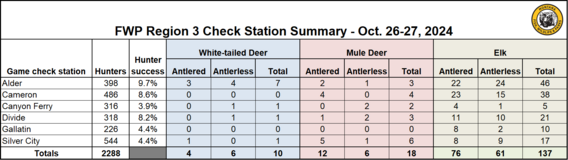
Over opening weekend on Oct. 26 and 27, biologists operated six check game check stations in the region: Alder, Canyon Ferry, Cameron, Divide, Gallatin and Silver City. They met with 2,288 hunters, who collectively harvested 137 elk, 18 mule deer and 10 white-tailed deer, among other species.

The Alder, Divide and Canyon Ferry check stations saw lower-than-average hunter numbers for opening weekend. Hunter numbers were about average at the Cameron and Gallatin check stations. Participation ranged from 544 hunters at the Silver City check station to 226 hunters at the Gallatin check station.

Hunter success was below average at the Alder, Canyon Ferry, Divide and Gallatin check stations, and within the long-term average at the Cameron check station. Hunter success ranged from 9.7 percent at the Alder check station to 3.9 percent at the Canyon Ferry check station.

Weather over the weekend was sunny and warm in most areas of the region, with snow only at the highest elevations.

Be bear aware

FWP reminds hunters that bears will remain active throughout the general season, and hunters should be prepared for bear encounters. Montana is bear country. Grizzly bear populations continue to become denser and more widespread in Montana, increasing the likelihood that residents and recreationists will encounter them in more places each year.

People who hunt in places that have or may have grizzly bears—which includes much of the western two-thirds of the state—should take special precautions:

  • Carry bear spray and practice to be prepared to use it immediately.
  • Look for bear sign and be cautious around creeks and areas with limited visibility.
  • Hunt with a group of people. Making localized noise can help alert bears to your presence.
  • Be aware that elk calls and cover scents can attract bears.
  • Bring the equipment and people needed to help field dress game and remove the meat from the kill site as soon as possible.
  • If you need to leave part of the meat in the field during retrieval, hang it at least 10 feet off the ground and at least 150 yards from the gut pile. Leave it where it can be observed from a distance of at least 200 yards.
  • Upon your return, make noise and observe the meat with binoculars. If it has been disturbed or if a bear is in the area, leave and call FWP.

For more information and resources on bear safety, visit fwp.mt.gov/bear-aware.

Add a Comment »

Accomplished engineer Jim Weatherly inducted into Montana Professional Engineers Hall of Fame


BOZEMAN
— Jim Weatherly, whose career includes leading an influential Montana-based engineering firm for nearly 30 years, will be inducted into the Montana Professional Engineers Hall of Fame on Nov. 6.

Montana State University’s Norm Asbjornson College of Engineering houses the hall of fame, which was founded in 2002 to recognize engineers who have made outstanding contributions to the profession and public welfare of Montana.

“There is no greater honor for a professional than to be recognized by their peers for contributing to the profession and for improving the lives of their fellow man,” Weatherly said. “As a young engineer, I was guided by so many of the previous inductees to the Montana Engineers Hall of Fame.”

Weatherly earned a Bachelor of Science in civil engineering from North Dakota State University in 1967. He served as a sergeant in the U.S. Army and was recognized with the Army Commendation Medal and Bronze Star for meritorious service in the Vietnam War.

Weatherly served as partner, shareholder and president of Sorenson and Company from 1975 to 1989, when the company changed its name to WGM Group. He would then serve as president of WGM until 2004, helping the company broaden its services to include land use and transportation planning. The company also became an adviser to the city of Missoula.

Weatherly was responsible for the engineering and services provided to the U.S. Army Corps of Engineers and the U.S. Forest Service. Related projects include work around the Dworshak Reservoir in Idaho, final construction stages of Libby Dam on the Kootenai River and design phases for nearly 3,000 miles of forest development roads that spanned multiple national forests in Montana.


Weatherly was a member of Montana Society of Engineers and recipient of its Young Engineer of the Year award. He also served as the organization’s president and national director. He was the Montana director of the National Society of Professional Engineers, a representative of the Montana Technical Council, president and national director of the Montana Consulting Engineers Council, and a member of the American Society of Civil Engineers.


His civic involvement includes serving as board member and president of the United Way of Missoula County. He also served on the boards of Missoula Bank of Montana, Norwest Bank and Wells Fargo Bank. He was an adviser for four new facilities at the University of Montana. He also served as director and founding member of Five Valleys Chapter of Safari Club International, and board president and executive director of Montana Wild Sheep Foundation, where he earned the Duncan Gilchrist award for outstanding service.


He also provided pro bono engineering services for the YMCA of Missoula, making contributions in the mid-1980s for the infrastructure relocation of the Washington-Grizzly Stadium on the University of Montana campus, as well as the design of UM’s football practice field, track and field facilities, and the university’s intramural and soccer fields.

Add a Comment »

Friday, Nov. 1st, 2024

Do you sometimes wish you could spend a holiday sober?

Do you sometimes wish you could spend a holiday sober? 

Can't stop drinking? 

We get it. 

Contact Alcoholics Anonymous today! 

Call 1-833-800-8553 to talk to an AA member or go to a meeting in-person or online. For a full list of meetings visit the website, aa-montana.org, or download the  MEETING GUIDE® APP 

If you have a problem with alcohol, contact A.A. We can help!

AA HolidaySchedule : From 5:30 PM on Christmas Eve to 5:30 PM Christmas Day 

24 hours of continuous meetings

Add a Comment »

Hunters can thank landowners through portal on FWP website

HELENA – Hunters will again have the opportunity to thank landowners who allow hunting access on their land. The “Thank a Landowner” web portal is an easy way for hunters to pass on a note of thanks and a photo to landowners who have allowed them access.  

FWP collects these submissions and mails the letters and photos to all landowners who were identified. Last year, nearly 600 hunters submitted a thank you note to private landowners through the portal.   

This portal is part of the “It’s Up To Us” campaign to promote ethical hunting and help improve relationships between hunters and landowners. This campaign is an annual effort with FWP and several partner organizations to encourage hunters to take the initiative to promote good hunter ethics and behavior, particularly on private lands. The campaign website is fwp.mt.gov/ItsUpToUs. Here hunters can find tips on ethical hunting, links to informative video content and the “Thank a Landowner” portal.   

The page also features access to the Hunter Landowner Stewardship Project and links to campaign partners.    

Add a Comment »

Montana State’s MilTech, now 20 years old, links U.S. military to manufacturers

BOZEMANMilTech, a Montana State University program dedicated to moving technology and information research to the U.S. military and Department of Homeland Security, is arguably one of the university’s least known offices, but its growth over the past 20 years has generated tens of millions of dollars per year in research expenditures and provided career paths for many MSU students.


In fiscal year 2024, MilTech spent $44.6 million on research expenditures, second only to the College of Agriculture’s $54.1 million. The organization takes neither state tax dollars nor money from MSU, relying solely on federal grants.

And that level of spending is no anomaly, according to executive director Al Deibert. MilTech, which reports to MSU’s vice president of Research and Economic Development, has experienced around 45% growth in research expenditures year over year since its inception in 2004.

“MilTech has quietly built an engine of innovation for seeking, developing and translating technology for our nation’s defense,” said Alison Harmon, MSU’s vice president for research and economic development. “In doing so, the organization has been a major contributor to the research goals of MSU.”

MilTech, which grew out of MSU’s TechLink Partnership Intermediary and the university’s Montana Manufacturing Extension Center, employs around 98 people, Deibert said. As many as a quarter of the employees are MSU alumni and approximately 30% are veterans. It continually employs around 15 graduate and undergraduate students, who sometimes become full-time employees upon graduation.


“We would have more student employees if we didn’t hire so many into full time work after they graduate,” Deibert said.

And because virtually all the work conducted at MilTech is “controlled unclassified” — and a small amount is deemed “classified” — some of the students may receive a government clearance to work on sensitive projects, he added.

Classified or not, what specifically does MilTech do?

“MilTech is a partnership intermediary that is tasked by the Departments of Defense and Homeland Security to provide information and mature technologies that can be evaluated,” Deibert said. “We also provide information research, analysis and technology scouting to help them make better, more informed decisions.”


Essentially, MilTech helps transition goods, services and technologies from the research stage to make them available to the U.S. military and Department of Homeland Security, Deibert said.

But MilTech’s role is distinct from that of procurement. Over the past two decades, the office has assisted in the development of hundreds of technologies, including medical oxygen generators for use in the field, a heavy-duty pylon stand to help ground crews working on F-16 fighter jets and improving a fluorescent coating system that can show stress fractures in aircraft parts during testing.


Some of MilTech’s work can help save lives too, Deibert said. When the military was evaluating the carrier for torso-covering armor it called MilTech. The office helped locate potential manufacturers capable of delivering a product that would meet the requirements of U.S. soldiers and Marines who would wear it daily. They also spoke with the people who’d actually be using the armor.


“What are you currently using? What works on it? What doesn’t work? What changes are you looking for?” Deibert said. “If we can’t talk with the Marines or soldiers, we will fail 100% of the time.”

MilTech also sought input from people who manage the logistics along the supply chain.

“It’s not just the Marine who will wear this thing every day on a yearlong deployment, it’s the other people involved in every aspect of handling it from supplying it, fitting it and training on how to use it,” said Deibert, who holds bachelor’s and master’s degrees in industrial and management engineering from MSU.

Once the expectations are clear, MilTech works with manufacturers capable of delivering prototypes for the military to consider.

“Once we understand those needs, we translate them into design features and design criteria, and we work with manufacturers to provide evaluation samples,” he said. “I would love for Montanans to know that every time they look at a soldier or Marine’s plate carrier they can say, ‘MSU did that.’”

Add a Comment »

Tuesday, Oct. 29th, 2024

Why Are Medical Supply Chain Failures a Silent Threat to Public Health?

We often take for granted that when we need medical care, the necessary supplies will be readily available. But behind the scenes, a complex network called the medical supply chain works tirelessly. It ensures hospitals, clinics, and pharmacies have the necessary medications, equipment, and devices.

When this intricate system falters, it poses a silent yet significant threat to public health. Recent years have exposed cracks in these crucial networks. The COVID-19 pandemic highlighted how fragile these systems can be, but the issues didn’t start or end there. From equipment shortages to defective medical devices, supply chain disruptions affect patient care every day.

This blog post explores how medical supply chain failure poses a hidden threat to public health. Moreover, it will cover the broader impact on patient safety and national security.

The Fragility of Global Medical Supply Chains

The medical supply chain isn't a simple, linear process. It involves a vast network of interconnected players, including manufacturers creating the products and distributors transporting them. You also have group purchasing organizations (GPOs) that negotiate prices and healthcare providers who use them. Ultimately, you have patients relying on them.

This intricate web spans the globe, making it vulnerable to disruptions in any part of the world. For instance, a natural disaster in Asia could disrupt the production of raw materials. This can cause a ripple effect, delaying the manufacturing of critical medical devices in the US. Any disruption, whether due to political instability, shipping delays, or production shortfalls, can cause serious hospital shortages.

For example, most medical devices, including life-saving equipment such as oxygenators, catheters, and surgical instruments, are manufactured overseas. Thus making them vulnerable to delays. These delays don't just inconvenience patients; they worsen health outcomes and increase healthcare costs.

How Do Supply Chain Failures Impact Patient Care?

One of the most dangerous consequences of supply chain failures is the effect on patient care. When hospitals face shortages of vital medical devices, treatment can be delayed or compromised. For instance, patients who require syringes to administer medication could face delays if supplies are unavailable.

These delays don’t just inconvenience patients. They can cause serious harm, particularly in cases where timely treatment is essential. This leads to prolonged suffering, worsened medical conditions, and even increased mortality rates.

The resulting outcome is significant, too. According to Deloitte, nearly half of service-line administrators and 39% of primary care providers identify controlled expenses as their organization’s fundamental progressive force. About 25% of hospital staff employees have witnessed or heard about a withdrawn or worn-out product being used on a patient.

Moreover, over 55% of respondents experienced a physician not having the supplies necessary for a patient's procedure. This strain can lead to reduced services and higher healthcare costs for you and your community. When medical supplies and equipment become scarce, their prices tend to increase. This can put a significant financial burden on healthcare providers, who may be forced to pass these costs on to patients.

Moreover, defective devices that make it into hospitals due to supply chain failures can pose even greater risks. In some instances, product defects have led to lawsuits, as seen in cases involving catheter ports. The port catheter lawsuit, for example, brought attention to the significant dangers patients face when defective products are used in medical treatments.

TorHoerman Law reveals that these catheters have structural and production defects and can disintegrate or migrate within the body. This can damage the patient’s veins and blood vessels and cause necrosis, blood clots, and deep vein thrombosis, among other injuries. The FDA recalled this product in March 2020, and it was withdrawn by May 2022. Such recalls also compromise supply chains in the medical industry.

Hidden Costs and National Security Concerns

The risks posed by medical supply chain failures go beyond immediate healthcare concerns. These disruptions also create hidden costs that ripple throughout the healthcare system. The financial impact of supply chain failures is widespread, from higher operational expenses for hospitals to increased insurance premiums.

Beyond cost, supply chain fragility poses a national security threat. When a country relies on foreign manufacturing for critical medical supplies, it becomes vulnerable to geopolitical shifts and international disputes. According to The National Interest, medical supply chains have become a national security issue, with foreign dependence leaving nations at risk during a crisis​. The COVID-19 pandemic highlighted these concerns.

The international pharmaceutical supply chain relies on India and China for most pharmaceutical supplies and packaged goods. This increases the chance of supply outages during global downturns. Hence, the US government passed presidential decrees to bolster the domestic output of essential pharmaceuticals and healthcare products. Strengthening domestic manufacturing capabilities has become a priority for many countries to safeguard their healthcare systems against future disruptions.

Digital Threats and Cybersecurity in Medical Supply Chains

In today’s digital age, medical supply chains are also vulnerable to cyberattacks. Healthcare systems are increasingly targeted by hackers, who disrupt operations by attacking hospitals and supply distribution networks. These cyberattacks can cause delays or even halt essential medical supply deliveries.

HealthcareDive states that in 2023, over 90% of healthcare providers experienced cyberattacks, compared to 88% in 2022. Such attacks disrupt patient care​. About 70% of these attacks impacted patient care, with 56% reporting poor patient outcomes due to care delays. 53% admitted to increasing procedure complications. Even more concerning, nearly 30% of respondents reported increased mortality rates following these incidents.

These digital breaches can throw supply chains into chaos. They disrupt inventory systems, delay shipments, and even compromise patient data. The result? Further strain on an already vulnerable system.

People Also Ask

Q1. Are there any specific medical supplies that are particularly vulnerable to shortages?

Yes, unfortunately. Essential items like personal protective equipment (PPE), certain medications, and even basic surgical supplies can be prone to shortages, especially during emergencies. This is often due to manufacturing capacity, raw material availability, and global demand.
Q2. How can technology help make the medical supply chain more resilient?

Technology offers some promising solutions. Imagine AI predicting potential disruptions or blockchain technology tracking medical products in real-time to improve transparency and prevent counterfeiting. These advancements can help create a more efficient and reliable supply chain.
Q3. How do medical supply chain issues affect rural hospitals differently from urban ones?

Rural hospitals face major challenges during supply chain disruptions. With fewer supplier options and limited storage capacity, they often pay premium prices. Many rural facilities lack the purchasing power of large urban hospitals, making them more vulnerable to shortages and price fluctuations.

Medical supply chain failures may not make headlines, but they pose a significant public health threat. From equipment shortages to cybersecurity risks, these failures have far-reaching consequences that can impact patient care and national security. Remember, a resilient medical supply chain benefits everyone. It ensures the necessary supplies are available when you or your loved ones need medical care.

The healthcare system must prioritize the development of more resilient, diversified, and secure supply chains to avoid future disruptions. By doing so, we can ensure that patients receive the care they need when they need it most, without delays or added risks.


Add a Comment »

2024 Investing Trends and Strategies to Watch

As we edge into 2024, investors are keenly observing the evolving market dynamics to align their strategies with the latest trends. The financial world is ever-changing, and staying informed about these shifts is crucial for making sound investment decisions. In this context, platforms like aktiepuls.se have become invaluable resources, offering insights into stock analysis and trading ideas. They enable investors to navigate through the complexities of the market with a clearer perspective.

The year 2024 promises to be particularly interesting for investors, with various factors influencing the financial markets. From technological advancements to geopolitical shifts, the financial sector is poised for significant changes. But what are the key trends that investors should be aware of as they plan their portfolios? And how can they leverage these trends to maximize returns while minimizing risks?

Economic outlook for 2024

The global economy is anticipated to experience a period of stabilization in 2024, following the turbulence of recent years. According to BMO Global Asset Management, economic challenges are expected to ease, providing a more favorable environment for investment. This optimistic outlook is supported by various indicators, suggesting a gradual recovery across different sectors.

In the United States, Vanguard projects a positive performance for bonds, driven by a combination of factors including lower inflation rates and improved fiscal policies. Investors may find U.S. bonds attractive as a safer option amidst global uncertainties, offering a balance between risk and return. Additionally, the Federal Reserve's monetary policy is likely to play a crucial role in shaping the economic landscape, influencing interest rates and investor sentiment.

While the economic forecast appears promising, it is essential for investors to remain vigilant and adaptable. Market conditions can change rapidly, and being prepared to adjust strategies accordingly is key to navigating the complexities of 2024. By staying informed and proactive, investors can capitalize on opportunities while mitigating potential risks.

Opportunities in mid- and small-cap stocks

Mid- and small-cap stocks are gaining attention as potential high-return investments in 2024. Compared to their large-cap counterparts, these stocks often present attractive valuations, making them appealing to investors seeking growth opportunities. The technology sector, in particular, has seen a surge in interest, with many mid- and small-cap companies demonstrating strong growth potential.

Experts suggest that these stocks could outperform larger companies due to their ability to adapt quickly to market changes and capitalize on emerging trends. For investors willing to take on a bit more risk, mid- and small-cap stocks offer a chance to diversify portfolios and achieve higher returns. However, it's important to conduct thorough research and consider the inherent volatility associated with these investments.

The rise of direct indexing

Direct indexing is emerging as a popular trend among investors, offering a more personalized and cost-effective approach to portfolio management. This strategy allows individuals to directly own the underlying securities of an index, rather than purchasing a mutual fund or exchange-traded fund (ETF). As a result, investors can tailor their portfolios to align with specific goals and preferences.

Cyrus Amini, CFA and CIO at Helium Advisors, highlights the advantages of direct indexing, noting its potential to enhance tax efficiency and customization. By selecting individual stocks, investors can optimize their portfolios based on personal values, such as environmental or social considerations. This level of customization is increasingly appealing to investors seeking greater control over their investments.

The rise of direct indexing reflects a broader shift towards more individualized investment strategies. As technology continues to advance, investors have access to tools and platforms that enable them to implement these strategies with ease and precision.

Real estate investment trusts (REITs) and cash holdings

Real estate investment trusts (REITs) are poised for a potential rebound in 2024, driven by expectations of declining interest rates. As borrowing costs decrease, the real estate sector may experience renewed growth, making REITs an attractive option for income-focused investors. These trusts offer exposure to real estate assets without the need for direct property ownership, providing a diversified income stream.

In addition to REITs, there is a notable trend of increasing cash holdings in money market funds. This reflects a cautious approach by investors who are seeking to preserve capital amidst market uncertainties. By maintaining higher cash allocations, investors can remain flexible and ready to seize opportunities as they arise.

Both REITs and cash holdings offer unique advantages, depending on an investor's risk tolerance and financial goals. While REITs provide potential for income and growth, cash holdings offer liquidity and security. Balancing these elements can help investors navigate the complexities of 2024 with confidence.

Charting the course for a prosperous 2024

As we look ahead to 2024, the investment landscape presents a mix of opportunities and challenges. By understanding and leveraging the trends discussed, investors can position themselves for success in the coming year. Staying informed and adaptable will be crucial as market conditions evolve, and platforms like aktiepuls.se can provide valuable insights to guide investment decisions.

Whether exploring mid- and small-cap stocks, embracing direct indexing, or balancing portfolios with REITs and cash holdings, investors have a range of strategies to consider. The key is to remain proactive and responsive to changes, ensuring that portfolios are aligned with both short-term objectives and long-term goals.

In the end, the journey through 2024 will require careful planning and strategic thinking. By charting a course that considers the dynamic nature of the financial markets, investors can navigate the year with confidence and optimism.

Add a Comment »

Monday, Oct. 28th, 2024

FWP announces 414-acre addition to Isaac Homestead WMA along Yellowstone River

HYSHAM – On Thursday, Montana Fish, Wildlife & Parks announced a 414-acre addition to the Isaac Homestead Wildlife Management area bringing the WMA to approximately 1,532 acres of native wildlife habitat and cultivated farm ground.

“We are grateful for our relationships with our agricultural families who have been our partners in the Hysham area for many years,” FWP Region 7 Supervisor Brad Schmitz said. “Their willingness to work with FWP, not only on this purchase but with habitat renovations and farming practices on the WMA over the past decades have helped the department with our conservation mission, while also keeping us viable in the local agricultural community.”

Located west of Hysham, the WMA originally comprised two separate units. The west unit is accessible by county road and the east unit can only be accessed by the public via the Yellowstone River. This purchase restores access to what was lost between the two parcels of land more than two decades ago during a large flood and erosion event on the Yellowstone River establishing one contiguous WMA.

In addition to establishing one contiguous WMA, this acquisition:
1) Conserves Yellowstone riparian, wetland and sagebrush-steppe habitats


2) Expands public recreational opportunities along the Yellowstone River


3)  Enhances opportunity for a cooperative farming lease in partnership with local ag producers.


“This new acquisition has some great prairie grassland and seasonal wetland habitat along with some wintering range for our bigger game, which produces even greater hunting opportunities for hunters across the state,” FWP Wildlife Biologist Steve Atwood said.

FWP's stated management goal of this property is to “protect existing riparian habitat and maintain a mosaic of native and cropland habitat for the benefit of white-tailed deer, pheasants and turkeys. Thereby providing recreational opportunity for sportspersons.”

At the announcement on Thursday, Governor Greg Gianforte took advantage of his time at the Isaac Homestead’s new addition, taking some time to enjoy the upland bird habitat the new acreage has to offer.
“As we work to increase public access across the state, we enhance and protect our Montana way of life,” Gov. Gianforte said. “We’ll continue to expand public access to our public lands for hunters, anglers and outdoor enthusiasts to enjoy for generations to come.”
 

Caption 3: Governor Gianforte and Region 7 Supervisor Brad Schmitz upland bird hunting on the Isaac Homestead WMA.

The Isaac Homestead WMA was purchased in 1969, by what was then known as the Montana Fish and Game Department using hunting license dollars and Pittman-Robertson Wildlife Restoration funds. Subsequent additions to the WMA occurred in 1970, 1973, 1982 and 1983. The Montana Outdoor Legacy Foundation purchased this parcel through the Montana Fish and Wildlife Conservation Trust to help bridge the acquisition for the department.  

Add a Comment »

Thursday, Oct. 24th, 2024

2025 Montana Migratory Bird Stamp contest opens

HELENA – Montana Fish, Wildlife & Parks is seeking submissions for the 2025 Montana Migratory Bird Stamp contest.  

This is the second year of the new Montana Migratory Bird Stamp program. In 2024, Florida artist John Nelson Harris won with his painting of a pintail. The first year of the new program saw more than 70 submissions from artists around the country.  

“We’re excited to see the interest this contest has with artists,” said FWP Director Dustin Temple. “We will continue to use the Montana Migratory Bird Stamp as a tool to generate awareness in the importance of wetland conservation and restoration around the state.” 

The 2025 Montana Migratory Bird Stamp contest will be open through Jan. 31. The Wetlands Protection Advisory Council will select the winning art in early February.  

Details on contest rules and entry information can be found here. The winning artist will receive a $2,000 cash prize and be featured on promotional materials throughout 2025.  

Wetlands are critical for many wildlife and aquatic species, as well providing critical ecosystem functions like flood control, groundwater recharge and water purification. FWP’s Migratory Bird Wetland Program helps landowners and other conservation partners develop and fund projects that protect, conserve, enhance or create high-quality wetland habitat.  

The 2025 Montana Migratory Bird Stamp will not be required to hunt migratory birds in Montana. To hunt migratory birds, hunters will need a current Montana migratory bird license and their federal duck stamp, the same as in years past.   

However, those who purchase a Montana migratory bird license will receive a free collectable sticker showing the winning artwork, information about the Migratory Bird Wetland Program and information about how to make additional contributions. Purchasing a Montana migratory bird license is a great way to support wetland habitat conservation. FWP will work with Montana’s Outdoor Legacy Foundation and other partners to provide other ways to help support wetlands conservation. More information will be provided on donation opportunities in the coming months.  

For more information on the contest, contact Greg Lemon at glemon@mt.gov. For more information on the Migratory Bird Wetland Program, click here.  

Add a Comment »

News Comments