



MSU paleontologist unearths new species of ancient iguana-like lizard
A Montana State University paleontologist is part of a team that discovered a new iguana-like lizard that roamed the earth 75 million years ago, alongside dinosaurs such as tyrannosaurs and bird-like troodons.
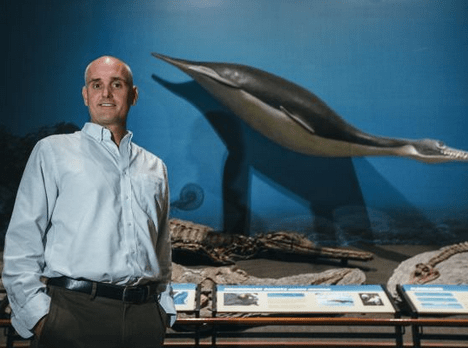
David Varricchio, associate professor of paleontology in MSU’s Department of Earth Sciences in the College of Letters and Science, led the expedition on Montana’s Egg Mountain that unearthed two nearly complete fossils of a Late Cretaceous iguanomorph found in a nesting site.
Named Magnuviator ovimonsensis, which means “mighty traveler from Egg Mountain,” the specimens are the oldest, most complete iguanian fossils discovered in the Americas.
Former MSU paleontologist Jack Horner christened Egg Mountain, which is located in the Two Medicine Formation near Choteau, after he and his crew discovered fossil eggs and clutches there beginning in 1979. The fossils represented the first dinosaur eggs from North America.
In 2010, Varricchio received funding from the National Science Foundation that made it possible for him to return to Egg Mountain and excavate.
“We began excavating there in 2010, continuing through 2016,” Varricchio said. “This was the first concentrated effort at Egg Mountain in 25 years. The lizard specimens were discovered during these new excavation efforts.”
Some lizard material had been found at the site before, Varricchio said, but nothing as remarkable as the nearly complete and fully articulated skeletons.
“In the field, we knew we had some special specimens, as articulated lizards are exceptionally rare in the Cretaceous,” he said. “But, it wasn’t until Dave DeMar really examined the specimens that we knew it was a new species.”
David DeMar, postdoctoral research associate in the University of Washington biology department and the Burke Museum of Natural History and Culture, is lead author of the discovery paper.
“It is incredibly rare to find one complete fossil skeleton from a relatively small creature like this lizard," DeMar said. "But, in fact, we had two specimens, both from the same site at Egg Mountain in Montana.”
The paper, “A new Late Cretaceous iguanomorph from North America and the origin of New World Pleurodonta,” was published Jan. 25 in Proceedings of the Royal Society B. It details the findings from the four-year study of Magnuviator ovimonsensis, including its appearance and the importance of the discovery.
“It is not particularly distinctive; it would look fairly unremarkable next to modern lizards,” Varricchio said. “For the time, though, it is a relatively big lizard at about eight inches long. It’s somewhat chunky with a high number of small teeth and may have fed on insects.”
Despite its non-distinctive appearance, Varricchio said, the specimens provide new morphological information that will help paleontologists determine some evolutionary and biogeographic pathways.
“For example, Magnuviator belongs to the iguanomorphs, a large group of lizards that includes iguanas and horned lizards,” he said. “The specimen is about 20 million years older than the next oldest specimen from North America. It also provides a better picture of the Egg Mountain ecosystem during that time.”
Because the specimens were so well preserved, Varricchio said, the scientists may be able to answer a number of questions about the lizard.
“We can ask questions about ‘what it did for a living,’” he said. “From its preservation we suspect it may have burrowed, and we will be able to test this given the near-complete skeleton we have. Very few lizards are known from anything more than jaw fragments for the Cretaceous of North America, so these are excellent specimens.”
Mary Hubbard, head of the Department of Earth Sciences, said Varricchio’s work greatly benefits MSU and the science of paleontology through his important discoveries.
“The Department of Earth Sciences at MSU is proud to have Dr. David Varricchio and his students who have the expertise and are able to do the fieldwork in the extensive Cretaceous rock units of Montana that is necessary for making these sorts of discoveries,” Hubbard said.








News Comments
Definitely not the quality it used to be. Mint cholate chip just has big chunks of chips stuck together not throughout the nearly mint flavored ice cream. Sorry you’ve lost me
Ownership Changes at Wilcoxson’s Ice Cream Celebrate Montana Heritage and Future Growth
Thursday, Jul. 23, 2026
Why didn’t the Kagy and 3rd project get started when college was out? How is the football game traffic at MSU going to be handled? Timing of this project is awful.
Construction Starts on West Kagy to Babcock Sewer Improvements Project
Monday, Jul. 20, 2026
Why couldn't the fish in the hatchery be raised to a marketable size and then sold to grocery stores and restaurants? The danger is only having the snails pass intact through the fish's digestive ...
Drainpipe cause of New Zealand mudsnails at FWP fish hatchery
Sunday, Apr. 12, 2026
Congratulations to Nephew David and Bridger Brewing. It has been so great seeing your vision become a reality. We'll never forget our visit to Bozeman!
Bridger Brewing Named Large Brewery of the Year at 2026 Montana Beer Awards
Tuesday, Apr. 7, 2026