Thursday, Aug. 8th, 2024

Bozeman Receives Funding to Improve, Create Shared Use Paths Around City

BOZEMAN — The City of Bozeman, in partnership with the Montana Department of Transportation, recently began work on two projects after being awarded Federal Highway Transportation Alternatives (TA) funding. In the first project, the City will add new 10’ wide shared use pathways on East Valley Center Road between Catron and Catamount Streets, North 19th Avenue between Baxter Lane and Rawhide Ridge Road, and Flanders Mill Road between Sunstone Street and Durston Road. The second project involves pavement preservation on several existing separated shared use paths along Oak Street, North 19th Avenue, and Huffine Lane/Main Street. City Engineering Staff will complete design for both projects, reducing reliance on outside consultants and stretching the funding further.


“This funding will help us more quickly address a need we hear from many residents – safer, separated paths for bicyclists and pedestrians,” Transportation & Engineering Director Nicholas Ross stated. “We’ve been working hard planning and designing for these projects, and now we get to make them a reality without relying solely on local taxpayer dollars.”


The new shared use paths will fill gaps in missing sections of the City’s transportation network, helping to safely route pedestrians and cyclists throughout the City. The pavement maintenance project will help to prolong the useful life of the existing shared use pathways. When pavement preservation projects such as these are done, it prevents the need for costlier reconstructions of pathways further down the line.


“MDT is glad that the City of Bozeman applied for and was successful in receiving this funding,” said Dave Holien, MDT Transportation Alternatives Engineer. “These are highly needed projects and will provide much needed safety and connectivity improvements for pedestrians and bicyclists.”

For more information on either of these two projects, call Kellen Gamradt, PE at 406-582-2283.

Add a Comment »

NASA to launch instrument developed at Montana State to study sun

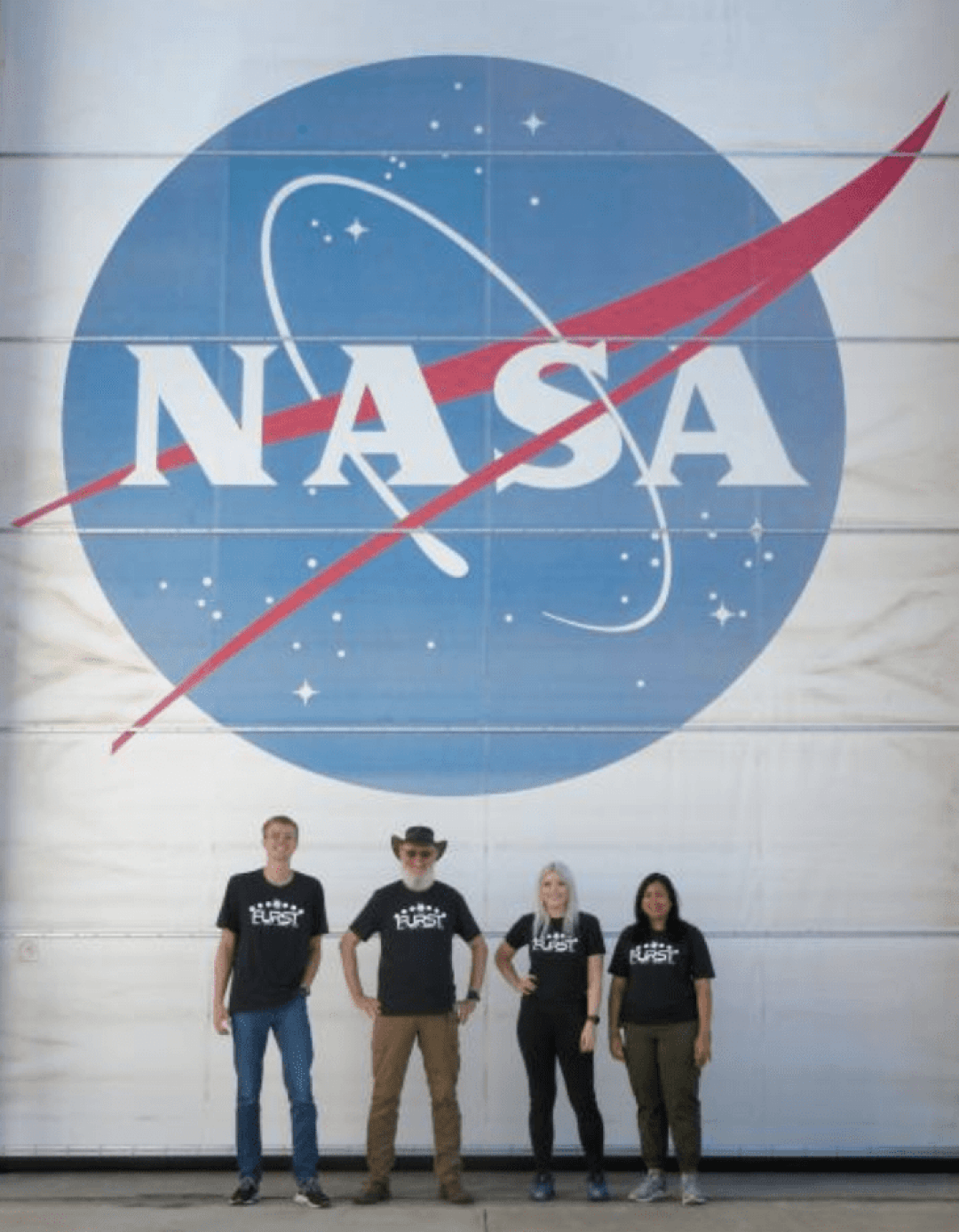
Montana State University alumnus Jake Davis, left, Professor Charles Kankelborg, and doctoral students Catharine "Cappy" Bunn and Suman Panda, pose at White Sands Missile Range in New Mexico, where they are preparing for the launch of the FURST rocket mission to observe the sun in far ultraviolet.

BOZEMAN
– An instrument designed and built at Montana State University to capture the first high-resolution, far-ultraviolet spectrum of the entire sun will be launched into space aboard a NASA rocket on Sunday, Aug. 11.

The launch, scheduled for 1:05 p.m. Mountain time from the White Sands Missile Range in New Mexico, will be livestreamed at https://video.ibm.com/wstf-wsmr.

The unnarrated video will be “pretty spartan,” according to Charles Kankelborg, MSU professor of physics and principal investigator for the scientific mission, but viewers should be able to visually follow the rocket’s trajectory, watch its first and second stages separate, and see the second stage fire as it catapults the Full-sun Ultraviolet Rocket Spectrometer, or FURST, into space for its roughly five-minute mission.

Kankelborg, a member of MSU’s internationally known Solar Physics Group, has built several scientific instruments to study the sun. He began developing FURST in 2018, after the idea was suggested to him by Phil Judge, a senior scientist at the High Altitude Observatory at the National Center for Atmospheric Research.
“He said nobody has ever measured a high-resolution, far-ultraviolet spectrum of the sun-as-a-star – it hadn’t been done,” said Kankelborg.

The sun emits light from across the electromagnetic spectrum, including near, middle, far and extreme ultraviolet light, whose wavelengths are shorter than visible light. The MSU team’s instrument is designed to measure far ultraviolet light, with wavelengths ranging from 120 to 180 nanometers. Those wavelengths are absorbed high in Earth’s atmosphere, which is why the readings need to be taken from space.

Kankelborg explained that scientists routinely collect high-resolution spectral data from little sections of the sun at a time, but nobody has ever taken a high-resolution, far ultraviolet reading from the entire solar orb at once – and because of the extreme variability in activity and presentation between the sun’s center and edges, as well as the various features like sunspots and plages, it’s impossible to use those slices of data to make accurate conclusions about the sun as a whole.

“When trying to assemble or guesstimate a whole-sun spectrum from little pieces, there’s no way to be sure you’ve done it right,” he said.

By contrast, the Hubble telescope has captured far-ultraviolet spectra of many entire, far-away stars. Those data helped scientists determine the stars’ characteristics, such as temperature, density, chemical composition and velocity.

“The main purpose of this mission is to really understand the solar spectrum and compare it with other stars,” Kankelborg said. “We don’t yet have the data we need to put the sun in context with all of those.”

Being able to make those direct comparisons may help scientists better understand how ultraviolet radiation emitted by the sun affects comets, moons and planets, including Earth, he added. The new data also may help answer how the common, small explosions of plasma in the sun’s transition region – the area between the solar surface and the outermost part of the sun’s atmosphere, called the corona – influence the spectrum of the sun as a whole. Kankelborg said such explosions, which are about the size of Earth, change the frequency of light emitted by the sun.

MSU doctoral student of physics Catharine Bunn, who is part of the FURST launch team, has been studying magnetic reconnections in the sun by analyzing data collected by NASA’s Interface Region Imaging Spectrograph, or IRIS, satellite, which scans the sun every month to produce a high-resolution, full-disk image. Kankelborg explained that by comparing IRIS and FURST data, scientists will be able to see for the first time how those events affect the spectrum of the star as a whole.

Typically, far-ultraviolet spectra are collected by directing light through a tiny slit in a spectrograph and using diffraction grating – a tool that splits light into its different colors – to reimage the beams. When he started to design FURST, Kankelborg said he didn’t know how he would focus light from the entire sun through a tiny slit.

“We needed to squeeze the whole width of the sun down to 15 microns,” Kankelborg said. “The idea came to us to just use little glass cylinders – stirring rods like you use in chemistry class.”
Unable to find an optics manufacturer to make the cylinders, the team instead bought commercial glass cylinders and “diced them up,” Kankelborg said. MSU electrical engineering doctoral student Suman Panda built a digital microscope to examine their optical quality and selected the cylinders best suited for the mission. Those were given a reflective coating so that when sunlight hits their convex surfaces, it is reflected and directed so it can be split and analyzed.

NASA’s sounding rocket won’t deliver FURST into orbit, but it will take it high enough to escape Earth’s atmosphere – about 300 kilometers, or 186 miles, above the ground.

“We’ll have about 300 seconds, or five minutes, and will take an exposure every 10 seconds. As we’re doing that, we’re rotating between channels – each glass stirring rod takes a different channel, so we’ll be able to observe in each of those channels over and over again,” Kankelborg said.

The instrument will return to Earth via parachute for retrieval.

Kankelborg has been in New Mexico since mid-July preparing for the mission with Bunn, Panda, and MSU mechanical engineering alumnus Jake Davis, who works for MSU’s Space Science and Engineering Lab (SSEL). MSU electrical engineering alumnus James Joseph, who designed the electronics and software for the FURST shutter controller in the SSEL, spent 10 days with the team at White Sands in July. Roy Smart, a doctoral student in physics who created the detailed optical design for the instrument, will join the team for the launch.

Kankelborg said sounding rocket missions provide an excellent learning opportunity for students.

“They have serious responsibilities and will be hands-on with instrument hardware and operationally on launch day,” he said. “They learn experimental space science from the inside out.”

Because the project was delayed by the COVID-19 pandemic, it wasn’t originally scheduled to take place during the current high point in the sun’s 11-year solar activity cycle.

“We had no intention of waiting until solar maximum, but we’ll take it – it’s exciting to measure the sun when it’s active,” Kankelborg said. “I think we have a really versatile experiment. It will be informative for heliophysicists like me, but also for atmospheric scientists, stellar astronomers and people interested in the atmospheres of other solar system bodies.”


Add a Comment »

HRDC Offering No-Cost Preschool Opportunity

Bozeman, MT – HRDC is excited to announce that we have spots available in our no-cost preschool program for the upcoming school year. Families in Bozeman and Belgrade with children ages 3-5 are encouraged to enroll their children in this high-quality early childhood education program.

Designed to prepare students for kindergarten through a play-based learning approach in a natural environment, 94% of HRDC’s ECE graduates meet or exceed school readiness standards. Each child’s curriculum is individualized within an inclusive learning setting that supports all children, including those with disabilities.

“Our no-cost preschool programs are a fantastic opportunity for families in our community,” said Sandy Stavig, HRDC’s Early Childhood Education Director. “We are dedicated to ensuring that every child, regardless of their background, has access to high-quality early education that sets them up for success.”

Family eligibility is income-based and includes households with incomes below 130% of the Federal Poverty Line. Eligibility is based on income and household situation. For families that exceed the income eligibility threshold, a waitlist is kept should openings become available.

Interested applicants can visit HRDC Early Childhood Education Enrollment for an online application or call 406-586-9652 for more information. Applications are available in English and Spanish, and interpreters are available upon request.

HRDC is also seeking dedicated individuals to join our early childhood education team. We currently have four positions open: Bi-lingual Early Childhood Education Teacher, Early Childhood Education Substitute, Early Childhood Education Teacher, and Education Aide. These roles are essential in supporting our mission to provide exceptional early education to children in our community. Interested candidates can find more details and apply by visiting HRDC’s website.

About HRDC

As a private, not-for-profit Community Action Organization focused on building a better community through its nearly 50 initiatives, HRDC combats poverty in southwestern Montana and believes everyone deserves the opportunity to be financially stable. Donors, volunteers, and community members can learn more at https://thehrdc.org/

Add a Comment »

Gateway Conservation Alliance Files Lawsuit Claiming Recent Changes to Opencut Mining Act Are Facially Unconstitutional

Gallatin Gateway – In a matter of statewide significance, Gateway Conservation Alliance (“GCA”) filed a new lawsuit this week challenging the issuance of TMC, Inc.’s Opencut Mining Permit #3462 for a new gravel pit located in Gallatin County, Montana (the “Black Pit”) and contesting parts of Montana’s Opencut Mining Law as facially unconstitutional.

More specifically, in its new lawsuit, GCA alleges that House Bill 599 (“HB 599”) allowed Montana’s Department of Environmental Quality (“DEQ”) to issue this and innumerable other Opencut Mine permits around the state without assessing critical human, environmental and wildlife factors.

Furthermore, GCA alleges through this lawsuit that HB 599 essentially eliminated DEQ’s duty and ability to review proposed opencut mining operations for environmental harms, including surface and groundwater quality, as well as removed public participation opportunities. The result has been to turn the Opencut Mining Act’s (“OMA”) permitting process into a meaningless form-filling exercise.

Montanans have a fundamental right to a clean and healthful environment as guaranteed by Article II, Section 3 of the Montana Constitution, which rests at the center of this new lawsuit. As a result, GCA alleges that HB 599 thereby violates the Legislature’s duty to provide for adequate remedies and administration to maintain and improve a clean and healthful environment under Article IX, Section 1 and Article II, Section 3 of the Montana Constitution and the public’s right of participation under Article II, Section VIII of the Montana Constitution.

Passage of HB 599 by the Legislature and signed into law by the Governor has rendered the OMA incapable of ensuring Montanans their constitutional rights to prevent environmental harms. HB 599 created arbitrary loopholes with which to avoid permitting altogether, removed essentially all substantive environmental considerations from DEQ’s decision-making, including the ability and authority to prevent harmful projects from occurring and minimized or erased opportunities for the public to give input or for DEQ to conduct a meaningful and rigorous permit review.

Tracie Gibbons for GCA stated. “While we certainly did not ask for this fight or want it forced upon us, we are proud to bring this case to hold our government accountable to our Constitution, which demands that our natural life support system be protected for present and future generations. We look forward to moving this critically important case forward both to defend our home and community in Gallatin Gateway, but more importantly, to protect communities around Montana and ensure our rights to a clean and healthy environment.”

Legal counsel for GCA and other groups around the state, Graham Coppes, said: “While we expected the mining companies to fight us, we did not expect our biggest opponent to be the State of Montana. What we have learned through this process is that the state – by and through the Department of Environmental Quality - is pouring endless hours, dollars, and legal resources into fighting against citizens, communities, clean water and air, all to increase the bottom line of a few private companies.” The State cannot plausibly contend that “cutting red tape” constitutes an interest of the “highest order” that cannot be “otherwise served” without gutting Montanans Constitutionally enshrined environmental protection against the potentially harmful consequences of these mining operations.”

Add a Comment »

Wellness Effort in Big Sky files Suit over Petition to Withdraw from the Madison County Hospital District

Big Sky – Plaintiffs supporting the efforts of the Big Sky Wellness Coalition filed a lawsuit in the Madison County District Court today after months of unsuccessful attempts to communicate with and obtain records from Madison County regarding the Madison Valley Hospital District and the refusal of the Madison County Commissioners to hold a hearing on the petition to withdraw from the Hospital District.

The Big Sky Wellness Coalition is comprised of partners and community members across diverse organizations who have a shared interest in addressing the growing gap in the Big Sky community’s healthcare services. Through collaboration, the coalition began an effort to address community needs in health and wellness services, and in August of 2023 began the effort of collecting signatures on a petition to withdraw from the Hospital District.

With the petition, Madison County residents of Big Sky aimed to withdraw from the Hospital District, citing the taxpayers within the boundary of the special hospital district have been unable to utilize the services provided due to proximity and an inability to access those services in Madison County. Madison County residents of Big Sky would need to commute 2.5 hours and through an adjoining county to have access to the services funded through taxes they currently pay to this special hospital district. The signatures collected targeted the eligible list of qualified voters identified by the advice and methodology provided by the Madison County Clerk & Recorder last October. More than 240 signatures were collected, enough to meet the 51% threshold requirement for a hearing on the merits, and in December 2023 the petition was filed.

Minutes into the January 18, 2024, hearing, the meeting adjourned after the Clerk & Recorder announced that approximately 200 signatures were disregarded and therefore the petition did not contain enough eligible signatures for the hearing to take place. In a subsequent follow up with the Clerk & Recorder, advocates learned the methodology applied in January was different from the original framework provided, and further that multiple signatures eligible even under the Clerk & Recorder’s second methodology were erroneously rejected. Despite the coalition’s best efforts, the Madison County Commission refused to reconsider the Clerk & Recorder’s erroneous methodology and signature tally and refused to hold a hearing on the merits of the petition.

The complaint filed in Madison County’s Fifth Judicial Court details four counts seeking preliminary and permanent injunctive relief and asks the court to enter an order directing the Commissioners to cease levying taxes on Plaintiffs to fund the special hospital district, given that it appears the special hospital district does not legally exist and/or is not operating properly under Montana law. The request also asks the court to direct the Commissioners to find the original petition meets the required threshold for signatures, and to schedule a time for a hearing on the merits of the petitioners’ requested withdrawal from the special hospital district within the 2024 calendar year. The petitioners assert their tax dollars should fund services within their community that they actually receive and use, rather than fund services they cannot and do not access.

The complaint filed today can be found here. To learn more about the Wellness Coalition, visit www.wellnesscoalitionbigsky.com.

Add a Comment »

Wednesday, Aug. 7th, 2024

Bozeman Symphony Individual Concert Tickets Available

BOZEMAN -- Individual Bozeman Symphony concert tickets are now available for the highly anticipated 2024-25 season of Music that Moves Us. Music Director Norman Huynh has curated a spectacular lineup of concerts featuring internationally acclaimed guest soloists and local talents.

The season features seven unforgettable Classical Series concerts of blockbuster music including Rachmaninoff’s Third Piano Concerto, Mussorgsky’s Pictures at an Exhibition, and Beethoven’s Symphony No. 7. The concerts feature acclaimed guest artists from around the globe such as guitarist Pablo Sainz-Villegas, pianist Vijay Venkatesh, and violinist Will Hagen.

The Bozeman Symphony Presents Series includes the Symphony’s most popular concert, the Holiday Spectacular. This year’s concert features local favorite Paige Rasmussen. There will also be a Valentine’s weekend concert with internationally celebrated singer, multi-instrumentalist, and songwriter Kishi Bashi.

New this year is the Bozeman Symphonic Choir Concert Series which includes powerful programs highlighting a rich array of timeless and diverse music that will move the audience emotionally and spiritually: Mozart’s Requiem with four guest soloists and The Stones Sang:  Celebrating the Land.

Individual tickets for the 2024-25 season are available at bozemansymphony.org, or by calling the Bozeman Symphony Box Office at (406) 585-9774. For patrons interested in the full season, the Bozeman Symphony also offers subscription packages, allowing music enthusiasts to experience the full range of artistic expressions throughout the season.
 
All classical and Bozeman Presents Series performances will be at the Willson Auditorium, 404 West Main Street in downtown Bozeman. The choir concerts will be performed at area churches. Concerts would not be possible without strong community support and sponsorship. The Bozeman Symphony thanks Conductor’s Circle Sponsors Cal & Tricia DeSouza, Donald B. Gimbel, and Gary Kunis & Connie Wong for supporting the 2024-25 season.

Add a Comment »

Tuesday, Aug. 6th, 2024

License required to train bird dogs on wild game birds, training season dates coming up

HELENA – Do you plan to train your dog on wild game birds this season? If so, a bird dog training license is required, and you must abide by season dates when training on public land. 

This is the second year that this license has been required, after it was created during the last Montana legislative session. In addition, a slight change was made to the nonresident season dates (from a start date of Aug. 15 to a later start date of Sept. 1).  

Below are a few reminders: 

Who needs this license: 

Anyone training bird dogs on wild game birds needs to hold a bird dog training license, whether they are training on private or public land (note training season dates below for public land). 

How to obtain this license: 

  • Licenses can be purchased online, at an FWP office, or at any license provider. 

    • Licenses are: $5 for any Montana resident over age 18 
                           $10 for any nonresident over age 18 

  • Note: A special recreational use license (SRUL) from the Montana Department of Natural Resources and Conservation (DNRC) may be needed to train on state school trust lands. 

Public land bird dog training dates: 

  • Resident training dates are Aug. 1-March 31. 

  • Nonresident training dates are Sept. 1-March 31. 

Add a Comment »

Thursday, Aug. 1st, 2024

HRDC Offering Special Streamline Route to Sweet Pea/SLAM Festival, Encouraging All Attendees to Bring Food Donations

BOZEMAN — HRDC is thrilled to be part of the upcoming SLAM Festival and Sweet Pea Festival this weekend.

We will be operating a special Streamline route on Saturday, August 3rd following the Sweet Pea Parade to connect community members in Belgrade to all of the festivities without the hassle of driving and parking a personal vehicle. To view a list of stops and scheduled times, please visit Streamline’s website.

We also invite all SLAM festival-goers to join us in supporting our Gallatin Valley Food Bank by donating food, funds, and grocery store gift cards. You will find HRDC team members next to the Information Tent during the festival hours on Saturday, August 3rd from 10 AM to 7 PM and Sunday, August 4th from 10 AM to 5 PM.

We will be accepting donations of food, funds, and grocery store gift cards. Our food wish list for the SLAM Festival includes:

  • ●  Pasta

  • ●  Cereal

  • ●  Canned fruit

  • ●  Peanut butter

  • ●  Canned tomato products

    The SLAM festival is also hosting a raffle to win a stunning art piece by local artist Nic Fischer. Raffle tickets are available for purchase for $5 each or 5 for $20. All proceeds will directly support HRDC’s food and nutrition programs.

    The rising costs of food and housing have increased the need for our services. This past year alone, we’ve seen a 47% increase in new households visiting our Gallatin Valley Food Bank.

Our food and nutrition programs are mostly funded by local support. We are proud of the community that allows us to keep up with the growing need for food assistance. Together, we can ensure that no one in our community goes to bed hungry.

About HRDC

As a private, not-for-profit Community Action Organization focused on building a better community through its nearly 50 initiatives, HRDC combats poverty in southwestern Montana and believes everyone deserves the opportunity to be financially stable. Donors, volunteers, and community members can learn more at https://thehrdc.org/

Add a Comment »

Montana State doctoral student awarded prestigious Gilliam fellowship


Montana State University graduate student Lauren Gedlinske is pictured Thursday, July 18, 2024, in Bozeman, Montana. MSU photo by Colter Peterson

BOZEMAN – Montana State University graduate student Lauren Gedlinske is one of 50 students from across the U.S. – and the first ever from MSU – to receive a prestigious Gilliam Fellowship from the Howard Hughes Medical Institute.  

The award recognizes students and their advisers for outstanding scientific research and commitment to advancing equity and inclusion in science. It provides each student-adviser pair with $53,000 in support each year for up to three years of the student’s dissertation research and enrollment in a one-year course that provides leadership training, professional development and support in promoting healthy and inclusive graduate training environments.

Joshua Hall, senior program officer for the Gilliam Fellows program, said recipients were selected not just for their scientific accomplishments, but also “for the unique ways each and every one of them makes the science ecosystem a better place.”

For Gedlinske, who has been interested in community ecology since she watched insects visiting the wildflowers in her grandmother’s garden as a child, the award recognizing her support for the graduate student community is meaningful.

“It’s a huge honor and pretty humbling,” said Gedlinske, who is pursuing a doctorate in ecology and environmental sciences in the Department of Ecology in MSU’s College of Letters and Science.

Gedlinske, who aspires to a career in research and ultimately in science policy, studies how floral scents emitted by wildflowers affect pollinator behavior and the associated reproductive success of plants. She said most prior research relied on studies of plant traits that could be seen, such as the number and size of flowers, because methods to effectively quantify floral scent compounds didn’t exist until recently. She expects her work to add to fundamental knowledge and hopes it will one day assist with ecosystem management.

After earning her bachelor’s degree in environmental studies from the University of Oregon in 2013, Gedlinske chose MSU for graduate school because it offered the opportunity to work with ecology professor Laura Burkle, whose writing she had studied and admired. Burkle is now her faculty co-adviser.

Since she arrived at MSU in 2021, Gedlinske has advocated for graduate students by helping to survey them about the local cost of living and working to improve graduate student stipends. She is active in Graduate Women in Science and Engineering, or WISE, a student organization whose goal is to support graduate students of all genders in science, social science, math and engineering by providing opportunities for professional and social development.

As a panelist for WISE discussions, she has spoken not only about her journey as a scientist but also about the struggles she faced adjusting to the structure of graduate school. Those ultimately led to her being diagnosed with attention deficit hyperactivity disorder, or ADHD.

“It was my inability to manage my own timelines, motivate myself without urgent deadlines and maintain organization on the various moving parts of my projects that initially led me to seek out a diagnosis,” she said.

Inspired by her experience, Gedlinske helps connect peers who grapple with similar challenges to local resources. She also works with the MSU student group, Society for Neurodivergent Graduate Students, to raise awareness on campus about those students’ specific challenges.

“I would definitely like to do more to support and advocate for my neurodivergent peers in the future,” she said.

She added that she looks forward to applying what she learns in Gilliam Fellow workshops about fostering equitable and inclusive environments in graduate programs.

“I hope I am able to take some skills from these workshops and use them to continue to advance the causes and initiatives that mean the most to me,” she said.

A portion of the fellowship funds are allocated to the research team for projects that enhance a healthy and inclusive experience for graduate students. Burkle said ecology department faculty members and students have expressed strong interest in trainings related to equity and inclusion, and she is looking into workshops provided by various organizations.

About MSU’s first Gilliam Fellow, Burkle added, “This is a real honor for Lauren – we’re very proud and excited for her. It’s a testament to her scientific work, as well as her commitment to advancing equity and inclusion at MSU.”


Add a Comment »

Tuesday, Jul. 30th, 2024

News Comments