

Sunday, Aug. 16th, 2026

The Best Travel Memories Aren't Always Found at Famous Attractions

Famous places and landmarks might be one of the main reasons why people opt to go on a trip. But what makes the difference between traveling, sightseeing, and actually creating travel memories is having different experiences.

With that being said, that's also the reason people tend to visit southwest Montana. All those attractions in Yellowstone really do deserve the attention they receive, but the point is to find unique experiences beyond landmarks.

So, what makes them interesting is the title of the world's first national park, and what makes the experience is the willingness to get familiar with local communities and lifestyles.

See the Icons, But Don't Rush the Journey

Let's not reduce the value of real monuments and wonderful sights. Otherwise, it wouldn't count millions of visits each and every year with no signs of slowing down.

Landmarks such as Old Faithful and Grand Prismatic Spring are the symbols of Yellowstone. There are also Lamar Valley and Mammoth Hot Springs that, all together, show remarkable geothermal features and different wildlife habitats.

But these routes are very well planned, and as eruptions of Old Faithful are predictable, so could be the rest of the trip. This is the point where you might want to leave room for more spontaneous steps and discovering wildlife beyond just the top trendy/attractive places.

Asking a local about a certain species, or how they live there, might change your perspective. Or going into the forest early in the morning, when animals are most active.

Every step that is out of plan can give you more than any structured plan.

The Communities Around Yellowstone Complete the Experience

The whole point is slowing down, and while you have a few days there or in the nearby cities, use that time to its fullest.

Depending on whether you are closer to the north or western side of Yellowstone Park, you can visit local cities such as Bozeman or Gardiner. These can be your gateway from those structured plans.

Apart from the historic roles of these cities, they also hide something special. For example, the Museum of the Rockies in Bozeman can be a great experience, especially if you visit it with kids. But there is also Historic Downtown, which gives you a variety of shops, art galleries, and restaurants.

However, the thing is to go away from tourist attractions and to find a place that feels more local. These cafes and shops give away real Montana culture and show how nice the community actually is.

Authentic Local Experiences Matter Wherever You Travel

Some people never stop in smaller towns, only drive through them; then they stop to wonder why the whole trip ended up as looking at a few things over and over again.

You never know if there is some seasonal manifestation or cultural events.

Led by the previous example in Bozeman, for decades they have had a Sweet Pea Festival manifesting every August. It has become a tradition and a perfect way to get to know locals and those who are coming from other cities.

Not to mention that this type of travel isn't just practical when visiting national parks and local cities; it's a great thing to include in your next vacation.

So, the next time you really want to get to know the place and people, the best way is to spend the day just as if you are living there.

No matter where you might be.

For instance, if you went to Yellowstone in the summer and want somewhere warmer, you might opt for Cusco, Peru. As if everything is different and you might not know how to get around, firstly do research at home.

Think about it – what are sights that YOU would like to see, but also what’s making that place truly special? Not just saying the word ‘special’ just to say it. Like REALLY special! Here, companies that specialize in such tours, like Fernwayer, might be of help, as they're focused on guides and consultations as well as the special experience.

The next thing after you find the best way to get familiar with their culture and lifestyles is to start to plan a route. On that note, historic monuments might still be on top of your list, as it was the capital of the Inca Empire, but more insight into their life you will get from locals and at markets.

That's why people plan a Cusco market walk, as it's a unique experience, in particular San Pedro Market.

Conclusion

At the end of the day, most people would remember beautiful sights but also authentic stories they heard about specific places. So, when you are retelling your experiences, you will be more than happy to include some fun facts or a spooky story. But you wouldn't have known them if you didn't get to know locals.

All in all, it comes to balance.

You get to know the world while also giving a chance to new people and new cultures outside the framework of an average trip. No matter if you’re traveling across the world, visiting nearby national parks, or historic destinations, keep in mind that there is always a story behind it.

Add a Comment »

Bozeman Symphony Welcomes Six New Musicians for the 2026-27 Season


BOZEMAN
– The Bozeman Symphony and Music Director Norman Huynh are pleased to welcome six outstanding musicians to the orchestra for its 2026–27 season, Music that Moves Us . . . Near and Far.

Following a national audition process, Elizabeth Overweg has been appointed Associate Concertmaster. Also selected from the national audition process are violinists Sarah Francis, Beckett Koch, and Edith Samuelsson; violist Nicole Smith; and cellist Sam Spottiswoode.

"We are delighted to welcome these exceptional musicians to the Bozeman Symphony," said Music Director Norman Huynh. "Their talents will strengthen our orchestra and help us create inspiring performances that connect audiences through the power of live music."

Overweg, of Bozeman, performs with the Louisiana Philharmonic Orchestra and has appeared with orchestras across the country. An accomplished soloist, educator, and award-winning violinist, she earned a Master of Music in Performance from the University of Nevada, Reno.

Francis, of Ogden, Utah, previously performed as a substitute violinist with the Bozeman Symphony and has also appeared with the University of Utah Philharmonic Orchestra and the Salt Lake Choral Artists. Her performance experience spans opera, chamber music, and summer music festivals. She earned a Master of Music degree from the University of Utah.

Koch, of Billings, has been a tenured violinist with the Billings Symphony Orchestra since 2015. His career also includes teaching violin in Connecticut and Maine and performing as a section violinist with orchestras in Connecticut and Michigan. He earned a bachelor's degree in Violin Performance from the University of Hartford in West Hartford, Connecticut.

Samuelsson, of Chicago, serves as ensembles assistant at DePaul University and as an account manager and instrument technician for StringWorks. She performed with the DePaul University Symphony Orchestra, DePaul Concert Orchestra, and the Wheaton College Symphony Orchestra. Samuelsson earned a Master of Music degree in Violin Performance from DePaul University.

Smith, of Ogden, Utah, previously performed as a substitute violist with the Bozeman Symphony and served as a section violist with the Helena Symphony. She has also toured and performed with orchestras throughout the western United States. She earned a Bachelor of Arts degree in Music Education from the College of Idaho.
Spottiswoode, of Bozeman, serves as assistant principal cello of the Montana State University Symphony Orchestra and has performed with the Bozeman Symphony, Opera Montana, and the MSU String Quartet. He is pursuing a Bachelor of Arts in Music at Montana State University and expects to graduate in 2027.

The Bozeman Symphony opens its 2026–27 season on September 12 and 13 with Revolution & Revelry: Shostakovich 5. Tickets are available at bozemansymphony.org or by calling 406-585-9774. Adult tickets start at $30, with discounted pricing available for students. Tickets purchased at the door are subject to availability.

Add a Comment »

Montana State weather instruments monitor air quality

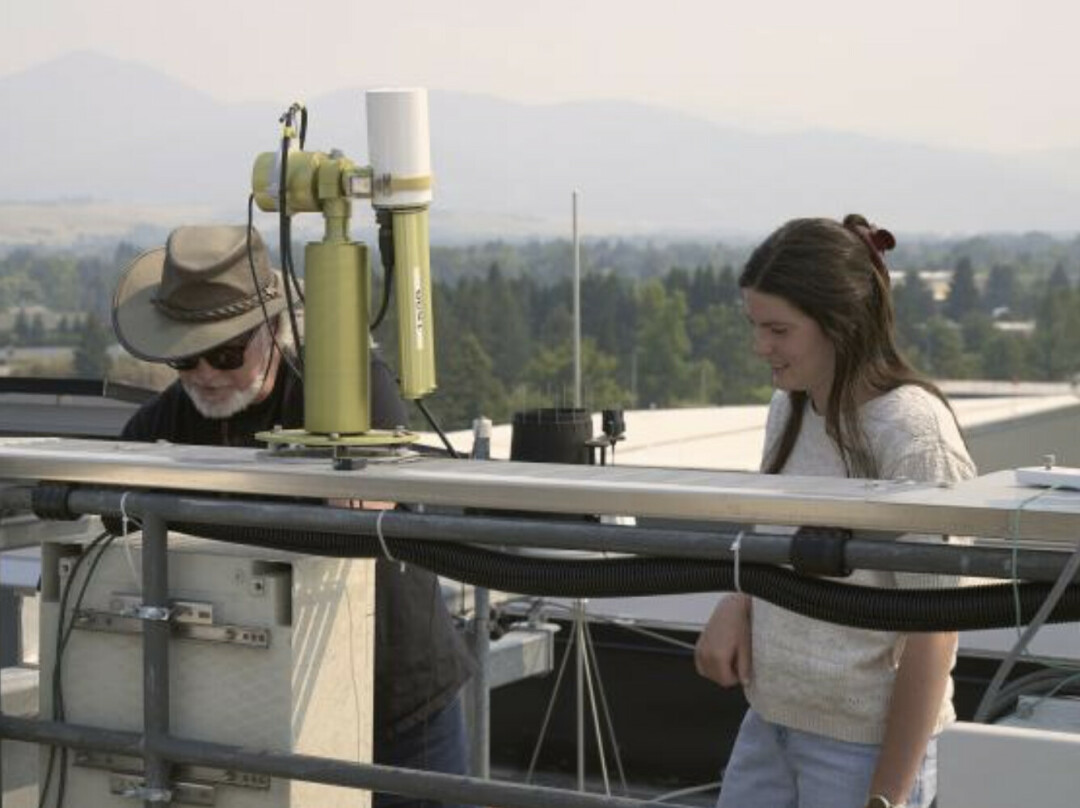
Montana State University Electrical and Computer Engineering professor Joe Shaw, left, and doctoral student Morgan Hasenmyer work with instruments that measure how the brightness of the sun is reduced by air particles. These measurements can also used to determine air quality. MSU photo by Kelly Gorham
BOZEMAN
— As wildfire smoke continues to collect heavily across parts of Montana, Joseph Shaw logs into his computer to check the data gathered from a weather station atop Montana State University’s Norm Asbjornson Hall. What he saw a few nights ago was a first in his 20 years of collecting weather-related data.

“I would say on a normal, clear day in Montana the scattering coefficient would be five, or maybe 10,” said Shaw, who is a distinguished professor of electrical and computer engineering in MSU's Norm Asbjornson College of Engineering. “Around midnight a few days ago, it was 516, which is the highest that I’ve ever measured.”

The scattering coefficient measures how strongly airborne particulate matter redirects light as it passes through a given distance in air. The corresponding air quality index value of 232 triggers a “very unhealthy” warning from the U.S. Environmental Protection Agency, advising sensitive groups to avoid all outdoor exertion, and for everyone else to limit outdoor exertion.

The weather station at MSU has the instrumentation to measure and report a bevy of scientific weather data, including the air quality index. He installed the instruments piecemeal over two decades to provide more accurate location-specific data for researchers around the world to utilize. One of the differences between the campus-centric data generated by the weather station at MSU and Bozeman-area weather data often available through smartphone apps is that the latter often comes from a weather station located at Bozeman-Yellowstone International Airport. Despite being less than nine miles from campus, the airport can experience weather conditions that are measurably different from those of MSU’s campus, Shaw said.

Another difference is that Shaw’s data isn’t available via an app. The data are intended mostly for scientific research, so the web-based interface might appear non-intuitive to laypersons. But to see a real-time user-friendly measurement of the current AQI at Asbjornson Hall, visit the PurpleAir website, which is part of the global AERONET network of weather-data gathering stations. The campus-specific data updates from Shaw’s instruments every 10 minutes, 24 hours per day.

“Our instruments suck air in and they scatter laser light off of it,” he said. “They then determine how many particles are there from that laser light.”

Of particular interest, Shaw said, are the smallest particles with diameters less than 2.5 micrometers, which can enter people’s lungs and cause irritation and sometimes exacerbate medical conditions such as asthma, he said. The larger particles tend to migrate to the ground relatively quickly, he said. The density of the smallest particles is used in the EPA-defined calculation for the AQI.

Despite having access to a cluster of comprehensive weather-related instruments, Shaw sometimes uses another measurement for air quality – at least when smoke in the air isn’t making headlines. He uses the line-of-sight clarity of mountains 30 to 40 miles away as a means of approximating visually the amount of haze in the air.

“For light haze, I use the visibility of the Tobacco Root Mountains from the top of Asbjornson Hall,” said Shaw, who is also director of MSU’s Optical Technology Center.

OpTeC is a globally recognized center advancing optical technology through research, education and collaborations with private industry.

Add a Comment »

What you need to know about hunting at Missouri Headwaters State Park this fall


THREE FORKS –
Montana Fish, Wildlife & Parks is implementing a new lottery system for managing hunting access at Missouri Headwaters State Park.

Missouri Headwaters State Park offers quality wildlife habitat and diverse recreation opportunities. As interest in hunting in the park grows alongside general park visitation, FWP staff are looking to manage hunting access in a way that ensures the safety of all visitors while keeping the park open for hunting where appropriate.

Beginning this season, hunting access at Missouri Headwaters State Park will be managed through a lottery reservation system. Those who wish to hunt in the park must complete an online application the week before they plan to hunt, choosing up to three days as possible hunting dates. Up to six hunters will be selected randomly for each day. Those hunters will receive an email with hunting rules, a map with safety zones, and a tag for their vehicle.

The online application will be open each Wednesday from 8 a.m. to 4 p.m. from Aug. 26 through Jan. 6, with hunting dates available weekly from Sept. 1 through Jan. 15. Hunters will be selected one week at a time.

For example, those who wish to hunt in the park any time from Sept. 1 through 6 will fill out the application on Wednesday, Aug. 26. Up to six hunters will be selected randomly for each day of that hunting period. If those hunters wish to hunt on future dates, they must fill out a new application.

To access the application starting Aug. 26, click here.

Those planning to hunt in the park after Jan. 15 must stop by the visitor center during business hours for a permission slip. 

Other hunting rules apply, including a weapons restriction and a safety closure near park facilities. Upland bird hunting will be limited to a certain portion of the park, while deer and waterfowl hunting will be open in additional areas. To see the map, a complete list of rules and a lottery schedule, click here. 

“Missouri Headwaters State Park provides a variety of recreation opportunities for thousands of visitors each year,” said park manager Alice Southworth. “We’re hopeful this new approach to managing hunting access in the park will help ensure visitor safety while maintaining the opportunities many people enjoy.”

Within the boundaries of Missouri Headwaters State Park, the Jefferson, Madison and Gallatin rivers merge to form the Missouri River, the longest river in the U.S. The site is significant to Native American peoples and was visited by members of the Corps of Discovery in 1805. Now a national historic landmark, the park hosts thousands of visitors each year. The park is about 5 miles northeast of Three Forks on Trident Road. For more information about the park, click here or call 406-285-3610.

Add a Comment »

Wednesday, Aug. 12th, 2026

NSF grant worth $3 million helping retain Montana teachers in rural areas and reservations


BOZEMAN
— For Christopher Quinlivan, a science teacher for Superior Public Schools west of Missoula, the most energizing part of his day is witnessing the “aha” moment for students – when the science content he teaches finally clicks for them.

“The next generation needs to look at the world with a lens of wonder,” said Quinlivan, who sees his teaching career as a way to both share his love for science and help children in extra need of support. “I think the sciences can either cultivate that or kill it, depending on how they’re taught.”
Quinlivan has worked in the rural school district for 14 years. He teaches courses for middle and high school students including physical science, biology, physics, chemistry and labs in STEM, which stands for science, technology, engineering  and math.

In addition to his heavy teaching courseload, this year he also completed a master’s degree in education through Montana State University.

MSU received a $3 million grant from the National Science Foundation’s Robert Noyce Scholarship Program in 2024 to support a project called the Noyce Master Teacher Fellowship for Rural and American Indian School Educators as STEM Leaders. The project, which seeks to improve the number, quality and experience of STEM teachers in rural states like Montana, funded Quinlivan’s tuition. It also is supporting 26 other Montana teachers through the six-year fellowship. Some of the fellows already have master’s degrees but are still in the program for the professional development, networking opportunities and stipend it provides.

The participants, who were already working as Montana teachers, received  tuition for master’s degrees and other resources such as monthly group check-ins , funding travel to relevant conferences, and a weeklong in-person gathering at MSU each summer.

This August, the gathering provided a chance for fellows to present their master’s research, attend informational sessions at the STEM Summer Institute and Montana Council of Teachers of Mathematics MCubed conferences held at MSU the same week, and participate in a team-bonding activity of rafting on the Madison River.

The opportunity for the 27 teacher fellows to gather in person is of huge value and aligns with the goals of the program, said Fenqjen Luo, professor of education in MSU’s College of Education, Health and Human Development and principal investigator on the grant. It provides a chance for them to learn from each other and cut through the isolation and loneliness that can sometimes impact people teaching in rural areas.

Overall, Luo said, the goal of the program is to support and retain teachers in rural Montana – especially those who are already serving as leaders and mentors of other teachers in their schools.

Data from the Institute of Education Sciences about Montana shows that more than half of school districts report difficult filling positions, and there are hundreds of teacher vacancies across the state. Additionally, upwards of 30% of teachers will change careers within five years of starting their teaching job.

Luo said that in eastern and other rural pockets of Montana, many math teachers come from countries including the Philippines, India and Ghana. That’s due to state incentives because there are simply not enough American math teachers in rural Montana to meet the demand.  

Luo, who previously taught in a small village in Taiwan, shared the same challenge as the Montana teachers: feeling unable to forge connections or find support systems because there were few other teachers around.

That’s exactly what the Noyce fellowship aims to address. One teacher, Bill Becker, said that a week of being surrounding by like-minded teachers who are professionally motivated to better themselves was “very rejuvenating.” He teaches mathematics and advanced electives at Ronan Public Schools on the Flathead Reservation.

Sometimes, due to stressors of the job, the teaching environment can be negative and unmotivating, Becker said, but being with the group of fellows was a breath of fresh air for him.

While on campus, he was able to exchange ideas with other teachers from Montana to benefit his classroom. Specifically, he presented his place-based lesson plan centered around the Confederated Salish and Kootenai tribal flag and its unique designs, customizable to many grade levels. Not only do students learn about the cultural significance of the flag, they are exposed to mathematical equations. For example, by plugging in different numbers into the equation of a circle, students see how the circle changes size and position on the flag.

Becker’s presentation then pointed teachers to the starter templates he created for the other tribal flags in Montana for use in their own math classes.

Quinlivan also shared his master’s thesis project, centered on his efforts to bring 3D printing into his science classroom. A grant enabled his purchase of two 3D printers in 2025, and his sophomore biology class has used them to learn about the classification of different animals and print the structures of viruses, bacteria and protozoa.

Quinlivan said it’s been a great way to bring students who have more of an art mindset into the sciences and also expose them to computer technology that could help them in future careers.

“I have learned so much about effective teaching methods through the MSSE  program that I believe I am already seeing positive changes in my classroom,” he added.

Connie Michael, a fifth-grade all-subject teacher at Crow Agency Public School, said the fellowship has helped her build bridges between other science and math teachers in her district and throughout the state. Having that network is important to her, especially since she started her career at a more populated district in Washington state before moving to the rural district. She has now been a teacher for 35 years.  

In 2025, Michael won a $27,000 award from Voya Financials in recognition of the caliber of her teaching, which funded her project to integrate Native American knowledge into STEM curriculum. She was able to share some of her teaching strategies in conversations with others at MSU.   

“Having the opportunity to talk with other teachers in similar situations and share strategies is so important, and we are able to share opportunities for professional development that we may not be aware of,” Michael said. “I have built some good relationships with teachers from across the state and hope to continue to build on those so we can share ideas and learn from each other.” 

NSF is funding the program through 2030. People can learn more at www.montana.edu/smrc/noyce/about/. MSU also houses the Center for Research on Rural Education which creates resources specific to the state’s rural teachers.

Add a Comment »

Community Invited to Celebrate National Nonprofit Day at Downtown Bozeman August 17

BOZEMAN — Monday, August 17, Greater Gallatin United Way invites the community to celebrate National Nonprofit Day at the second annual Nonprofit Walk, a free community event highlighting the organizations that strengthen Gallatin Valley every day.

From 5:00 to 7:00 p.m., downtown businesses will host local nonprofits outside their storefronts, creating an interactive evening where community members can explore downtown, meet the people behind local missions, discover volunteer opportunities, and learn new ways to give back—all while supporting local businesses.

Rather than a traditional walk, the event transforms Downtown Bozeman into a celebration of community, bringing together nonprofits, businesses, volunteers, and neighbors in one shared space.

"Nonprofits are at the heart of a strong community," said Ben Frentsos, Director of Community Impact at Greater Gallatin United Way. "Every day they provide services, create opportunities, and improve lives across Gallatin Valley. National Nonprofit Day is the perfect opportunity to recognize their impact while connecting them with the people and businesses that help make their work possible."

More than a thirty nonprofit organizations are expected to participate, representing causes including youth development, education, health, conservation, arts and culture, basic needs, and community services.

Community members are encouraged to stroll through downtown at their own pace, stop to visit participating nonprofits, learn about local organizations, and explore volunteer, donation, and engagement opportunities.

Downtown businesses are also joining the celebration by hosting nonprofit organizations outside or inside their storefronts, hosting give backs, and helping create a vibrant evening that highlights the power of local partnerships.

"Strong communities don't happen by accident," Frentsos added. "They are built by people showing up for one another. Whether you are volunteering, supporting a nonprofit, shopping downtown, or simply stopping to learn about an organization you've never heard of before, every connection helps strengthen our community."

The event is free and open to everyone.

Event Details

Nonprofit Walk
Monday, August 17, 2026 | 5:00–7:00 p.m. | Downtown Bozeman

A map of participating businesses and nonprofits will be available online prior to the event. For more information, participating organizations, or to register as a nonprofit or downtown business, visit: GreaterGallatinUnitedWay.org/NonprofitWalk

Add a Comment »

Tuesday, Aug. 11th, 2026

Bozeman Continues Community Engagement for Urban Forest Management Plan Update

BOZEMAN —The City of Bozeman is updating its Urban Forest Management Plan (UFMP) and continuing with public engagement for the project. All are invited to the in-person UFMP Public Engagement Meeting on Aug. 31 from 4 to 6 p.m. at the Bozeman Public Safety Center, 901 N Rouse Avenue. This will be the final formally scheduled public engagement meeting for the UFMP update process.

“We’ve learned a lot through this process and are eager to see residents’ thoughts on our draft plan,” said Alex Nordquest, Forestry Manager at the City of Bozeman. “If you haven’t been involved yet, now is the time. Feedback at this stage is critical as it helps to inform our final plan.”

The UFMP Update builds on the 2016 framework to ensure sustainable, holistic, and efficient management of the city’s urban forest. The updated plan will guide Forestry Division operations, planning, and public outreach, incorporating professional analysis and community input through meetings with staff, officials, and local stakeholders. Key components of the plan include community engagement; tree infrastructure; staffing and equipment; planning and development integration; and insect, disease, and disaster preparedness.


During the most recent public engagement meeting for the plan update, the project team presented the draft UFMP that has since been posted for public review and comment. The public comment period will begin on Monday, Aug. 17 and run through Tuesday, Sept. 15, allowing ample time for Plan review and comment formulation and submittal.


Comments can be provided during the meeting on Aug. 31 or by emailing comments@Bozemanmt.gov.

For more information on the UFMP Update and to sign up to receive updates on the project, visit the project website at engage.bozemanmt.gov/urbanforest.

Add a Comment »

Monday, Aug. 10th, 2026

Full Closure of S. 3rd Ave Starting This Week

BOZEMAN – Construction is underway on the City of Bozeman’s West Kagy to Babcock Sewer Improvements project. Crews are working 24-hour shifts to complete work at the South 3rd Avenue/West Kagy Boulevard/South Willson Avenue intersection before the school year begins.

Starting late next week, a full closure of South 3rd Avenue will be implemented while construction crews work on the manhole on the southeast corner of the intersection, near Crossings Kitchen. South 3rd Avenue will be closed to all directions of traffic between the West Kagy Boulevard intersection and West Graf Street but will remain open for local residents and business access. Detour signs will direct northbound through traffic on South 3rd Avenue to take West Graf Street to South 11th Avenue.

When work at the South 3rd Avenue/West Kagy Boulevard/South Willson Avenue intersection is complete and the intersection is reopened, crews will begin working on the West Kagy Boulevard and South Tracy Avenue intersection. The public can expect intermittent closures along South Tracy Avenue beginning the week of August 24, weather and other factors permitting.

In addition to the upcoming closures on South 3rd Avenue and South Tracy Avenue, the City of Bozeman has issued the following travel advisories:

Starting this week, there will be intermittent closures of the westbound left-turn lane from West Kagy Boulevard into the Museum of the Rockies’ (MOR) main entrance. During these closures, signs will be in place directing westbound MOR visitors to take South 7th Avenue into the museum’s staff parking lot and then follow the service drive to the visitor parking lot.

Access to the business center at the corner of West Kagy Boulevard and South 3rd Avenue is and will continue to be available throughout construction.

Pedestrians and bicyclists must follow all traffic control and posted signage. Barricades and other devices are in place to maintain worker and public safety.

The purpose of the West Kagy to Babcock Sewer Improvements project is to replace aging sewer pipelines to maintain a resilient and reliable sewer system in southwest Bozeman. The project will be completed in two phases over the next couple of years, beginning with the West Kagy Boulevard upgrades this summer. The next phase of the project includes sewer improvements in a residential area between West Babcock and West College Street—near Cooper Park—which is tentatively planned for spring 2027.

More information about the West Kagy to Babcock Sewer Improvements project can be found at https://bit.ly/kagysewer. To sign up for email or text alerts, click the “eNotifications” link at the top of the page.

Add a Comment »

Saturday, Aug. 8th, 2026

Shooting Facilities Task Force to meet Aug. 10

HELENA – The Montana State Shooting Facilities and Improvements Development and Oversight Task Force will meet Monday, Aug. 10, from 10 a.m. to 4 p.m. The meeting will be held on Zoom.  

The task force is responsible for identifying shooting facility needs in Montana and is tasked with developing a set of recommendations for the development, location and administrative structure of state shooting facilities and improvements. The deadline for the recommendations is June 30, 2027.  

“We learned a lot about shooting facilities in South Dakota, Wyoming and Colorado,” said task force co-chair Rep. Kerri Seekins-Crowe of Billings. “We also heard from over 1,400 shooters in Montana about the facility needs in our state. We will use all this information as we draft our recommendations.”   

The public is invited to watch the meeting and participate in the public feedback session. For the Zoom link and more information about the task force, click here.     

“We appreciate the passion and participation from the public,” said task force co-chair Sen. John Fuller of Kalispell. “Our recommendations will reflect that passion and benefit shooters in the entire state.” 

Add a Comment »

Top 10 Things to Check on a Refurbished Espresso Machine Before You Buy

The espresso machine is usually the biggest single line item in a new cafe budget, and in the Gallatin Valley it has to compete with rent, a build out, and a hood system before you have poured a single shot. That is why a refurbished espresso machine looks so good on paper. A two or three group machine that was out of reach new suddenly fits the number, and the listing photos look immaculate.

The catch is that "refurbished" is not a regulated word. It can mean a full teardown, new seals and a pressure test by a certified technician, or it can mean somebody ran a cleaning cycle and wiped down the panels. Here are ten things to check before you pay, ordered roughly the way a technician would walk through the machine.

Start With the Machine Itself
Bozeman has a real coffee scene and a lot of people quietly shopping used gear for it. The three checks below are the ones that decide whether you bought a workhorse or a project.

1. Boiler condition and scale
Ask directly whether the boiler was opened, descaled, inspected or replaced, and ask for photographs of the inside, not just the exterior panels. Scale is the slow killer on commercial machines. It insulates the heating element, drags down recovery time between shots, and it hides behind a machine that looks perfect from the front. A seller who has genuinely been inside the boiler will have photos and will be happy to show you. A seller who changes the subject has told you something.

2. Group heads and gaskets
Group gaskets, shower screens and dispersion blocks are wear items, and they are cheap to replace compared to what they cost you when they fail during a Saturday rush. Ask when they were last changed. Then look at the group itself for pitting, corrosion and burned in coffee oils around the seal. If you can, watch the machine pull a live shot and check that each group holds pressure and does not weep around the portafilter.

3. Pump and motor
On a rotary pump machine, listen to it. A healthy motor runs at a steady hum, not a rattle or a whine that climbs. Ask whether the pump has been rebuilt or replaced, and whether the machine holds a stable brew pressure across a full shot. Any seller who cannot tell you the pump's history probably did not touch it.

Check What Your Building Can Actually Give It
This is where most first time buyers get caught out, and it has nothing to do with the machine's condition. A perfect machine in the wrong building is still an expensive paperweight.

4. The electrical supply you actually have
Commercial espresso machines are not all the same animal electrically. Two and three group machines commonly need 220 to 240 volt service on a dedicated circuit, and the amperage draw varies by model. Before you buy anything, find out what your space has and what your panel can carry, and get an electrician to confirm it in writing. Retrofitting a circuit in an older downtown Bozeman building can cost real money and take real time, and that budget has to sit alongside the machine, not after it.

5. Plumbing and drainage
Most commercial machines need a plumbed in water line and a proper drain, not a drip tray you empty by hand. Check where the nearest supply and drain are relative to where the machine will live on your bar, and check what your landlord and the local health inspector will allow you to change. Food truck and mobile setups need a completely different conversation about tanks, pumps and capacity before you commit to a plumbed machine.

6. Water hardness and treatment
Whatever water your building draws, get it tested and budget for filtration and softening from day one. A refurbished espresso machine that was descaled last month will scale up again just as fast as a new one if you run untreated hard water through it. Ask the seller what treatment the machine was on in its previous life, because a unit that spent years on filtered water in a well run cafe is in a very different condition from one that did not, even if they look identical.

Ask About the History and the Parts
A used machine is really two purchases: the hardware, and the paper trail that tells you what happened to it.

7. Service records and who rebuilt it
Ask who did the refurbishment and what their qualifications are. Ask for an itemized list of what was replaced, not a summary. Ask how many years the machine ran, in what kind of volume, and whether it came from a cafe, an office or a home. A dealer that rebuilds machines in house should be able to answer all of that in one email. Local support matters too. Bozeman Magazine's 2023 interview with Ghost Town Coffee Roasters noted that their wholesale side includes equipment sales and service, so technicians who know commercial gear do exist in the valley.

8. Parts availability for that brand and model year
An orphaned machine is the worst outcome in this entire category. Before you commit, check that gaskets, valves, boards and elements for that exact model are still made and still stocked in the United States. If you are looking at a refurbished espresso machine from a specialist dealer, you will notice the same well supported names keep appearing. One US dealer's current renewed and used listings run from about $3,799 to $11,999 and include a renewed La Marzocco Linea Classic, a Nuova Simonelli Appia and a WEGA Atlas. That is a short list of nine machines, not a warehouse, which is worth knowing before you plan around it. For context, new commercial machines from the same dealer span roughly $1,995 to $41,500.

What a Refurbished Espresso Machine Should Come With
The last two checks are about the seller rather than the hardware, and they are the ones people skip when they are excited about a price.

9. Warranty and return terms
Get the warranty in writing and read what it actually covers. Parts only, or parts and labor? For how long? Who pays freight if a boiler fails in month three, and is there a return window at all? A dealer standing behind a rebuild will put terms in writing without being pushed. Freight matters more than people expect in Montana, so ask who arranges shipping, whether it comes on a pallet with a liftgate, and what happens if it arrives damaged.

10. What "refurbished" means from that particular seller
Finally, ask the seller to define the word. A refurbished espresso machine from a specialist dealer normally means teardown, new seals, replaced wear parts, a pressure test and a warranty. A private as is sale means you are buying a photograph and a story. Both can be good buys, but they should not carry the same price. If the answer is vague, treat the machine as as is and price your risk accordingly.

Work the list in order and the decision usually makes itself. If your building cannot carry the power and plumbing, no amount of rebuild quality fixes that, and you are better off with a smaller unit you can actually run. If the space is ready and the paper trail is clean, a properly rebuilt commercial machine will pour for years and free up capital for the things your customers will actually notice.

Buying a refurbished espresso machine for a Bozeman cafe? Ten checks on boilers, power, water and warranty to make before you hand over the money.

Add a Comment »

News Comments