Tuesday, Nov. 3rd, 2020

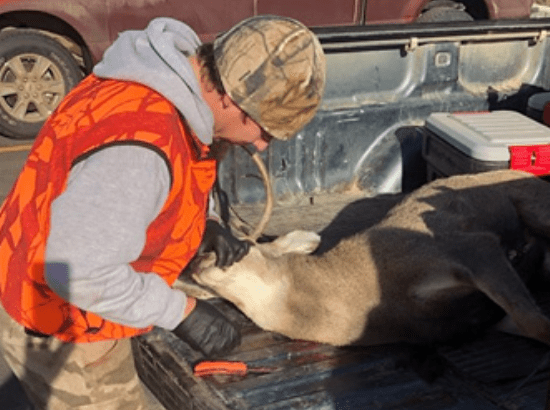
Hunter success at or above average during second weekend of general hunt in southwest Montana

The second weekend of Montana’s general deer and elk hunt in southwest Montana saw lower-than-average hunter participation for the same weekend in previous years, but hunter success was at or above average.

Wildlife biologists with Montana Fish, Wildlife & Parks operated three check stations Oct. 31 and Nov. 1, observing a total of 709 hunters. Biologists use check stations to collect data on hunter participation and success, as well as the species, sex and age class of the animals harvested. This supplements data collected through hunter harvest phone surveys.

The three check stations — at Cameron, Divide and Mill Creek — each saw an increase in hunter numbers from the previous weekend, but a decrease from the same weekend in 2019. At Cameron, hunter success was 11.8 percent, which was within the long-term average for the same weekend in previous years. The Divide check station saw a hunter success rate of 9.2 percent, which was 6 percent greater than the long-term average. Hunter success at Mill Creek was 7.4 percent, which is about 80 percent greater than the long-term average.

In total this past weekend, biologists checked 43 elk, 10 mule deer and 12 white-tailed deer.

These figures do not account for different hunting season regulations over the years, which have varied from liberal to restrictive for elk and mule deer, depending on population status.

Add a Comment »

Monday, Nov. 2nd, 2020

Five Tips for Leaving the Kids at Home and Enjoying a Night Out on the Town


Going out at night gets a lot harder when you’re older. As you age, you get more cautious, which is a good thing! After all, you don’t want to find yourself in an accident where you have to hire an attorney to help you with a personal injury. In addition, you likely have responsibilities that you have to keep in mind, which means returning home sooner than you would have in your early 20s.

For many of us, that also means figuring out how to enjoy a night out on the town when you have kids at home.

Don’t give up date night or a night with your girlfriends just because you have kids! There are things you can do to make it easier to leave the kids at home so you can have a good time getting out of the house.

Get a Sitter You Trust
If you want to go out, you have to find someone else who is willing to watch your kids. Unfortunately, that’s a lot easier said than done for many families.

Not everyone has friends or family they can fall back on. Even if you do, you may not trust grandma to watch after your little ones. If grandma is willing to watch the kids for free, but you’re worried about the care your kids are receiving while she’s there, you won’t have a good time.

Even if it costs money and takes time, it’s important to find a good babysitter that you trust. If you find a competent sitter, you can feel good that your children are in good hands so you can truly relax.

Make It Sound Exciting to the Kids
You’re probably looking forward to getting out with friends or a spouse, but you’re sad about leaving your kids at home. Although it’s true that your kids might be stressed when you first leave, it’s also true that they can have a great time too!

Make having a babysitter sound fun to the kids. That means helping the sitter come up with fun games and activities to do with the kids while you’re gone. A few ideas include:

• Buy a new board game
• Get out the arts and crafts
• Have them make a homemade pizza
• Prep an outdoor scavenger hunt in the dark

Make a Plan for Drinks
Having a few drinks isn’t something you get to do very often when you’re hanging out with the kids, but it’s something you can do when you go out at night! Just make sure you have a plan in place for drinks.

If you are driving home at the end of the evening, make sure you know how much you can drink to drive home safely. If you aren’t going to be the one driving, you should still have a plan for how much you’re going to drink if you’re returning home at the end of the evening. That way, you aren’t taking care of the kids the next day while you’re hung over!

Say Goodbye to the Kids
Although you may be tempted to sneak out when it’s finally time to go, it’s important that you say goodbye to your children. It’s an important lesson for them to learn that their parent will have to leave sometimes, but you will always come back.

It’s also good to model positive social behaviors for your children. You deserve to have a life with friends and loved ones outside of your immediate family unit, and it’s important that your kids see that.

Don’t Hesitate to Check In
You may think that checking in will make it more difficult for you to have a great time. That could be true. If you’re going out, you should spend less time worrying about what’s happening at home and more time enjoying yourself.

However, if you’re feeling anxious about how things are going at home, you probably aren’t going to be able to relax until you check in. Give a quick call or send a text message if you feel like you need to. Just try not to spend your entire evening checking in every few minutes. Otherwise, you might as well have stayed home!

Don’t put off going out at night and enjoying yourself for years because you’ve got kids at home. There are ways you can leave the kinds behind with a sitter and feel good about it so you can make great memories with adult friends and loved ones.

Add a Comment »

Belgrade traffic to bypass train crossing on Jackrabbit


BELGRADE, Montana (November 2, 2020) – Commuting on Jackrabbit Lane is expected to become easier in the coming years. The Montana Department of Transportation (MDT) announced today that the Montana Transportation Commission recently approved a change in scope for the Jackrabbit – Madison to Main project. This change will add an underpass on Jackrabbit Lane at the railroad crossing near Main Street. Once built, vehicles will be able to pass beneath the train tracks, limiting congestion.

The next step involves assigning the project design to a consultant in order to develop engineering plans for the revised project. MDT anticipates selecting a consultant engineering firm in the coming months.
 
“MDT has heard so much great feedback from this region about pedestrian access, area development, and more vehicles than ever utilizing this major thoroughfare,” William Fogarty, Butte District Administrator for the Montana Department of Transportation, said. “Providing a separated crossing beneath the railroad tracks came up frequently during those conversations. We did not want to jump ahead of ourselves without understanding the risks associated with adding a railroad underpass and having full approval. Now that we have that, we couldn’t be more excited to see this happen.”

 
The original Jackrabbit – Madison to Main project called for expanding Jackrabbit Lane to a five-lane roadway, from Madison Avenue to Main Street, which is still included in the plans. This project was expected to undergo construction around 2023, but with the addition of the railroad underpass, work has been delayed in order to complete the comprehensive design process and identify funding sources. Based on these factors, construction could be considered as soon as 2026 however, funding and the development schedule will ultimately dictate when construction begins. 

 
With the addition of the underpass, the Jackrabbit – Madison to Main project is estimated to cost as much as $25 million. MDT will work closely with multiple partners in order to identify available funding. The vast majority (80 to 90 percent) is expected to come from federal dollars.
 
“Incorporating community feedback involves balancing needs with funding,” Fogarty said. “We’re looking forward to more conversations with residents and project stakeholders as the project moves forward.”
 
To stay up to date on Jackrabbit – Madison to Main, call the Montana Department of Transportation hotline at 406-207-4484 or contact Takami Clark at takami@bigskypublicrelations.com. Learn more online at https://www.mdt.mt.gov/pubinvolve/jackrabbit/default.shtml.
 
Alternative accessible formats of this document will be provided upon request. Persons who need an alternative format should contact the Office of Civil Rights, Department of Transportation, 2701 Prospect Avenue, PO Box 201001, Helena, MT 59620. Telephone 406-444-5416 or Montana Relay Service at 711.

Add a Comment »

Saturday, Oct. 31st, 2020

How Can You Prepare for Civil Unrest?

This year has been one like no other. As early as February, much of the U.S. started bracing for the arrival of COVID-19. It wasn’t long before it was here in full swing, leading to shutdowns and other unheard-of measures before the pandemic.

Following that, there have been a number of situations throughout the country that have led to civil unrest. Most recently was Philadelphia, but the upcoming presidential election also has many concerned that we could see more unrest.

So what can you do to protect your family and prepare for civil unrest? You may be especially worried if you live in a big urban area.

The following are some ways to prepare your family for emergencies of this type.

Decide If You’ll Stay Put
If you live in a suburban or rural area, you might not be overly concerned about the immediate threat of civil unrest. You could see protests or face some inconveniences if this is going on in a part of your city, but it’s unlikely to happen in more suburban areas.

If you live in a big city, you might want to create an emergency plan that gives you somewhere to go with your family if you’re nervous about the direction things are heading.

Be aware that civil unrest tends to spike in central locations that make it easy for people to come together.

If you’re staying home and you’re concerned, ensure that all of your entry points are secure. There’s just a level of uncertainty that you have to consider in these situations.

If you live in an apartment, you might just have one entryway you need to secure. If you live in a single-family home but it’s near a central area, you might want to secure all points of entry and perhaps even board up. It really just depends on your location and what the expectations are.

Get Supplies
You should have an emergency kit with supplies not just in the event of civil unrest but also if there’s a weather situation or if we have another major spike in COVID cases. We all remember the anxiety bare shelves were creating back in March, so if you have some staples on hand you can avoid this.

Aim to have at least a two-week stash of food, water, and medical supplies.

What’s good about stocking up on supplies is that it can also help you feel more in control of the situation and less panicked.

If you live somewhere that a situation is particularly risky or heated, you might plan to stay home and have enough supplies for as long as a month of sheltering in place. Of course, this is a worst-case scenario, but preparing for worse cases is what emergency planning is all about.

Car Supplies
If you have a car and you think you might at some point head of out of town, have at least a half tank of gas at all times. You might want an extra stash of gas because often, if situations are stressful, many people are heading out of town all at once, and they may be waiting in line for gas.

You should have an emergency kit in your car with non-perishable food, water, and some basic tools in case you experience car trouble.

Have a Plan If You Aren’t with Your Family and Something Breaks Out
By and large, we do have a pretty good idea of when situations will arise that would be considered civil unrest. Most of these situations occur in response to certain events and often are in the night hours.
However, if something happens and your children are in school, for example, you should have a plan for what you’ll do. Ask your child’s school what their emergency plans are as well. It’s good to know what school protocols are not just from a civil unrest standpoint but in case of any other scenario.

Finally, if you’re ever in a situation where you’re directly in harm’s way—for example, close to where you live is being overtaken by a mob—it’s important to try and find a safe spot. Don’t get accidentally involved in the mob, and don’t try to defend your home if it looks like an impossible situation. Safety is the priority.

Unfortunately, we’ve all had to endure so many challenging situations this year, but preparing your family for a broad set of possible emergencies is important. Again, preparing for emergencies isn’t just for civil unrest. There are natural disasters, fires, and a host of other situations that you should also prepare for.

Add a Comment »

Friday, Oct. 30th, 2020

Seeing Purple/ Seeing Red: A virtual exhibition

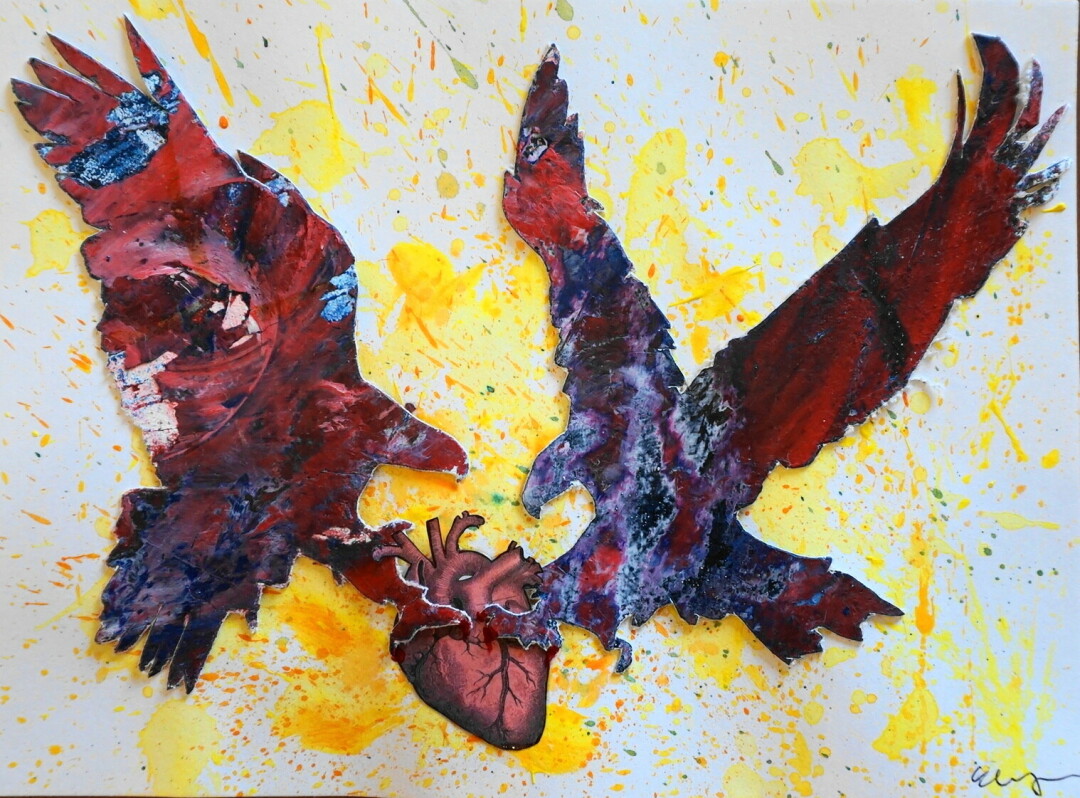
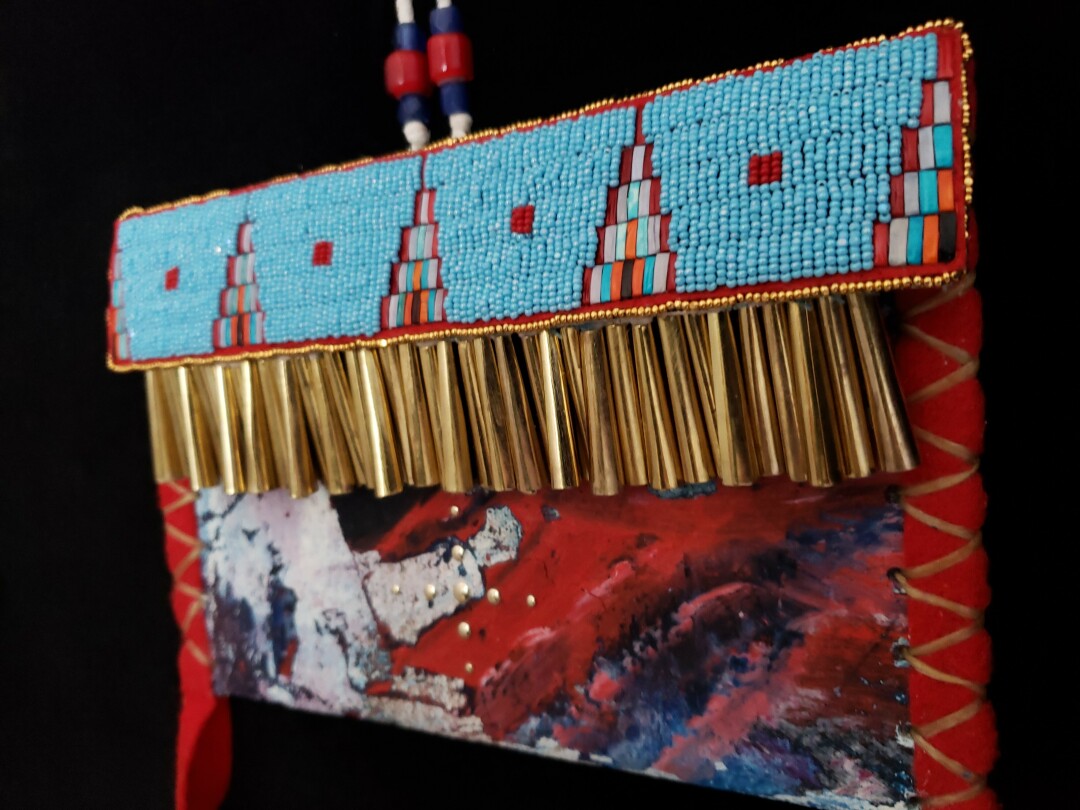
Artist and curator, Ella Watson is pleased to announce the launching of an experimental collaborative, virtual exhibition, Seeing Purple/ Seeing Red. Seeing Purple/ Seeing Red will launch on Oct. 5, 2020 and be live until Nov. 3, for the month preceding the 2020 elections. The exhibition can be found at www.seeingpurpleseeingred.com. Seeing Purple/ Seeing Red will include the work of around 35 artists and participants. Each person was provided a section of painting made by Watson in 2005 that was inspired by Obama as his star was rising. The artists were then invited to create a new work out of the scrap that discusses life in the post-Obama/ Trump era.

At the launch, a handful of works will be posted and then, throughout the month of October as elections near, new works of art will be posted. Please visit the website frequently for new pieces discussing this period of political, social, and environmental turmoil throughout the month of October. Artists and participants come from across the country, including Montana, Colorado, Virginia, New York, North Carolina, Iowa, and Texas. Heralding from numerous backgrounds including painters, sculptors, quilters, bead and quill workers, speech pathologists, Dreamers, diplomats, veterans, and more, participants visually discuss being disenfranchised, terrified, vulnerable, or injured by the state of national affairs.

According to painter, Ron Johnson, “We live in a divided country, chaos, uncertainty...red vs. blue, Republican vs. Democrat, good vs evil, masks vs. anti-mask...etc.  The shift in or lack of humanity the last three years has been seismic. I voted...I'm an optimist...but we all need to do better...we need to be better.”

Countering these sentiments are depictions of hope, faith in the American creed, and prayers of mothers dreaming for a better future for their children. As Montana artist Jenna Hawthorne tells, the act of art is advocacy, “I am unable to do very much in order to make these United States a place where all are treated equal, but I can vote and I can make art that hopefully says to the viewer how important it really is to bring people into office that will advocate for the same values they hold dear.”

This exhibition is 15 years in the making. In 2005, Watson was a junior Painting & Printmaking student at Virginia Commonwealth University in Richmond, VA. Watson was inspired by a Newsweek article entitled “Seeing Purple” about Senator Barack Obama from Illinois, who could bridge party lines. She created a 4 x 8 ft painting in cold wax and oil paint in shades of red, white, and blue, resembling a satellite photo of a building hurricane.  After college, Watson left the painting in Richmond, only to have the piece resurface in 2019, when the political landscape had seemingly reversed from 2005. Watson tore Seeing Purple into dozens of smaller pieces, no larger than 8 x 10 in. She has since been giving out these scraps and asking participants to make a new piece from the scrap that discusses the post-Obama/Trump era.  The artists had complete freedom with the piece, just as long as the original scrap was at least referenced in the final product.

Being highly immunosuppressed herself, the threat of COVID-19 made Watson unwilling to create a public space for people to congregate. Yet, recognizing the urgency of this collaboration ahead of the election, Watson is capitalizing on the new popularity of online shows by making the showcase virtual, in hopes of reaching a wider audience.

By slowly uploading the works, Watson hopes to provide space for each piece to breathe, allowing viewers to consider the featured works individually, similar to spacing the works apart on a gallery wall. Given that the subject matter is political, Watson felt it was prudent to find ways to create space around each work. Alternately, interested viewers can check in weekly for a new batch of works and or wait until Election Day for a rush of politically engaged pieces.

This exhibit is particularly experimental in that anyone who wanted to participate was gifted a scrap of the painting, unlike normal invitationals where the participants are specifically curated and chosen. Given the ubiquitous, indiscriminate nature of the present national turmoil, Watson felt that all voices and opinions should be heard-- that artistic education is of secondary importance. According to Watson, “In times of when political calm is presented, debates about who gets to make art is a luxury. People are literally dying. In the face of this chaos, no one should be denied a voice. If my art practice can help offer a microphone to those that would normally not be heard (at least through art) then I am honored. Likewise, I appreciate giving artists a venue for a political statement—many say it has made them feel better to put their frustration somewhere.”

As for the participants themselves, engaging their skills politically has given a sense of action. According to Richmond artist, Sally Bowring, “I was surprised when I started working on the piece I became more optimistic than I was feeling watching the news - my heart lightened up - - although I have known for a longtime art is always the question and answer!” The exhibit features artists of varying career levels and education, as well as a few non-artists. Considering the democratic, open structure of the internet, Watson is interested if the varying skill sets of the participants will engage the varying art knowledge and appreciation of the general public.

For more information, please visit www.seeingpurpleseeingred.com, find the project on Facebook or Instagram, or email Ella Watson at watsonartadvocates@gmail.com.

Add a Comment »

General hunt in southwest Montana begins with mixed hunter success

BOZEMAN – Montana’s general hunting season for deer and elk began Saturday, with lower-than-average hunter participation in some areas of southwest Montana due to challenging weather and travel conditions, similar to 2019.

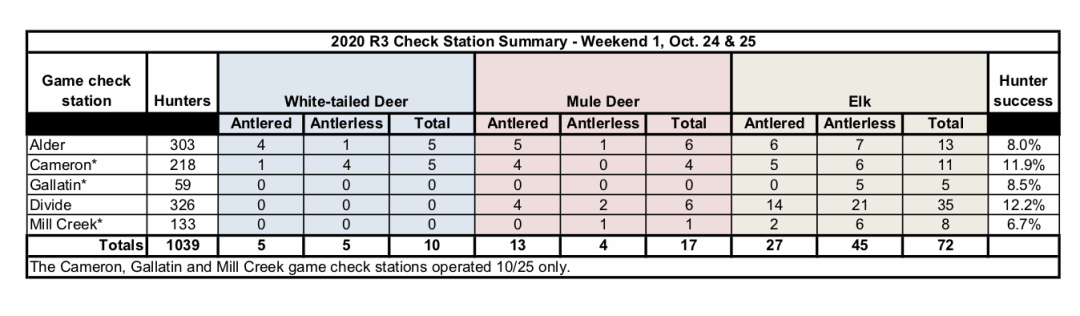
Wildlife biologists with Montana Fish, Wildlife & Parks operated five check stations over the weekend, observing a total of 1,039 hunters. Biologists use check stations to collect data on hunter participation and success, as well as the species, sex and age class of the animals harvested. This supplements data collected through hunter harvest phone surveys.

Three of the check stations — Cameron, Gallatin and Mill Creek — only operated on Oct. 25. The Alder and Divide check stations operated on both Oct. 24 and 25. Hunter success was below average at the Alder check station, about average at the Cameron check station, and above average at the Gallatin, Divide and Mill Creek check stations.

In total, biologists checked 10 white-tailed deer, 17 mule deer and 72 elk over the weekend.

These figures do not account for different hunting season regulations over the years, which have varied from liberal to restrictive for elk and mule deer, depending on population status.

Add a Comment »

Thursday, Oct. 22nd, 2020

5 Reasons Why Fresh Dog Food is So Good for Your Dog

Fresh dog food is the new rage among pet parents. A few years ago, it was difficult to find fresh dog food unless you cooked it at home or happened to have a kitchen nearby that would do it for you. However, in the past couple of years, many different fresh pet food companies have been founded. Many of these deliver fresh dog food right to your front door. There are actually quite a few benefits to feeding your dog a fresh dog food, as opposed to canned or dry dog food. Fresh dog food is almost always more expensive. However, you may find the price worth it when it comes to your pooch’s health!  

Healthier Ingredients

Fresh dog food almost always has fresher, better ingredients than other commercial dog foods. This is partially because fresh dog food can’t hide unsightly ingredients deep in the ingredient list. You can see everything you’re feeding your dog when you put it in their bowl! However, dry and canned food has been processed to the point that you really can’t tell what’s in it without looking at the ingredient list. This isn’t even an accurate detailing of everything in the dog food, though. According to one study done by Chapman University, many dog foods do not have accurate ingredient lists. In some cases, the listed meat couldn’t even be detected. 

Safer For Dogs

As you might imagine, not having an accurate ingredient list can be potentially dangerous. Some dogs have allergies, which can make exposure to particular ingredients troublesome. Other dogs need a special diet to control health problems. When you can’t even be sure what is in your pet’s commercial dog food, this can be a problem! Furthermore, a quick glance at any dog food recall list will make it very clear that fresh dog foods hardly ever get recalled. On the other hand, though, canned and dry foods get recalled for all sorts of reasons all the time. 

Convenience 

In many cases, fresh dog food is much more convenient than other commercial dog food options. Most fresh dog food companies will deliver their food right to your front door. This means you don’t have to make a shopping trip or haul a bag of dog food through the store. Plus, you’ll never run out! At the same time, many fresh dog foods are also pre-portioned for your canine. This feature means that you don’t have to worry about scooping or measuring.  Two of the most popular brands for fresh dog food include Nom Nom Now and Farmer’s Dog (see how they compare). With both brands, all the work is done for you. You just need to pour it into a bowl!

Personalizable

Many fresh dog foods formulate their food depending on your dog’s needs. When you sign up for a new fresh dog food, you will often be asked all sorts of questions about your pet’s health and activity level. Overweight dogs will automatically be given a food that is formulated to help them lose weight, while active dogs will be provided a food that is designed to keep their muscles in top-top shape. This personalization is simply not possible with most commercial dog foods. Because of this, you’ll need to deal with all the measurements and personalizations by yourself or with a vet. 

Fewer Possible Allergens

Fresh dog foods usually have very short ingredient lists. Many are only made with a meat and a few veggies. This is in stark contrast to the mile-long lists that are common on commercial dog foods. This factor means that your dog is less likely to be allergic to any of the ingredients in the dog food - simply because there are fewer ingredients in general! Plus, if your dog does become allergic to something in their food, it is much easier to figure out what it is!  So what are you waiting for?  Add Fresh Dog Food to your resolutions for next year!

Add a Comment »

Bozeman Ranks #7 on the 2020 Arts Vibrancy Index

Bozeman has been named the seventh most arts-vibrant medium-size community across the nation in 2020, returning to the list from 2017. 

The sixth annual Arts Vibrancy Index Report, compiled by SMU DataArts, a national center for arts research at Southern Methodist University, ranks more than 900 communities across the country examining the level of supply, demand, and government support for the arts in each city. According to the report, Bozeman ranks 9th in the country on independent artists and 11th on arts, culture, and entertainment firms per capita, driving it to the 13th spot overall on Arts Providers for medium-size communities with populations between 100,000 and 1,000,000. 

The SMU DataArts press release states, while the report is based on 2019 data and therefore does not reflect the impact of the coronavirus pandemic, its findings help illustrate the critical role of the arts, both socially and economically, in cities and towns around the nation. At this historic moment, the report also serves as a pre-pandemic benchmark of where the most arts-vibrant communities are located. 

Bozeman Symphony Executive Director Emily Paris-Martin has been with the organization for more than 17 years and has experienced first-hand the impact arts have on the community. “As a performing musician and arts administrator, I have always seen strong support for the arts in Bozeman. It is exciting to see our community recognized on a national level. With the growth that Bozeman is experiencing, the study solidifies the demand for arts and culture in our community.”

In the report, the Bozeman Symphony was listed as a local landmark arts organization, along with the Arts Council of Big Sky, Intermountain Opera Company, Equinox Theatre Company, Montana Ballet Company, and Emerson Center for the Arts & Culture. Bozeman was also recognized for its many unique museums, The Bozeman Public Library, and Montana State University’s diverse arts department. 

“It is an honor to be represented along with many of Bozeman’s beloved arts organizations and artists who add to the dynamic of a thriving arts scene in our community,” said Emily. “The study recognizes the vibrancy we’ve all come to love as the arts inspire and inform our own lives. It is a wonderful reminder during a challenging time.” 

From the onset of COVID-19, the Bozeman Symphony, like many arts organizations across the nation, has learned to adapt and come up with new innovative ways to connect to the community. Recently, the Bozeman Symphony presented its first-ever Ranch Around concert series hosted by The 1915 Barn and The Big Yellow Barn. These unique open-air concerts featured Music Director Norman Huynh along with musicians from the Bozeman Symphony and guest violinist William Hagen. This was Norman’s first conducting and programming debut as the new Music Director for two sold-out performances.  

The Symphony wishes to thank the community at large for supporting the arts, and a special thanks to David Ross and Risi for their season sponsorship and the season subscribers, donors, and patrons who have provided support through these extraordinary times. The Bozeman Symphony is fully committed to serving its role as a leading arts institution in the community and believes music will move us forward. To read the entire 2020 Arts Vibrancy Index Report, please visit bozemansymphony.org

Add a Comment »

Wednesday, Oct. 21st, 2020

Hunter check stations, CWD sampling stations ready for general season


Big game hunter check stations will be in operation across Montana beginning this weekend and continue through the general rifle season with a few changes in protocol related to COVID -19 safety. 

General big game season runs from Oct. 24 through Nov. 29.  At check stations public safety as it relates to the spread of COVID-19 will be important. FWP staff will be working to reduce crowding at the stations this season and for hunters the check station process will be streamlined as much as possible.

However, each check station may handle this process a bit differently, depending on staff, check station logistics and traffic flow. Please follow all directions and signs from FWP staff as they work diligently to check game, answer questions and get you on your way. If social distancing is difficult, please be ready to wear a mask.

Additionally, in the northwest, eastern and southwest parts of Montana, FWP will be operating CWD sampling stations where staff priority will be collecting samples rather than the traditional check station process. Again, please follow site-specific directions and signs from FWP staff. These CWD sampling locations are as follows:

  • Ennis Lions Club Park
    • Saturday and Sunday, 10 a.m. to dusk
    • Monday and Tuesday, 8 a.m. to 12 p.m.
  • Dillon – 730 N. Montana St.
    • Saturday and Sunday, 10 a.m. to dusk
    • Monday and Tuesday, 8 a.m. to 12 p.m.

FWP is also ready to help hunters sample their deer, elk or moose for CWD at our offices:

  • Region 3 Headquarters – 1400 S. 19th Ave., Bozeman
    • Monday through Friday, 8 a.m. to 5 p.m.
  • Helena Area Resource Office – 930 Custer Ave. W.
    • Monday through Friday, 8 a.m. to 5 p.m.
  • Butte Area Resource Office – 1820 Meadowlark Lane​
    • Monday, 12 p.m. to 5 p.m.
    • Tuesday and Friday, 9 a.m. to 12:30 p.m.

For more information on CWD, please look online at fwp.mt.gov/cwd.
 

Add a Comment »

Montana State alum teaching in rural one-room school named Montana Teacher of the Year


Kristi Borge, a Montana State University alumna who now teaches kindergarten through eighth grade in a one-room schoolhouse in the small rural community of Polaris, has been named Montana Teacher of the Year.

Borge said she was humbled by the award, given by the office of the Montana Superintendent of Public Instruction, and called it a tribute to the “incredible mentor teachers” she has had.

“Every action I do is a result of the leadership of others who have really shown me the essence of teaching,” she said. “I feel incredibly proud and honored. However, I think that there are so many teachers who have influenced me who are equally deserving of this recognition. While the (Montana Teacher of the Year) is awarded to an individual, I think this year it celebrates the hard work of the rural, multi-grade teachers who share similar responsibilities (to) my own.”

Borge currently teaches 11 students, including students in first, third, fourth, fifth and seventh grades. She said she enjoys teaching in a small school and loves Polaris, which is located about 35 miles northwest of Dillon and has only about 100 residents.

“I get to know the families so closely, which allows me to illustrate relevant connections between student lives and classroom content,” Borge said.

Borge began teaching in Polaris in the fall of 2015 after four years teaching middle school social studies and language arts at Monforton School in Four Corners. Earlier that year, she and her husband, Erik, were considering moving to the outskirts of Bozeman when they learned Maverick Mountain Ski Area near Polaris was for sale.

“We are both passionate about skiing – we actually met coaching ski racing in Big Sky – and Erik convinced me that we could sell our house and have enough for a down payment on the ski area,” Borge said. “I knew that in order to feel fulfilled and be happy, I would need to be able to keep teaching if we moved.”

Coincidentally, Polaris needed a multi-grade teacher.

“I immediately felt comforted by the wide-open valley nestled into the Pioneer Mountains,” she said. “The school is really cozy and picturesque and is just so inviting.”

Borge noted that the educational setting is particularly appealing because it affords her a great deal of creativity and autonomy.

“I can integrate curriculum – or connect subject area topics – easily because I am so in tune with what each student is learning in every subject,” she said. “If we are really caught up in a specific lesson, I can adjust the daily schedule as needed to allow for those teachable moments.”

Borge said some of her current challenges include having no preparatory periods, long hours and a lot of lesson planning each week to address unique grade-level standards.

“This year I have five grade levels, so you can imagine how complex that can look when planning five math lessons, five reading lessons and so on,” Borge said. “I spend long hours at the school most days and have a lot of extra duties that one may not think of, such as shoveling the sidewalk, ordering supplies, coordinating school maintenance projects, managing all of the technology devices and writing administrative reports.”

Borge was born and raised in Big Sky. She attended Ophir Elementary School and high school in Bozeman. She enrolled at MSU after receiving a Montana University System scholarship, which covered her tuition. She also competed as a member of the university’s alpine ski team.

She credits her own early educational experiences for choosing to study education at MSU.

“I had such a positive elementary school experience and have always been drawn to the classroom,” Borge said. “My own fifth through eighth grade teacher, Alec Nisbet, created a remarkable sense of community and belonging for me and my classmates that really made me love school and all it entailed.”

At MSU, a number of professors in the Department of Education were especially impactful. Among them were Ann Ellsworth, who had high expectations and reminded Borge that teachers should approach reading and writing instruction with a deliberate, research-based approach; Lynn Kelting-Gibson, who related theoretical methods to real-world applications; and Christine Rogers Stanton, who Borge said pushed her to think critically and was an important mentor when working on her master’s degree.

She also valued the field experiences that came with her major in education, said Borge, who completed her student teaching at Anderson School outside of Bozeman.

“Getting to spend time in the classroom is really what gave me confidence that I was on the right career path,” she said. At Anderson, her mentor teachers, Stephanie Lourie and Sandy Wilson, “opened my eyes to the art and science of teaching” and taught her to incorporate humor and relationship building to make deeper connections with students. 

Borge received a bachelor’s degree in elementary education K-8 with a reading K-12 minor in 2010 and a master’s degree in curriculum and instruction with an educational researcher option in 2016, both from MSU’s College of Education, Health and Human Development.

In a press release from the Office of the Montana Superintendent of Public Instruction announcing Borge’s award, Beaverhead County Superintendent of Schools Linda Marsh said she was honored to nominate Borge for the honor.

“I have worked with Kristi for several years and have seen firsthand her ability to create an environment with a positive culture for learning in which all students are free to make choices, ask and find answers to their questions, and develop a love of learning,” Marsh said. “During the school closures this spring due to COVID-19, she displayed great flexibility incorporating technology to ensure her students didn’t miss a beat. She even kept the year-end awards tradition alive virtually and provided summer school instruction to her students.”

For her part, Borge said she loves seeing both social and academic growth of her students over time.

“I have had students for several years who I taught to read and count in kindergarten and are now writing essays and multiplying decimals as fifth graders,” she said.

Borge hopes to continue to learn and implement research-based practices that directly impact student success both academically and behaviorally.

“As a professional, I hope to continue to learn about the instructional planning practices of multi-grade teachers and establish frameworks and systems to help both myself and other multi-grade teachers to manage our workload and be more efficient, effective educators,” she said. And, “with the COVID-19 pandemic at the forefront of our lives, I am focused on building social-emotional skills with my students so that they can have a strong foundation of stress management and tools for building growth mindsets during challenging times.” 

Borge will represent Montana in the 2021 National Teacher of the Year Program. More information about the Montana Teacher of the Year program is available at the Office of Public Instruction’s website at http://opi.mt.gov/Educators/Teaching-Learning/Montana-Teacher-of-the-Year.

Add a Comment »

News Comments