Thursday, Nov. 7th, 2024

988+1 veteran coins designed at Montana State to prevent suicide

BOZEMAN — Military challenge coins serve as an easy conversation starter. Some are tokens of time spent overseas, while others are a remembrance of rank or an award.

Now, a new set of challenge coins minted by the state of Montana — and designed by a Montana State University student — are intended to aid in preventing suicide among veterans.

Dubbed 988+1 suicide prevention coins, the coins will be distributed to veterans across the state in an attempt to lower the suicide rate among that population. This coin is meant to be a conversation starter for when a veteran meets a fellow service member in a time of need.

If a veteran is in distress, a fellow soldier can show him or her the coin, which includes the state’s suicide help line number: 988. Upon dialing the number, callers can press 1 to connect with someone who is familiar with the challenges veterans face.

“We think of these challenge coins as a reminder that you are not alone and that there is someone there for you,” said Todd Bucher, who served in the Marines and is the director of MSU Veteran Services. “There will always be somebody out there that will be right by your side no matter what you’re going through.”

Montana has for years been among the states with the highest suicide rates in its veteran community, according to the U.S. Department of Veterans Affairs. The reasons for this are myriad, according to the Montana Department of Health and Human Services, including environmental factors that increase the risk of depression, high firearm ownership rates, social isolation, and a lack of adequate mental health and crisis services.
The coins came about as a collaboration between the MSU veteran community and a graphic design class in the School of Art in MSU’s College of Arts and Architecture led by instructor Bruce Barnhart.

In the spring of 2023, students in Barnhart’s class met with veterans to discuss ideas for coin designs related to the issues they face. Barnhart’s students submitted multiple coin designs, and 10 of those ideas were minted in limited numbers. This year, DPHHS selected one design, by former MSU student Jo Brown, to be initially minted into 100 coins.

Brown’s design features two clasped hands, which, she said, she included as a symbol of confidence and strength. Above the handshake is the phrase, “I will never leave a fellow veteran.” The reverse side of the coin features an American flag as well as “988+1 Montana Veteran Lifeline.”

“It’s a symbol of one veteran pulling another out from the mud, metaphorically,” said Brown, who is now working in California.

During her research, Brown said she learned of the soldier’s mentality to put the unit or mission before oneself, which sometimes leads to soldiers losing the ability to ask for help.

“It was really important for me that the motif of the coin was the moment of help from when that coin is given from one person to the next,” Brown said.
The newly minted coins will be distributed at various veterans’ events across the state. Veterans will be given two coins each – one to keep and one to hand to a fellow veteran in a time of need.

“If it makes a connection with one person, that makes it all worth it for me,” Barnhart said.

At MSU, Counseling and Psychological Services offers a variety of suicide prevention programming on campus, including in-person and online training and counseling services, as well as medical services at Student Health Services.

Often, preventing a suicide starts with identifying signs of distress, starting a conversation and directing an individual to available resources, according to CPS, much like the 988+1 coins are designed to do.

Add a Comment »

Saturday, Nov. 2nd, 2024

Collaboration between Montana State and Smithsonian elevates prairie and grassland research

Montana State University PhD student and Smithsonian Research Fellow, Claire Bresnan, launches a drone as part of a collaboration with the Smithsonian National Zoo and Conservation Biology Institute to study the ecology of rangelands and praries. Photo courtesy of the Smithsonian National Zoo and Conservation Biology Institute.

BOZEMAN
– While it’s known for its museums in Washington, D.C., the Smithsonian Institution also comprises dozens of research and education bodies around the world. And through a unique collaboration with one of those teams, faculty and students at Montana State University are amplifying ecological research in the northern Great Plains.

The Smithsonian’s Great Plains Science Program was established in 2018 and since then, scientists in the GPSP have connected and worked with researchers at MSU, bringing together a broad range of academic focus areas to study a bioregion with numerous ecosystems and astonishing diversity that is inadequately understood.

“MSU’s partnership with the Smithsonian provides faculty with an opportunity to make a strong contribution to our understanding of the ecology of the great plains—a service to both the state and to this valuable national landscape resource,” said Alison Harmon, MSU’s vice president for research and economic development. “Smithsonian scientists have proven to be excellent research partners while also contributing to graduate education in our ecology and LRES departments. The Smithsonian’s mission is well aligned with our land-grant mission at MSU.”

Andrew Felton, an assistant professor in MSU’s Department of Land Resources and Environmental Sciences in the College of Agriculture, is one of several MSU researchers involved in the GPSP’s work to illuminate a more complete picture of how the region’s animals, plants, climate and ecological processes overlap and influence each other. He studies how climate and moisture influence the ability of plants to acquire and store carbon, assessing the larger implications of varying heat and water stresses on ecosystem health.

“The northern Great Plains are huge, and pretty understudied,” said Felton. “What’s been cool about this project is that we can bring in a lot of people who have different types of expertise and different perspectives. There’s an opportunity to advance basic science on this topic.”

The cross-institution collaboration is led by Hila Shamon and Ellen Welti, two Smithsonian scientists and MSU affiliate faculty. Shamon studies how human activities impact wildlife populations and leads several reintroduction efforts, while Welti studies how insects provide critical services to their habitats, including pollination, nutrient cycling and being a food source for larger species.

Shamon said the ongoing partnership has led to a greater capacity to carry out both MSU’s and the Smithsonian’s missions of scientific understanding and education. Currently, the Smithsonian and MSU are collaboratively supporting six graduate students in both the Department of Ecology and the Department of Land Resources and Environmental Sciences.

“We have two parts to our mission: One part is to generate knowledge, and the second part is education of the next generation of conservationists, scientists and practitioners,” Shamon said.

“All the students that we have are exceptional, and the work that they're doing is important,” she said. “We have researchers who have very different expertise, from genomics to movement ecology, remote sensing and much more. We try to combine these superpowers to answer big questions.”

Claire Bresnan is one of the graduate students involved in the interdisciplinary research. A doctoral student in the College of Letters and Science’s Department of Ecology, Bresnan was inspired to pursue graduate school after meeting Shamon while participating in an internship with the Smithsonian. Now in the fourth year of her doctoral studies, her project involves collecting data about the movement patterns of bison to understand their social structures and how they impact their surroundings. By working with both the Smithsonian and MSU, graduate students are exposed to a larger research team with which to collaborate and network, opening additional research areas and opportunities, Welti said.

One of Bresnan’s advisers, MSU ecology professor Scott Creel, said the ongoing teamwork with the Smithsonian has allowed for broader avenues of research that involve many scientists and create knowledge through both discovery and application.
“The common denominator in all these collaborations is that we’re out there in the prairie and looking at the ways we’ve altered this place and the way it works,” he said.
Also part of the Smithsonian work are professor Laura Burkle and assistant professor Justine Becker from MSU’s ecology department. They are studying pollinators and small mammals, respectively, fitting two more pieces into the larger puzzle.

Burkle said that grasslands are unique places to study pollinators, which face several threats. She studies how the ripple effects of pollinators extend to other grassland species, and is exploring how other organisms, such as grasshoppers, beetles and birds, are impacted by grassland management and ongoing change. Burkle and Welti advise graduate student Calla Sopko, whose project examines large-scale insecticide use in rangeland systems for grasshopper control.

“There’s a lot of unknowns about what's going on with pollinators in that part of the world,” Burkle said. “Often when we do ecology, we can only manipulate a small plot of a few meters. Trying to scale up the implications of that is difficult, so having the ability to view and study big-scale manipulations is interesting.”

Becker advises two doctoral students with the Smithsonian team studying black-footed ferrets and prairie dogs, both threatened species, and their movements through underground burrows. Those tunnels, and prairie dog grazing, provide important services for the ecosystem.

Because GPS technology doesn’t work well underground, the research team is using accelerometers to collect previously unavailable data on where prairie dogs, a keystone species for the ecosystem, travel in their burrows.

“At a basic level, we’re trying to understand how animals are making movement decisions,” said Becker. “Understanding those connections helps us understand how they are impacting the distribution and abundance of each species and what happens when species are added to or removed from those systems. That is applicable in the context of this ongoing loss of species from ecosystems and, on a more hopeful note, the reintroduction and rewilding efforts that are happening in a lot of places.”

The many pieces of the Smithsonian-connected research form a larger exploration that can stretch much further than any one researcher could alone, Becker said. And more connections are being created all the time, including work by Shamon, Bresnan and others with Aaniiih Nakoda College on the Fort Belknap Indian Reservation. They have co-developed seminars and field classes with the college faculty, creating unique educational opportunities for students to participate in research that is ongoing on the reservation and surrounding lands. For Bresnan, that experience has been a highlight of her doctoral work at MSU.

“Being able to observe the Smithsonian co-developing research with tribal communities and seeing how projects are built, it's been very valuable as I think about what projects I want to do and what my career will look like," she said.


Add a Comment »

CWD detected for first time in elk in Ruby Mountains

TWIN BRIDGES – Chronic wasting disease was recently detected in an elk on the north end of the Ruby Mountains in Hunting District 322.

CWD is a contagious neurological disease that infects mule deer, white-tailed deer, elk and moose. It's always fatal, and there is no known cure. It was first detected in Montana’s wild herds in 2017.

A hunter harvested the CWD-positive elk adjacent to the lower Ruby Valley, where CWD has been observed at high prevalence locally in both white-tailed and mule deer. While this is the first time CWD has been detected in elk in the Ruby Mountains, it was expected to eventually occur given the presence of the disease among deer populations that use the same habitats.

Sampling from hunter-harvested animals indicates CWD prevalence likely remains low in elk in the area.

It’s unlikely this detection will result in changes to elk hunting regulations in this area, which already has liberal harvest regulations for elk. Hunters can help wildlife managers monitor CWD by continuing to submit samples from harvested animals.

Montana Fish, Wildlife & Parks has a variety of resources to help hunters get their harvested animals tested for CWD, including tutorials for taking and submitting samples themselves, as well as sampling stations where FWP staff are available to help. To view these resources, click here.

Hunting is the primary tool for monitoring and managing the spread of CWD. Concerns over CWD shouldn’t stop hunters from enjoying hunting season. Hunters are critical to conservation efforts across the state, including CWD management.

Hunters can help slow the spread of CWD by disposing of animal carcasses properly after harvesting the meat. This includes leaving carcass remains at the kill site or bagging the carcass and disposing of it in a Class II landfill.

There is no known transmission of CWD to humans. However, the Centers for Disease Control and Prevention recommends that hunters harvesting deer, elk or moose from an area where CWD is known to exist have their animal tested prior to consuming the meat, and do not consume the meat if the animal tests positive.

To learn more, visit fwp.mt.gov/CWD.

Add a Comment »

The Rise of EdTech: How Technology is Transforming Student Learning


In the dynamic world of education, remarkable transformations keep taking place on a constant basis. Now, students can easily find professional academic assistance: they just need to say, “Please write my paper online” to experts and get immediate results. Recently, there has also been the rise of Educational Technology (EdTech). It is revolutionizing the way students learn, interact, and engage with their academic pursuits. From interactive whiteboards to virtual reality simulations, EdTech is reshaping education, empowering educators and learners alike.

Introduction to EdTech
EdTech refers to the integration of digital tools, platforms, and innovative approaches aimed at enhancing and optimizing the learning experience. It encompasses a wide range of technologies, including, but not limited to, mobile devices, learning management systems, educational software, and online learning environments. The primary goal of EdTech is to leverage technology to create a more engaging, personalized, and effective learning process for students.

The Benefits of EdTech in Student Learning
The integration of EdTech in the classroom has yielded numerous benefits for students:

Increased Engagement: EdTech tools, such as interactive whiteboards, educational games, and multimedia content, have the power to captivate students, fostering greater engagement and enthusiasm for learning.

Personalized Learning
: EdTech platforms can analyze student performance data and tailor learning experiences to individual needs, allowing for a more personalized approach to education.

Improved Accessibility: EdTech solutions, such as text-to-speech and assistive technologies, can enhance accessibility, ensuring that students with diverse learning needs can actively participate and succeed in their academic pursuits.

Enhanced Collaboration: EdTech tools, like cloud-based document sharing and video conferencing, facilitate seamless collaboration among students, enabling them to work together, share ideas, and learn from one another.

Real-Time Feedback: EdTech platforms can provide instant feedback to students, allowing them to track their progress, identify areas for improvement, and receive timely guidance to support their learning.

EdTech Tools and Technologies Transforming Education
The field of EdTech is brimming with a wide array of innovative tools and technologies that are revolutionizing the way students learn:

Learning Management Systems (LMS): LMS platforms, such as Blackboard, Canvas, and Google Classroom, serve as centralized hubs for delivering course content, managing assignments, and fostering online collaboration.

Adaptive Learning Platforms: These AI-powered platforms analyze student performance and dynamically adjust the learning content and pace to cater to individual learning styles and needs.

Virtual and Augmented Reality: Immersive technologies, like virtual reality (VR) and augmented reality (AR), are being leveraged to create engaging, hands-on learning experiences in subjects such as science, history, and architecture.

Educational Apps and Games: A wide array of educational apps and games are designed to make learning fun, interactive, and more accessible for students of all ages.

Coding and Robotics: The integration of coding and robotics in the classroom helps students develop critical thinking, problem-solving, and STEM (Science, Technology, Engineering, and Mathematics) skills.

Examples of Successful EdTech Implementation in Schools
Across the globe, schools and educational institutions are embracing the power of EdTech to transform students’ learning experience.

Flipped Classroom Model: In this approach, students access course content, such as video lectures, at home, while class time is dedicated to interactive discussions, problem-solving, and hands-on activities.

Blended Learning: This model combines traditional face-to-face instruction with online learning components, allowing for a more flexible approach to education.
Project-Based Learning: EdTech tools, such as collaboration platforms and multimedia creation software, are enabling students to engage in authentic, real-world projects that foster their critical thinking and problem-solving skills.

Virtual Field Trips: Through virtual reality and video conferencing, students can now explore distant locations, historical sites, and scientific facilities without leaving the classroom.

Gamification in Education: Integrating educational games and game-based learning elements into the curriculum can enhance student motivation, engagement, and retention of knowledge.

Challenges and Concerns Surrounding EdTech
Despite the numerous benefits of EdTech, there are also challenges and concerns that must be addressed.

Equity and Access: Ensuring equal access to EdTech resources and addressing the digital divide among students from different socioeconomic backgrounds is a critical concern.

Privacy and Data Security: The integration of EdTech platforms raises important questions about student data privacy, security, and the ethical use of personal information.

Technological Limitations: Technical issues, such as unreliable Internet connectivity, outdated hardware, and compatibility problems, can hinder the effective implementation of EdTech in the classroom.

Teacher Training and Professional Development: Providing comprehensive training and support to educators to help them navigate EdTech is essential for its successful integration.

Balancing Technology and Traditional Teaching: Striking a balance between the use of technology and traditional teaching methods is crucial to ensure that the benefits of EdTech are fully realized without compromising the human element of education.

EdTech Resources and Platforms for Educators and Students
Educators and students alike have access to a vast array of EdTech resources and platforms to support their learning and teaching endeavors. Some notable examples include:

Online Learning Platforms: Coursera, edX, and Udemy offer a wide range of online courses, MOOCs, and educational content for both students and teachers.
Educational Apps and Software: Apps like Duolingo, Khan Academy, and Quizlet provide engaging, interactive learning experiences across various subjects.

Collaboration and Productivity Tools: Google Workspace for Education, Microsoft 365 for Education, and Zoom enable seamless collaboration, communication, and content creation in the digital classroom.

Professional Development Resources: Websites like Edutopia, EdSurge, and ISTE provide valuable insights, best practices, and training opportunities for educators to enhance their EdTech skills.

Educational Technology Conferences: Events like ISTE, BETT, and the ASU+GSV Summit bring together EdTech innovators, educators, and industry leaders to share insights and explore the future of technology in education.

The rise of EdTech has ushered in a new era of educational transformation, empowering students and educators both. By seamlessly integrating technology into the learning process, schools and educational institutions are fostering more engaging, personalized, and accessible learning experiences. As EdTech continues to evolve, it is clear that the future of education lies in embracing the transformative power of technology to unlock the full potential of student learning.

Add a Comment »

What to Do When the Roof Leaks


Leaky roofs might be the most common destructive inconvenience. Everyone has dealt with at least one in their lives and we all hate them. The temporary fixes are simple, sure, but finding the root cause can be tricky and interesting as you are proven incorrect over and over again.

Before you start exploring popular metal building roof styles to replace your roof altogether, see if any of the following tips can end your watery woes.

Take Immediate Action
There are ways to discover a leak before the damage seeps through the ceiling as drips, but none of that information helps in the heat of the moment. If your ceiling starts dripping then you need to take immediate action.

Hopefully, your immediate thought was to run and grab a bucket and a few towels. Make sure to bring an extra towel to set inside the bucket because ethos will prevent the water dripping into it from splashing out of it. The rest will help you clean up the mess or even move furniture out of the way.

What you do from here will vary. The first thing you need to consider is covering the offending part of the roof with a tarp. If this is not possible for whatever reason then take a bucket or plastic storage bin with you into the attic.

If you can find the leak here, palace the container beneath it. It will do the same thing as the one you placed to catch the ceiling drips but higher, saving your furniture from further harm.

Don’t forget to document any damage after the appropriate mitigation efforts have been made; you may be able to file a claim with your insurance and be reimbursed for the damage you suffered.

Pay Attention for the Signs
Discovering that you may have a leaky roof is easy to do once water starts pouring through the ceiling, but a lot had to happen before that.

Luckily, every single step of that process leaves visible signs that something is wrong. Smelling a musty smell is the first sign and one of the most alarming. This not only means that there is a problem but that it’s already creating another.

As you explore the attic, look above you for discoloration and watch beneath you for signs of saturated insulation. Stains or discolorations of the roof’s underside may indicate where water is leaking through while saturated insulation not only tells you where the water is landing but also that it's been leaking for a while and is about to start leaking through the ceiling.

If you see any of these or other signs of a roof leak, you need to act quickly to prevent further damage and to remedy that which has already been ruined.

Find the Source
One easy way to find the roof leak is to climb into the attic. As mentioned before, there may be multiple signs in there for where the leak started and where that water is going. You may be able to perform temporary repairs here to buy yourself some time while you figure out what happened on the outside to cause this.

Searching for the leak on the roof itself is a bit more tricky as they are slanted. This allows water to slide right off but can also make finding the leak source tricky. Despite this, sometimes the signs are easy to spot. Damaged and warped shingles, holes, clearly damaged roof fixtures and more can all be the cause of a leak.

If you struggle to find the source then you may need to call for help and hoist a hose up the ladder. Spraying water on the roof with the hose can help you identify exactly where the leak started because the helper who’s inside the attic will alert you to when drops start to form.

Prepare for Any Needed Repairs
When the sun shines bright and the roof is dry, it’s time to for you to actually repair the roof and stop the leak. Occasionally, the remedy is something simple you can do such as replacing dried-out caulking or just adding a few washers—but this is unfortunately not always the case.

An underlying problem could cause a section of shingles to absorb rain water and warp, a tree could have caused some serious damage or any other number of things could have gone wrong.

Even if you consider yourself to be pretty handy, these situations call for a professional. Contact your local roofer if the problem is too big for you to handle or you can’t find the leak at all because a failure at the top of your structure will cause problems all the way down, and the entire reason you're here is to fix one of these problems, not to create more.

Add a Comment »

Moose Creek Homicide Update


The Gallatin County Sheriff’s Office has identified a suspect in the Moose Creek homicide. The suspect is currently in custody on unrelated charges. The suspect is cooperating with our detectives and has led us to the evidence we have identified in prior press releases.

The investigation into this homicide continues. It is believed the suspect acted alone and there is no longer a threat to the community. Further details and charges are forthcoming, but it is important for this community to know they are safe to resume their outdoor activities. The Sheriff’s Office will have no further comment in regard to this investigation until charges are filed.

I want to thank the Gallatin County Sheriff’s Office Detectives for their unrelenting pursuit of justice on this case. They have worked day and night for nearly three weeks with limited sleep, limited time with their families and limited time to themselves. They have prioritized the safety of this community and the need to locate Dustin Kjersem’s killer above all else. It is this type of dedication that makes the Gallatin County Sheriff’s Office and all law enforcement officers special. This community should be proud of the men and women who have chosen a life of service to keep you, your families, and your friends safe.

I would also like to thank the multiple other agencies who have dedicated their time and energy into this case. The Montana Department of Criminal Investigation (DCI), the Montana State Crime lab, the Montana Department of Corrections, Probation and Parole, the Medical Examiner’s office, the Montana Highway Patrol, the Missouri River Drug Task Force, Jefferson County Sheriff’s Office, Butte-Silver Bow Law Enforcement, Montana Fish, Wildlife and Parks, the U.S. Forest Service and Gallatin County Search and Rescue.

Our thoughts and prayer continue for the family of Dustin Kjersem. We hope, by some small measure, our efforts can bring them a bit of peace during this horrific time. Our entire community mourns with you.

– Sheriff Dan Springer

Add a Comment »

Education and Community Engagement Coordinator Cierra Wallace Honored with 20 Under 40 Award


BOZEMAN
– Bozeman Symphony Education and Community Engagement Coordinator Cierra Wallace has been recognized among the Gallatin Valley’s top young professionals by receiving the Bozeman Daily Chronicle’s prestigious 20 Under 40 Award. She was honored at a luncheon on October 21 in Bozeman, where Bozeman Symphony Music Director Norman Huynh served as the keynote speaker.


The 20 Under 40 Award celebrates individuals who demonstrate exceptional professional success and make a meaningful impact in their community. Wallace was recognized for her dedication to enhancing the lives of people throughout the Greater Yellowstone region through music, education, and outreach.
In her role, Wallace oversees a diverse range of educational programs, including Symphony Storytime, KinderKonzerts, the Fourth Grade Concert, Masterclasses, and Side-by-Side performances. She also coordinates the Symphony’s community initiatives such as Far Afield concerts, the annual Family Concert, concerts in partnership with Befrienders, and the Memory Care and Joy Programs, which bring music to those in need of comfort and enrichment.

This marks the fourth consecutive year that a member of the Bozeman Symphony has received this recognition. Past honorees include Music Director Norman Huynh and Interim Symphonic Choir Director Maren Marchesini in 2023, former Executive Director Emily Paris-Martin in 2022, and Concertmaster Carrie Krause in 2021.

For more information about Bozeman Symphony’s educational and community programs, please visit www.bozemansymphony.org.

Add a Comment »

Montana State’s WTI awarded $6.4 million by federal Transportation Department for workforce development


BOZEMAN
— The U.S. Department of Transportation has awarded the Western Transportation Institute at Montana State University a grant to assist workforce development in the railway sector across the state of Montana.

The $6.4 million grant is part of an infrastructure initiative funded by the DOT’s Federal Railroad Administration and announced on Oct. 29. The award is part of a $2.4 billion rail-improvement law that funds 122 projects in 41 states and Washington, D.C.

The infrastructure initiative, which is administered through FRA’s Consolidated Rail Infrastructure and Safety Improvements Program, includes rail safety and service improvements such as upgrading track, replacing or rehabilitating aging bridges, expanding rail connections at ports, and adding modern locomotives to fleets. According to the Transportation Department’s announcement, the grants mark “the most significant investment in American rail in more than 50 years.”


The grants also support developing the workforce to maintain and operate the nation’s rail networks through new apprenticeship programs, expanded training opportunities, establishing partnerships with universities and advance research.

“The Western Transportation Institute is a national leader in transportation workforce development,” said Alison Harmon, MSU’s vice president for research and economic development. “This grant further solidifies WTI’s leadership position in rural and tribal-focused transportation development.”

According to the DOT, these projects will “make rail safer, more reliable and more resilient, getting goods and people where they need to be quickly with fewer disruptions, lower shipping costs and less pollution.”

The project in Montana is expected to include research and activities that build the rail workforce with a focus on increasing faculty, student and youth engagement with rail-related topics and skills, according to the DOT.

The goal is to improve coordination between industry, labor, economic development and education sectors. Other goals include helping faculty and teachers expand their understanding of rail topics; exposing more students to rail-focused topics earlier in their careers; and strengthening local talent pipelines.


MSU, California State University at Long Beach, the University of Memphis, and Big Sky Passenger Rail Authority will contribute the required 20 percent non-federal matching funds, increasing the total WTI funding to just over $8 million.

“We are very excited to have this opportunity to work with our core project partners at Big Sky Passenger Rail Authority, University of Memphis and California State University, Long Beach to develop nationally relevant workforce development strategies focused on meeting local economic development needs,” said Susan Gallagher, WTI’s education and workforce program manager.

Kelvin Wang is WTI’s executive director.

“WTI is fortunate to have nationally recognized staff, faculty and students,” Wang said. “Working with this talented team has been a rewarding experience, enabling us to continue serving the needs of Montana and the nation. We look forward to working with our partners on this exciting project.”

Add a Comment »

General season opens with mild weather, lower-than-average hunter success in southwestern Montana

Hunters should continue to practice bear safety

BOZEMAN – Montana’s general hunting season kicked off on Saturday with seasonably mild weather and mostly below-average hunter participation and success in several areas of southwestern Montana.

Wildlife biologists with Montana Fish, Wildlife & Parks use check stations to collect data on hunter participation and success, as well as the species, sex and age class of the animals harvested. This supplements data collected through hunter harvest phone surveys each year.

Opening weekend check station results

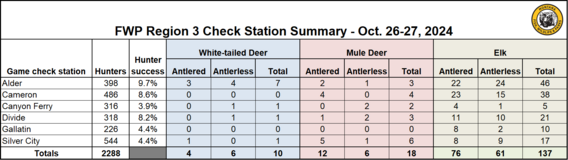
Over opening weekend on Oct. 26 and 27, biologists operated six check game check stations in the region: Alder, Canyon Ferry, Cameron, Divide, Gallatin and Silver City. They met with 2,288 hunters, who collectively harvested 137 elk, 18 mule deer and 10 white-tailed deer, among other species.

The Alder, Divide and Canyon Ferry check stations saw lower-than-average hunter numbers for opening weekend. Hunter numbers were about average at the Cameron and Gallatin check stations. Participation ranged from 544 hunters at the Silver City check station to 226 hunters at the Gallatin check station.

Hunter success was below average at the Alder, Canyon Ferry, Divide and Gallatin check stations, and within the long-term average at the Cameron check station. Hunter success ranged from 9.7 percent at the Alder check station to 3.9 percent at the Canyon Ferry check station.

Weather over the weekend was sunny and warm in most areas of the region, with snow only at the highest elevations.

Be bear aware

FWP reminds hunters that bears will remain active throughout the general season, and hunters should be prepared for bear encounters. Montana is bear country. Grizzly bear populations continue to become denser and more widespread in Montana, increasing the likelihood that residents and recreationists will encounter them in more places each year.

People who hunt in places that have or may have grizzly bears—which includes much of the western two-thirds of the state—should take special precautions:

  • Carry bear spray and practice to be prepared to use it immediately.
  • Look for bear sign and be cautious around creeks and areas with limited visibility.
  • Hunt with a group of people. Making localized noise can help alert bears to your presence.
  • Be aware that elk calls and cover scents can attract bears.
  • Bring the equipment and people needed to help field dress game and remove the meat from the kill site as soon as possible.
  • If you need to leave part of the meat in the field during retrieval, hang it at least 10 feet off the ground and at least 150 yards from the gut pile. Leave it where it can be observed from a distance of at least 200 yards.
  • Upon your return, make noise and observe the meat with binoculars. If it has been disturbed or if a bear is in the area, leave and call FWP.

For more information and resources on bear safety, visit fwp.mt.gov/bear-aware.

Add a Comment »

Accomplished engineer Jim Weatherly inducted into Montana Professional Engineers Hall of Fame


BOZEMAN
— Jim Weatherly, whose career includes leading an influential Montana-based engineering firm for nearly 30 years, will be inducted into the Montana Professional Engineers Hall of Fame on Nov. 6.

Montana State University’s Norm Asbjornson College of Engineering houses the hall of fame, which was founded in 2002 to recognize engineers who have made outstanding contributions to the profession and public welfare of Montana.

“There is no greater honor for a professional than to be recognized by their peers for contributing to the profession and for improving the lives of their fellow man,” Weatherly said. “As a young engineer, I was guided by so many of the previous inductees to the Montana Engineers Hall of Fame.”

Weatherly earned a Bachelor of Science in civil engineering from North Dakota State University in 1967. He served as a sergeant in the U.S. Army and was recognized with the Army Commendation Medal and Bronze Star for meritorious service in the Vietnam War.

Weatherly served as partner, shareholder and president of Sorenson and Company from 1975 to 1989, when the company changed its name to WGM Group. He would then serve as president of WGM until 2004, helping the company broaden its services to include land use and transportation planning. The company also became an adviser to the city of Missoula.

Weatherly was responsible for the engineering and services provided to the U.S. Army Corps of Engineers and the U.S. Forest Service. Related projects include work around the Dworshak Reservoir in Idaho, final construction stages of Libby Dam on the Kootenai River and design phases for nearly 3,000 miles of forest development roads that spanned multiple national forests in Montana.


Weatherly was a member of Montana Society of Engineers and recipient of its Young Engineer of the Year award. He also served as the organization’s president and national director. He was the Montana director of the National Society of Professional Engineers, a representative of the Montana Technical Council, president and national director of the Montana Consulting Engineers Council, and a member of the American Society of Civil Engineers.


His civic involvement includes serving as board member and president of the United Way of Missoula County. He also served on the boards of Missoula Bank of Montana, Norwest Bank and Wells Fargo Bank. He was an adviser for four new facilities at the University of Montana. He also served as director and founding member of Five Valleys Chapter of Safari Club International, and board president and executive director of Montana Wild Sheep Foundation, where he earned the Duncan Gilchrist award for outstanding service.


He also provided pro bono engineering services for the YMCA of Missoula, making contributions in the mid-1980s for the infrastructure relocation of the Washington-Grizzly Stadium on the University of Montana campus, as well as the design of UM’s football practice field, track and field facilities, and the university’s intramural and soccer fields.

Add a Comment »

News Comments