


Monday, Aug. 17th, 2026

Montana State researchers reconstruct environmental history of Yellowstone’s geyser basins

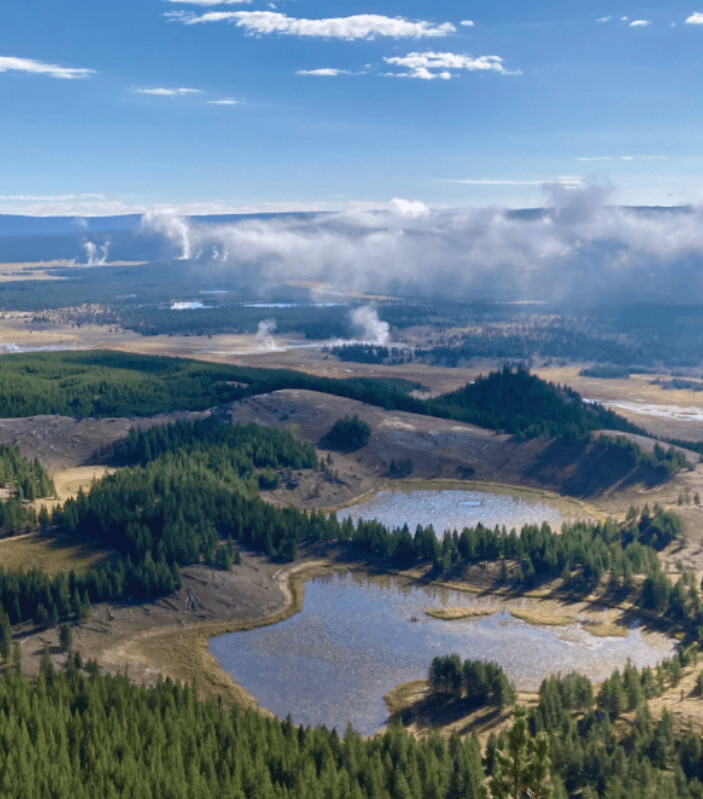
BOZEMAN – A study led by a Montana State University research professor reveals how climate and hydrothermal activity have shaped the vegetation, wildfire and aquatic ecosystem history of the Yellowstone Plateau over the past 15,000 years.

The results of the National Science Foundation-funded project were published this week in the journal Proceedings of the National Academy of Sciences.

Cathy Whitlock, MSU Regents Professor emerita of earth sciences in the College of Letters and Science and the first scientist to be elected to the National Academy of Sciences from a Montana university, has spent decades working in the Greater Yellowstone Ecosystem. Her interest in Yellowstone National Park’s Lower Geyser Basin was piqued in 2020 after she and co-author Chris Schiller took sediment cores from the bottom of one of the basin’s small lakes. They noticed that its contents differed from those in lakebeds in other parts of the park, suggesting that distinct geologic factors may have influenced the lake’s evolution. At about the same time, she read a paper speculating that a lack of water in the geyser system caused Old Faithful to stop erupting in the early 13th century for about 100 years.

As founder and past director of MSU’s 22-year-old Paleoecology Laboratory, which studies how past ecosystems responded to changing climates, Whitlock said the opportunity to learn more about Yellowstone’s geyser basins was irresistible. but also required the expertise of many scientific disciplines. 

“I thought, ‘Well, there have been long, dry periods in Yellowstone in the past, some of them lasting for several centuries. I wonder if we could document how periods of sustained drought affected ancient geyser activity,’” she said.

Collaborators on the project included MSU professor of earth sciences Dave McWethy, two MSU post-doctoral researchers, two MSU students, and scientists from the U.S. Geological Survey, Oregon State University, Manchester University and Colorado State University.

Throughout her career, Whitlock has reconstructed the histories of ecosystems from tiny clues deposited over time in the layers of lake sediments. By examining sediment cores, scientists can pinpoint the age of the layers through radiocarbon dating or from the buried evidence of known, natural events, such as past volcanic eruptions. Pollen assemblages tell scientists what type of vegetation was present at particular times. Layers with abundant charcoal identify past wildfire events. The concentration of arsenic and cesium and the composition of the diatoms in the sediments provide information on changes in hydrothermal activity, lake chemistry and water depth.

In this study, the team collected core samples from small lakes of different ages in the Lower Geyser Basin, which is Yellowstone’s largest geyser system. The lakes are closed, meaning that they have no inflowing or outflowing streams. Whitlock said they likely developed in depressions left by hydrothermal explosions that occurred during wet climate periods. Two of the lakes, in fact, formed shortly after the glaciers that once covered the region melted; removal of ice released overlying pressure that probably led to lake-forming, hydrothermal eruptions. 

Pollen records from the lakes indicate that after the ice receded, a grassy steppe ecosystem developed on the rhyolite volcanic soils. Steppe was replaced by a lodgepole pine forest that established between 12,800 and 11,000 years ago. Despite subsequent changes in climate, these pine forests have changed little in composition, leading the authors to suggest that lodgepole pine will continue to dominate the vegetation on the plateau even as the climate continues to warm in the future.

“The persistence of lodgepole pine for thousands of years is explained by the infertile soils on the rhyolite volcanic plateau and lodgepole’s adaptation to fire. It’s been very hard for anything else to get established in that area given limited nutrients and well-drained substrates,” Whitlock said. “While the vegetation has been remarkably insensitive to past climate change, fire activity on the plateau has responded dramatically.”

The team realized the importance of both geology and climate in explaining the environmental history of the geyser basin when the lake records were compared with high-resolution paleoclimate model results for Yellowstone. For example, the model showed that summers in the geyser basin were warmer and drier than today’s between 12,000 and 6,000 years ago, an observation that matched the charcoal evidence for more fires and the diatom records for lower lake levels then.

Whitlock said reconstructing a long-term fire history is extraordinarily complex, and the project wouldn’t have been possible without the baseline research her group conducted for 10 years after the Yellowstone fires of 1988.

“As soon as the fires were over, we started studying charcoal deposition into lakes to determine how far charcoal particles traveled during a fire, how long they took to get buried in the mud, that kind of thing,” she said. “The charcoal analytical techniques we developed for Yellowstone are now used in fire history studies on every continent.  We have a much better understanding of fire as a global phenomenon because of the work we did following the 1988 fires.”

Sediments in the Lower Geyser Basin lakes reveal that Yellowstone’s hydrothermal systems were more active in the past during wet periods than dry ones, suggesting that future warming in Yellowstone may result in reduced hydrothermal activity, as well as increased wildfire incidence.

Research geophysicist Michael Poland, scientist-in-charge of the USGS Yellowstone Volcano Observatory, said such changes likely won’t be noticeable on the timescale of a human lifetime, though the study does point to interesting possibilities for near-term changes in the timing, force and frequency of geysers in Yellowstone’s hydrothermal areas.

“This study and ones like it help to give us a sense of what might be expected in the future for hydrothermal activity given current trends in climate,” he said. “That’s always been a key aspect of geology, and these sorts of studies show the past is the key to the present, which is then the key to the future. The more we understand past conditions and what drove them, the more we understand what’s likely to occur in the future.”

Add a Comment »

How to Prepare a Package for Long-Distance International Transport

Long-distance shipping puts a parcel through repeated handling, sorting, loading, and changes in transport conditions. When arranging international delivery from the US for personal items or gifts, careful preparation helps reduce the risk of damage, delays, and packaging failures. The goal is to create a compact, stable parcel that can withstand a long route without unnecessary movement inside the box.

Pack the Parcel for Repeated Handling

A strong outer box and secure internal packing are essential because international parcels may pass through several facilities before reaching the recipient. Before sealing the shipment, check every part of the package carefully:

  • outer box — use a rigid corrugated cardboard box that is clean, dry, and free from weakened corners, tears, or old labels;
  • internal protection — wrap fragile items separately and use cushioning material to prevent contact with the walls of the box;
  • empty spaces — fill gaps with paper, air pillows, or other suitable packing material so the contents cannot shift during transport;
  • heavy items — place denser objects at the bottom and keep them away from delicate products that could crack under pressure;
  • sealing — close all seams with durable packing tape and reinforce the bottom and top flaps where the box carries the most stress;
  • labeling — remove outdated shipping labels and place the current address information on a flat, visible surface.

After packing, gently move the box from side to side and listen for shifting contents. If items move freely, add more cushioning before closing the parcel permanently, since the package should remain stable even when it is tilted or briefly placed on another side.

Protect Different Types of Items Correctly

Not every item requires the same type of protection. Clothing and other soft goods usually need less cushioning, but they should still be protected from moisture with an inner bag or another suitable layer. Folding them tightly can also reduce unused space and keep the package organized.

Fragile household items need more separation. Wrap glass, ceramics, and similar objects individually, then position them so they do not touch each other. Cushioning should cover the sides, top, and bottom of the box because impacts can come from any direction during sorting and handling.

Electronics require attention to both movement and sensitive components. Use protective material around the device and accessories, and avoid leaving loose cables or adapters that can strike the main item. When possible, keep smaller components in separate inner packages so they remain easy to identify after the parcel is opened.

Liquids and creams should be closed tightly and placed in sealed inner bags. Even a small leak can damage documents, clothing, or other contents. Containers should also have enough cushioning to reduce pressure on caps and lids while the parcel is in transit.

When several item types share one box, separate them according to weight, fragility, and the consequences of leakage. This approach prevents a durable object from becoming a source of damage to something more delicate during repeated handling.

Check Documents, Restrictions, and Final Details

Correct physical packing is only one part of preparing an international parcel. The sender should also describe the contents accurately and complete the required shipment information carefully. Clear descriptions help carriers and customs authorities understand what is inside the package and may reduce avoidable questions during processing.

Before sealing the box, confirm that every item is permitted for the destination country and for the selected transport method. Restrictions can differ by route, so products that are acceptable in one country may require special conditions or may not be accepted elsewhere.

It is also useful to prepare a simple record of what was packed. A photo of the contents before sealing and a note with the item descriptions can help the sender remember exactly what was included if a question arises later.

Check the recipient’s full name, street address, apartment or unit number, postal code, city, country, and contact details. Small mistakes in this information can create unnecessary delivery problems even when the parcel itself is packed correctly.

Finally, measure and weigh the sealed parcel rather than estimating its size from the empty box. Accurate shipment details help avoid discrepancies during processing and make the parcel easier to prepare for carrier acceptance.

Good preparation combines durable packaging, careful item placement, accurate information, and attention to destination requirements without unnecessary delays caused by preventable mistakes. For senders planning long-distance parcel transport, Meest-America provides international shipping services that can support the process from the United States to destinations abroad.

Add a Comment »

Bridger Creek 2026 Fall League Registration Now Open

Call Bridger Creek at 406-586-2333 or stop by the Pro Shop to sign up. Information for each league is listed below. Please let us know if you have any questions.

Wednesday Men’s Fall League
Begins Wednesday, September 2, and will run for five weeks, finishing on September 30.
Two-player teams ($40 entry fee per player; payment is required at the time of registration).
Each week will feature a team game format (Scramble, Chapman, etc.).
No GHIN handicap required.
Weekly payouts for gross and net team scores.

Tuesday Morning Men’s Fall League
Begins Tuesday, September 1, and will run for five weeks, finishing on September 29.
Same format as the Summer Tuesday Morning League.
GHIN handicap required.
Two-player teams competing against each other for points, with weekly individual payouts as well as season-ending payouts.
$40 entry fee per player (payment is not required at the time of registration).

Tuesday Ladies’ Fall League
Begins Tuesday, September 1, and will run for five weeks, finishing on September 29.
Two-player teams ($30 entry fee per player; no payment required at the time of registration).
Each week will feature a team game format (Scramble, Chapman, etc.).
No GHIN handicap required.
Weekly payouts for gross and net team scores.

More information can be found on the Bridger Creek website. If you do not have a partner, let us know, and we can try to pair you up.

Spots will fill quickly!

Add a Comment »

26th Annual Downtown Bozeman “Cruisin’ on Main” Car Show Winners

People's Choice: 1st Place –2013 DODGE VIPER GTS; STEVE KIDD (#2022)

The Downtown Bozeman Association and Cancer Support Community Montana, along with our gracious Sponsors present the 26th Annual “Cruisin’ on Main” Car Show on Sunday, August 16th. 

A huge thanks to our 2026 “Cruisin’ on Main” Car Show Sponsors!

Presenting Sponsor: Ressler Motors
Hot Rod: Montana Landscape Solutions, The Sapphire Motel, AAA
Classic Car: State Farm, L&L Site Services, Bozeman Health, Bozeman Lodge, Cloud 9 Cycles, Montana Reclaimed Lumber, GVARG, Back Nine Golf, Napa Auto Parts, SCS Wraps, EVESO, Kenyon Noble, SkinCare MT, KBZK
Checkered Flag: Les Schwab Bozeman, Little Stinkers, Rocking R Bar
Pit Crew: CarQuest Belgrade, Big Sky Build, DP Conversions, Martel Construction

We had over 240 entries this year and awards in 15 categories, as well as 1st, 2nd, and 3rd in People’s Choice and a Best in Show. Without further ado… the 2026 winners are:

1st Place by Class:

Ford –1965 SHELBY AMERICAN COBRA; DAN & MARTHA CASE FORD (#1031)
Chevy – 1956 CHEVY NOMAND; GORDY GOLLENHOM (#3050)
Mopar – 1970 PLYMOUTH BARRACUDA; GENE ATKINSON (#4015)
GM Product – 1965 POTIAC GTO; KIRK STOVALL (#3054)
Original/Survivor – 1960 CADILLAC SERIES 62; KENDRA CALLANTINE (#3048)
Antique (pre-1940’s) – 1931 GRAHAM 820; NATE SORENSON (#3002)
Street Rod/Custom –1942 CHEVROLET PANEL TRUCK; GARY THOMPSON (#1050)
Muscle Car & Resto Mod – 1947 INTERNATIONAL KB-5; RUSS GELDER (#2013)
Hot Rod & Rat Rod – 1951 WILLYS PICKUP; CASEY DODGE (#1021)
Truck –1952 CHEVROLET 3100; GARY L REED (#1049)
Special Interest –1948 WILLYS CJ2A; ALISA PORTEUS (#1003)
Import – 1966 VW TRANSPORTER; SANDY & DAVE DOLL (#2017)
2000 to Current – 2005 FORD GT; JIM DOLAN (#1070)
Motorcycle – 1973 SUZUKI TS185; MADDI HOHNER (#1093)
Adventure Vehicle – 1958 MERCEDES 220S; DAVID WATTERS (#1036)

People's Choice:

1st Place –2013 DODGE VIPER GTS; STEVE KIDD (#2022)
2nd Place – 1950 GMC FC 152; JAMES MARTIN (#1059)
3rd Place – 1968 CHEVROLET CAPRICE; SANDRA TORGERSON GOULD (#2016)

Best in Show:

1st Place – 1965 FORD MUSTANG; RONALD R BOERSMA (#2012)

The winner of the 50/50 Raffle was ticket number #5393053 and was claimed. More information can be found on www.cancersupportmontana.org.

For more information about the A “Cruisin’ on Main” Car Show, please visit https://downtownbozeman.org/news/26th-annual-cruisin-on-main-car-show-winners or contact Downtown Bozeman Association at 406-586-4008 and Cancer Support Community at 406-582-1600.

Add a Comment »

Sunday, Aug. 16th, 2026

The Best Travel Memories Aren't Always Found at Famous Attractions

Famous places and landmarks might be one of the main reasons why people opt to go on a trip. But what makes the difference between traveling, sightseeing, and actually creating travel memories is having different experiences.

With that being said, that's also the reason people tend to visit southwest Montana. All those attractions in Yellowstone really do deserve the attention they receive, but the point is to find unique experiences beyond landmarks.

So, what makes them interesting is the title of the world's first national park, and what makes the experience is the willingness to get familiar with local communities and lifestyles.

See the Icons, But Don't Rush the Journey

Let's not reduce the value of real monuments and wonderful sights. Otherwise, it wouldn't count millions of visits each and every year with no signs of slowing down.

Landmarks such as Old Faithful and Grand Prismatic Spring are the symbols of Yellowstone. There are also Lamar Valley and Mammoth Hot Springs that, all together, show remarkable geothermal features and different wildlife habitats.

But these routes are very well planned, and as eruptions of Old Faithful are predictable, so could be the rest of the trip. This is the point where you might want to leave room for more spontaneous steps and discovering wildlife beyond just the top trendy/attractive places.

Asking a local about a certain species, or how they live there, might change your perspective. Or going into the forest early in the morning, when animals are most active.

Every step that is out of plan can give you more than any structured plan.

The Communities Around Yellowstone Complete the Experience

The whole point is slowing down, and while you have a few days there or in the nearby cities, use that time to its fullest.

Depending on whether you are closer to the north or western side of Yellowstone Park, you can visit local cities such as Bozeman or Gardiner. These can be your gateway from those structured plans.

Apart from the historic roles of these cities, they also hide something special. For example, the Museum of the Rockies in Bozeman can be a great experience, especially if you visit it with kids. But there is also Historic Downtown, which gives you a variety of shops, art galleries, and restaurants.

However, the thing is to go away from tourist attractions and to find a place that feels more local. These cafes and shops give away real Montana culture and show how nice the community actually is.

Authentic Local Experiences Matter Wherever You Travel

Some people never stop in smaller towns, only drive through them; then they stop to wonder why the whole trip ended up as looking at a few things over and over again.

You never know if there is some seasonal manifestation or cultural events.

Led by the previous example in Bozeman, for decades they have had a Sweet Pea Festival manifesting every August. It has become a tradition and a perfect way to get to know locals and those who are coming from other cities.

Not to mention that this type of travel isn't just practical when visiting national parks and local cities; it's a great thing to include in your next vacation.

So, the next time you really want to get to know the place and people, the best way is to spend the day just as if you are living there.

No matter where you might be.

For instance, if you went to Yellowstone in the summer and want somewhere warmer, you might opt for Cusco, Peru. As if everything is different and you might not know how to get around, firstly do research at home.

Think about it – what are sights that YOU would like to see, but also what’s making that place truly special? Not just saying the word ‘special’ just to say it. Like REALLY special! Here, companies that specialize in such tours, like Fernwayer, might be of help, as they're focused on guides and consultations as well as the special experience.

The next thing after you find the best way to get familiar with their culture and lifestyles is to start to plan a route. On that note, historic monuments might still be on top of your list, as it was the capital of the Inca Empire, but more insight into their life you will get from locals and at markets.

That's why people plan a Cusco market walk, as it's a unique experience, in particular San Pedro Market.

Conclusion

At the end of the day, most people would remember beautiful sights but also authentic stories they heard about specific places. So, when you are retelling your experiences, you will be more than happy to include some fun facts or a spooky story. But you wouldn't have known them if you didn't get to know locals.

All in all, it comes to balance.

You get to know the world while also giving a chance to new people and new cultures outside the framework of an average trip. No matter if you’re traveling across the world, visiting nearby national parks, or historic destinations, keep in mind that there is always a story behind it.

Add a Comment »

Bozeman Symphony Welcomes Six New Musicians for the 2026-27 Season


BOZEMAN
– The Bozeman Symphony and Music Director Norman Huynh are pleased to welcome six outstanding musicians to the orchestra for its 2026–27 season, Music that Moves Us . . . Near and Far.

Following a national audition process, Elizabeth Overweg has been appointed Associate Concertmaster. Also selected from the national audition process are violinists Sarah Francis, Beckett Koch, and Edith Samuelsson; violist Nicole Smith; and cellist Sam Spottiswoode.

"We are delighted to welcome these exceptional musicians to the Bozeman Symphony," said Music Director Norman Huynh. "Their talents will strengthen our orchestra and help us create inspiring performances that connect audiences through the power of live music."

Overweg, of Bozeman, performs with the Louisiana Philharmonic Orchestra and has appeared with orchestras across the country. An accomplished soloist, educator, and award-winning violinist, she earned a Master of Music in Performance from the University of Nevada, Reno.

Francis, of Ogden, Utah, previously performed as a substitute violinist with the Bozeman Symphony and has also appeared with the University of Utah Philharmonic Orchestra and the Salt Lake Choral Artists. Her performance experience spans opera, chamber music, and summer music festivals. She earned a Master of Music degree from the University of Utah.

Koch, of Billings, has been a tenured violinist with the Billings Symphony Orchestra since 2015. His career also includes teaching violin in Connecticut and Maine and performing as a section violinist with orchestras in Connecticut and Michigan. He earned a bachelor's degree in Violin Performance from the University of Hartford in West Hartford, Connecticut.

Samuelsson, of Chicago, serves as ensembles assistant at DePaul University and as an account manager and instrument technician for StringWorks. She performed with the DePaul University Symphony Orchestra, DePaul Concert Orchestra, and the Wheaton College Symphony Orchestra. Samuelsson earned a Master of Music degree in Violin Performance from DePaul University.

Smith, of Ogden, Utah, previously performed as a substitute violist with the Bozeman Symphony and served as a section violist with the Helena Symphony. She has also toured and performed with orchestras throughout the western United States. She earned a Bachelor of Arts degree in Music Education from the College of Idaho.
Spottiswoode, of Bozeman, serves as assistant principal cello of the Montana State University Symphony Orchestra and has performed with the Bozeman Symphony, Opera Montana, and the MSU String Quartet. He is pursuing a Bachelor of Arts in Music at Montana State University and expects to graduate in 2027.

The Bozeman Symphony opens its 2026–27 season on September 12 and 13 with Revolution & Revelry: Shostakovich 5. Tickets are available at bozemansymphony.org or by calling 406-585-9774. Adult tickets start at $30, with discounted pricing available for students. Tickets purchased at the door are subject to availability.

Add a Comment »

Montana State weather instruments monitor air quality

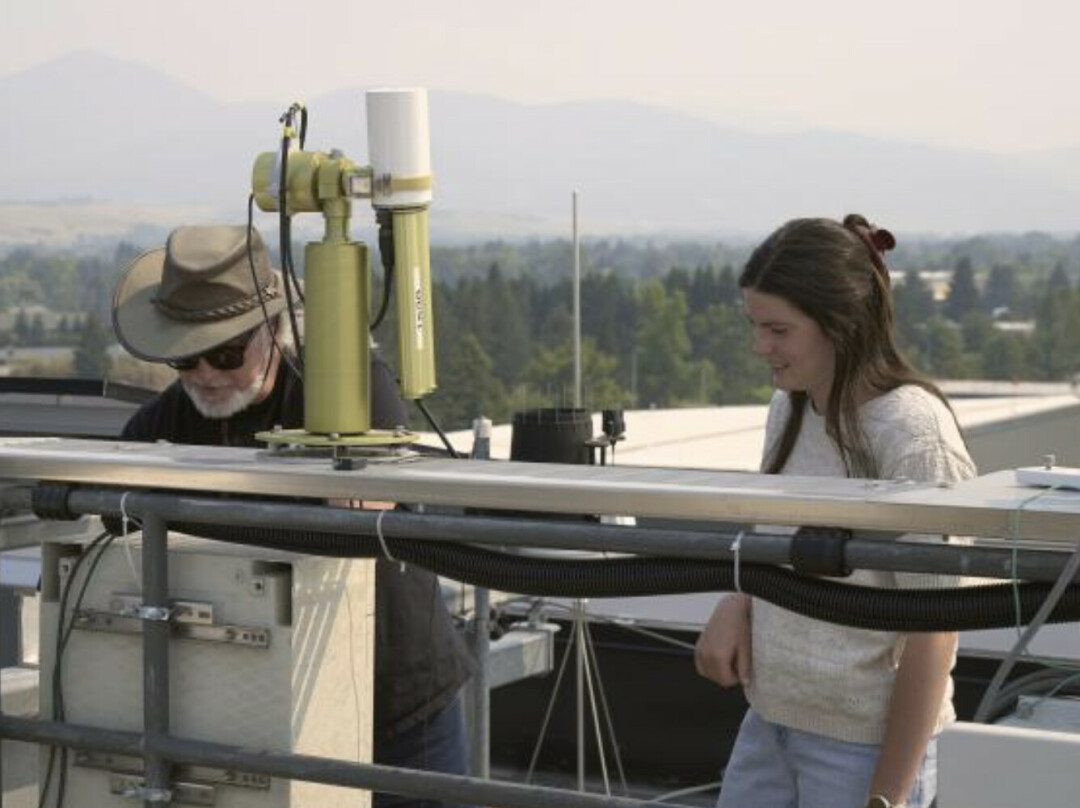
Montana State University Electrical and Computer Engineering professor Joe Shaw, left, and doctoral student Morgan Hasenmyer work with instruments that measure how the brightness of the sun is reduced by air particles. These measurements can also used to determine air quality. MSU photo by Kelly Gorham
BOZEMAN
— As wildfire smoke continues to collect heavily across parts of Montana, Joseph Shaw logs into his computer to check the data gathered from a weather station atop Montana State University’s Norm Asbjornson Hall. What he saw a few nights ago was a first in his 20 years of collecting weather-related data.

“I would say on a normal, clear day in Montana the scattering coefficient would be five, or maybe 10,” said Shaw, who is a distinguished professor of electrical and computer engineering in MSU's Norm Asbjornson College of Engineering. “Around midnight a few days ago, it was 516, which is the highest that I’ve ever measured.”

The scattering coefficient measures how strongly airborne particulate matter redirects light as it passes through a given distance in air. The corresponding air quality index value of 232 triggers a “very unhealthy” warning from the U.S. Environmental Protection Agency, advising sensitive groups to avoid all outdoor exertion, and for everyone else to limit outdoor exertion.

The weather station at MSU has the instrumentation to measure and report a bevy of scientific weather data, including the air quality index. He installed the instruments piecemeal over two decades to provide more accurate location-specific data for researchers around the world to utilize. One of the differences between the campus-centric data generated by the weather station at MSU and Bozeman-area weather data often available through smartphone apps is that the latter often comes from a weather station located at Bozeman-Yellowstone International Airport. Despite being less than nine miles from campus, the airport can experience weather conditions that are measurably different from those of MSU’s campus, Shaw said.

Another difference is that Shaw’s data isn’t available via an app. The data are intended mostly for scientific research, so the web-based interface might appear non-intuitive to laypersons. But to see a real-time user-friendly measurement of the current AQI at Asbjornson Hall, visit the PurpleAir website, which is part of the global AERONET network of weather-data gathering stations. The campus-specific data updates from Shaw’s instruments every 10 minutes, 24 hours per day.

“Our instruments suck air in and they scatter laser light off of it,” he said. “They then determine how many particles are there from that laser light.”

Of particular interest, Shaw said, are the smallest particles with diameters less than 2.5 micrometers, which can enter people’s lungs and cause irritation and sometimes exacerbate medical conditions such as asthma, he said. The larger particles tend to migrate to the ground relatively quickly, he said. The density of the smallest particles is used in the EPA-defined calculation for the AQI.

Despite having access to a cluster of comprehensive weather-related instruments, Shaw sometimes uses another measurement for air quality – at least when smoke in the air isn’t making headlines. He uses the line-of-sight clarity of mountains 30 to 40 miles away as a means of approximating visually the amount of haze in the air.

“For light haze, I use the visibility of the Tobacco Root Mountains from the top of Asbjornson Hall,” said Shaw, who is also director of MSU’s Optical Technology Center.

OpTeC is a globally recognized center advancing optical technology through research, education and collaborations with private industry.

Add a Comment »

What you need to know about hunting at Missouri Headwaters State Park this fall


THREE FORKS –
Montana Fish, Wildlife & Parks is implementing a new lottery system for managing hunting access at Missouri Headwaters State Park.

Missouri Headwaters State Park offers quality wildlife habitat and diverse recreation opportunities. As interest in hunting in the park grows alongside general park visitation, FWP staff are looking to manage hunting access in a way that ensures the safety of all visitors while keeping the park open for hunting where appropriate.

Beginning this season, hunting access at Missouri Headwaters State Park will be managed through a lottery reservation system. Those who wish to hunt in the park must complete an online application the week before they plan to hunt, choosing up to three days as possible hunting dates. Up to six hunters will be selected randomly for each day. Those hunters will receive an email with hunting rules, a map with safety zones, and a tag for their vehicle.

The online application will be open each Wednesday from 8 a.m. to 4 p.m. from Aug. 26 through Jan. 6, with hunting dates available weekly from Sept. 1 through Jan. 15. Hunters will be selected one week at a time.

For example, those who wish to hunt in the park any time from Sept. 1 through 6 will fill out the application on Wednesday, Aug. 26. Up to six hunters will be selected randomly for each day of that hunting period. If those hunters wish to hunt on future dates, they must fill out a new application.

To access the application starting Aug. 26, click here.

Those planning to hunt in the park after Jan. 15 must stop by the visitor center during business hours for a permission slip. 

Other hunting rules apply, including a weapons restriction and a safety closure near park facilities. Upland bird hunting will be limited to a certain portion of the park, while deer and waterfowl hunting will be open in additional areas. To see the map, a complete list of rules and a lottery schedule, click here

“Missouri Headwaters State Park provides a variety of recreation opportunities for thousands of visitors each year,” said park manager Alice Southworth. “We’re hopeful this new approach to managing hunting access in the park will help ensure visitor safety while maintaining the opportunities many people enjoy.”

Within the boundaries of Missouri Headwaters State Park, the Jefferson, Madison and Gallatin rivers merge to form the Missouri River, the longest river in the U.S. The site is significant to Native American peoples and was visited by members of the Corps of Discovery in 1805. Now a national historic landmark, the park hosts thousands of visitors each year. The park is about 5 miles northeast of Three Forks on Trident Road. For more information about the park, click here or call 406-285-3610.

Add a Comment »

Wednesday, Aug. 12th, 2026

NSF grant worth $3 million helping retain Montana teachers in rural areas and reservations


BOZEMAN
— For Christopher Quinlivan, a science teacher for Superior Public Schools west of Missoula, the most energizing part of his day is witnessing the “aha” moment for students – when the science content he teaches finally clicks for them.

“The next generation needs to look at the world with a lens of wonder,” said Quinlivan, who sees his teaching career as a way to both share his love for science and help children in extra need of support. “I think the sciences can either cultivate that or kill it, depending on how they’re taught.”
Quinlivan has worked in the rural school district for 14 years. He teaches courses for middle and high school students including physical science, biology, physics, chemistry and labs in STEM, which stands for science, technology, engineering  and math.

In addition to his heavy teaching courseload, this year he also completed a master’s degree in education through Montana State University.

MSU received a $3 million grant from the National Science Foundation’s Robert Noyce Scholarship Program in 2024 to support a project called the Noyce Master Teacher Fellowship for Rural and American Indian School Educators as STEM Leaders. The project, which seeks to improve the number, quality and experience of STEM teachers in rural states like Montana, funded Quinlivan’s tuition. It also is supporting 26 other Montana teachers through the six-year fellowship. Some of the fellows already have master’s degrees but are still in the program for the professional development, networking opportunities and stipend it provides.

The participants, who were already working as Montana teachers, received  tuition for master’s degrees and other resources such as monthly group check-ins , funding travel to relevant conferences, and a weeklong in-person gathering at MSU each summer.

This August, the gathering provided a chance for fellows to present their master’s research, attend informational sessions at the STEM Summer Institute and Montana Council of Teachers of Mathematics MCubed conferences held at MSU the same week, and participate in a team-bonding activity of rafting on the Madison River.

The opportunity for the 27 teacher fellows to gather in person is of huge value and aligns with the goals of the program, said Fenqjen Luo, professor of education in MSU’s College of Education, Health and Human Development and principal investigator on the grant. It provides a chance for them to learn from each other and cut through the isolation and loneliness that can sometimes impact people teaching in rural areas.

Overall, Luo said, the goal of the program is to support and retain teachers in rural Montana – especially those who are already serving as leaders and mentors of other teachers in their schools.

Data from the Institute of Education Sciences about Montana shows that more than half of school districts report difficult filling positions, and there are hundreds of teacher vacancies across the state. Additionally, upwards of 30% of teachers will change careers within five years of starting their teaching job.

Luo said that in eastern and other rural pockets of Montana, many math teachers come from countries including the Philippines, India and Ghana. That’s due to state incentives because there are simply not enough American math teachers in rural Montana to meet the demand.  

Luo, who previously taught in a small village in Taiwan, shared the same challenge as the Montana teachers: feeling unable to forge connections or find support systems because there were few other teachers around.

That’s exactly what the Noyce fellowship aims to address. One teacher, Bill Becker, said that a week of being surrounding by like-minded teachers who are professionally motivated to better themselves was “very rejuvenating.” He teaches mathematics and advanced electives at Ronan Public Schools on the Flathead Reservation.

Sometimes, due to stressors of the job, the teaching environment can be negative and unmotivating, Becker said, but being with the group of fellows was a breath of fresh air for him.

While on campus, he was able to exchange ideas with other teachers from Montana to benefit his classroom. Specifically, he presented his place-based lesson plan centered around the Confederated Salish and Kootenai tribal flag and its unique designs, customizable to many grade levels. Not only do students learn about the cultural significance of the flag, they are exposed to mathematical equations. For example, by plugging in different numbers into the equation of a circle, students see how the circle changes size and position on the flag.

Becker’s presentation then pointed teachers to the starter templates he created for the other tribal flags in Montana for use in their own math classes.

Quinlivan also shared his master’s thesis project, centered on his efforts to bring 3D printing into his science classroom. A grant enabled his purchase of two 3D printers in 2025, and his sophomore biology class has used them to learn about the classification of different animals and print the structures of viruses, bacteria and protozoa.

Quinlivan said it’s been a great way to bring students who have more of an art mindset into the sciences and also expose them to computer technology that could help them in future careers.

“I have learned so much about effective teaching methods through the MSSE  program that I believe I am already seeing positive changes in my classroom,” he added.

Connie Michael, a fifth-grade all-subject teacher at Crow Agency Public School, said the fellowship has helped her build bridges between other science and math teachers in her district and throughout the state. Having that network is important to her, especially since she started her career at a more populated district in Washington state before moving to the rural district. She has now been a teacher for 35 years.  

In 2025, Michael won a $27,000 award from Voya Financials in recognition of the caliber of her teaching, which funded her project to integrate Native American knowledge into STEM curriculum. She was able to share some of her teaching strategies in conversations with others at MSU.   

“Having the opportunity to talk with other teachers in similar situations and share strategies is so important, and we are able to share opportunities for professional development that we may not be aware of,” Michael said. “I have built some good relationships with teachers from across the state and hope to continue to build on those so we can share ideas and learn from each other.” 

NSF is funding the program through 2030. People can learn more at www.montana.edu/smrc/noyce/about/. MSU also houses the Center for Research on Rural Education which creates resources specific to the state’s rural teachers.

Add a Comment »

Community Invited to Celebrate National Nonprofit Day at Downtown Bozeman August 17

BOZEMAN — Monday, August 17, Greater Gallatin United Way invites the community to celebrate National Nonprofit Day at the second annual Nonprofit Walk, a free community event highlighting the organizations that strengthen Gallatin Valley every day.

From 5:00 to 7:00 p.m., downtown businesses will host local nonprofits outside their storefronts, creating an interactive evening where community members can explore downtown, meet the people behind local missions, discover volunteer opportunities, and learn new ways to give back—all while supporting local businesses.

Rather than a traditional walk, the event transforms Downtown Bozeman into a celebration of community, bringing together nonprofits, businesses, volunteers, and neighbors in one shared space.

"Nonprofits are at the heart of a strong community," said Ben Frentsos, Director of Community Impact at Greater Gallatin United Way. "Every day they provide services, create opportunities, and improve lives across Gallatin Valley. National Nonprofit Day is the perfect opportunity to recognize their impact while connecting them with the people and businesses that help make their work possible."

More than a thirty nonprofit organizations are expected to participate, representing causes including youth development, education, health, conservation, arts and culture, basic needs, and community services.

Community members are encouraged to stroll through downtown at their own pace, stop to visit participating nonprofits, learn about local organizations, and explore volunteer, donation, and engagement opportunities.

Downtown businesses are also joining the celebration by hosting nonprofit organizations outside or inside their storefronts, hosting give backs, and helping create a vibrant evening that highlights the power of local partnerships.

"Strong communities don't happen by accident," Frentsos added. "They are built by people showing up for one another. Whether you are volunteering, supporting a nonprofit, shopping downtown, or simply stopping to learn about an organization you've never heard of before, every connection helps strengthen our community."

The event is free and open to everyone.

Event Details

Nonprofit Walk
Monday, August 17, 2026 | 5:00–7:00 p.m. | Downtown Bozeman

A map of participating businesses and nonprofits will be available online prior to the event. For more information, participating organizations, or to register as a nonprofit or downtown business, visit: GreaterGallatinUnitedWay.org/NonprofitWalk

Add a Comment »

News Comments