

Monday, Aug. 8th, 2016

GVLT hits milestone conserving 100th property

This week the Gallatin Valley Land Trust, in partnership with the Toohey family, have finalized their 100th conservation easement, protecting 959 acres of prime farmland from subdivision and development. The property is located just north of Bozeman off Springhill Rd., and stretches from wetlands along the East Gallatin River all the way up to mule deer winter range in the Bridger foothills.  The property also includes the access road to the popular Middle Cottonwood Trail.

The Toohey family has been farming in the Gallatin Valley since 1876, when the great-grandfather of the current owners emigrated from Ireland. After four generations of farming the land, the family decided that given the rapid development in the area, they wanted to ensure the property could remain in production for future generations.

The conservation easement protects scenic views from some of Bozeman’s most popular roadways and ensures the productive and unique soils, which make it prime for farming, will always be available for agriculture.  Its proximity to other conserved land and the Custer Gallatin National Forest make it a critical piece in an effort to protect elk and deer winter range, as well as other habitat.  

But more than anything, the landowners say they’re conserving their land to protect a way a life. “Despite considerable pressures, our family has been able to withstand the temptation for developing that land and has continued to operate the property as a family farm and ranch. We want to be able to preserve this land for generations to come because it represents a way of life that once was common in the Valley, but is unfortunately rapidly disappearing” says Tim Toohey.

Private land conservation in the Gallatin Valley is picking up speed in response to ever-growing development pressure. In many ways the Toohey property is representative of our community’s biggest challenges with growth. What happens to our open land when development reaches farther out into the valley? And what does that mean for agriculture?

GVLT has been working with farming and ranching families since 1990 to protect the open spaces and productive soils that have defined this valley for generations. Even with 100 easements totaling over 45,000 acres conserved, there is more work to be done to protect the scenic quality of the landscape, access to local food, and rich agricultural heritage.

The Toohey conservation easement was made possible with funding from the USDA Natural Resource Conservation Service, Gallatin County’s Open Space Bond, and Montana Travelers for Open Land. These funding sources allow conservation groups to significantly increase the pace of conservation by compensating landowners for a portion of the value of their land. With development pressure growing, and with little money left in the Gallatin County Open Space Bond program, it will be critical to renew the fund to keep pace with development in Gallatin County. The 100th easement is a major milestone for the organization, and for the community, but GVLT is keenly aware of the work that lies ahead.

What is a conservation easement? The Gallatin Valley Land Trust (GVLT) partners with private landowners to conserve working farms and ranches, fish and wildlife habitat, open lands and scenic views.  To protect these special places, GVLT uses conservation easements, which are voluntary agreements with landowners that limit development on a property while keeping it in private ownership.  Each easement is tailored to the specific property and runs with the title of the land in perpetuity. GVLT is responsible for upholding the easement’s terms.  Because a conservation easement limits development rights and therefore decreases the value of the land, landowners may be eligible to write off the difference as a charitable donation. In some cases, landowners receive financial compensation for a portion of the value of the conservation easement.  The public benefits from the protection of conservation values such as prime agricultural soils, wildlife habitat, river corridors and the overall character of our region.

About Gallatin Valley Land Trust
Gallatin Valley Land Trust connects people, communities, and open lands through conservation of working farms and ranches, healthy rivers, and wildlife habitat, and the creation of trails in the Montana headwaters of the Missouri and Upper Yellowstone Rivers. For more information, visit www.gvlt.org.

Add a Comment »

Monday, Aug. 1st, 2016

Red Ants Pants Music Festival Announces Winner of Emerging Artist Competition

With attendance topping 16,000, the 6th Red Ants Pants Music Festival, which wrapped up on Sunday, was the largest to date. Proceeds from the festival benefit the non-profit Red Ants Pants Foundation, which has given more than $65,000 in grants to people and projects supporting our rural communities, working family farms and ranches and increasing women’s leadership. More than 200 volunteers helped put on the festival.

The Red Ants Pants Music Festival also announced the winner of their 2016 Emerging Artist Competition: Pollo Loco, of  Great Falls, Montana! The band includes Lonnie Johnson on the lead guitar, Chuck Fulcher playing upright acoustic bass, mandolin, harmonica, vocals and Jeff Christiansen on rhythm Guitar and vocals. The runner up was Feeding Leroy from Duluth, Minnesota.

 
The Emerging Artist Competition gives festival attendees the opportunity to vote for their favorite band playing the Side Stage – the winner earns the opportunity to play on next year’s Red Ants Pants Music Festival’s Main Stage.

“Music is a powerful tool for bringing people together and we are inspired by this banner year,” said Sarah Calhoun, Red Ants Pants Music Festival founder and producer. “We’re hugely appreciative of the support of the White Sulphur Springs community and the connection that happens when we all come together to celebrate.”

With a record attendance for the festival & campground, the 6th Red Ants Pants Music Festival is proud to also announce there were zero safety incidents and zero DUIs reported.  SAVE THE DATE for the 7th Red Ants Pants Music Festival July 27th – 30th, 2017 on the Jackson Ranch in White Sulphur Springs!

ADDITIONAL FESTIVAL HIGHLIGHTS:
2017 Montana Beard & Moustache State Championship, hosted by John Cordes of Roberts, Montana:
Moustache
1st    Pat Horvat - Lethbridge, Alberta
2nd   Sean Kochell - Missoula, MT  
3rd    Micheal Keator - West Yellowstone, MT
 
Partial Beard
1st     George Mcwilliams - Bozeman, MT
2nd    Bryan Holtz - Watford City, ND
3rd     Don Judge - Helena, MT  
 
Full Beard
1st     Taron Kifer - Helena, MT
2nd    Vinny Contreras - Martin City, MT
3rd     Gus Gustuson - Missoula, MT
 
Freestyle Beard
1st    Derik Austin - Helena, MT
2nd   Christopher Kirkwood - Bozeman, MT
3rd    Micheal McGuire - Richcrest, CA
 
Craft Beard
1st    Jessie Vaillancourt - Alberton, MT
2nd   Ellie and Cam - Billings, MT
3rd    Addison Oliver - Ennis, MT
 
Grand Champion - Jessie Vaillancourt - Alberton, MT
2017 Red Ants Pants Music Festival Crosscut Champions:
The winners of the crosscut competition for all events are a combination of two husband/wife teams from Red Lodge:
Men's division: Hans Howell and Ivan Kazorok with a time of 40.23 seconds.
Women's division: Jessica Howell and Anne Kazorok with a time of 47.8 seconds.
Co-Ed division: Hans and Jessica Howell with a time of 55.6 seconds. 

Comments 1

Friday, Jul. 29th, 2016

MSU professor publishes popular book on mushrooms of the Rocky Mountains

Years ago, Cathy Cripps found a mushroom atop Loveland Pass, Colorado. Hours later, she boarded a plane for Greenland and found the same mushroom species when she landed.

“I was amazed that the exact same species of mushroom I was holding in my hand 500 miles from the North Pole was one I had found a few days earlier above tree line across the Atlantic Ocean in the Rocky Mountains,” she said.

Now an associate professor in the Montana State University College of Agriculture's Department of Plant Sciences and Plant Pathology, Cripps said her research on mushrooms and their habitats has taken her all over the world. She recently published a book highlighting popular mushrooms found in the regions of the Rocky Mountains.

The book, “The Essential Guide to Rocky Mountains Mushrooms by Habitat,” has been trending locally on a top-ten book list. The book is geared toward the public, land managers, naturalists and mushroom enthusiasts, not specifically researchers or scientists, Cripps said.

“We wrote it so that it’s accessible to a lot of people who are observers interested in their own environment,” she said. “It’s a different kind of identification book because the readers are already interpreters of habitat.”

The book is organized by habitat, rather than traditional species taxonomy often employed in mushroom and plant guide books. The book includes bright images of more than 150 mushrooms species, many taken by Cripps herself. Mushrooms and their accompanying environmental markers are categorized by Rocky Mountain habitat zones. Also included are ecological indicators users are likely to find around various mushrooms species, including flowers, birds, animals and landscape features. The book includes notes on mushroom edibility, odor and medicinal properties as well as a mushroom checklist.

“We organized the book as nature, not scientists, would have intended, because it follows nature’s pattern,” she said. “I’m sharing what I might expect to see in a particular habitat.”

The Essential Guide to Rocky Mountains Mushrooms by Habitat” is co-authored with Vera Evenson with the Denver Botanical Gardens and Michael Kuo, English faculty and amateur mushroom expert at Eastern Illinois University. It is published by Illinois University Press and can be purchased locally at the Country Bookshelf or on Amazon.

At MSU, Cripps studies the roles mushrooms have within their larger ecosystems, namely their relationship with trees in Montana and other high-elevation mountain systems. Fungi provide a critical role in plant-based ecosystems by decomposing and recycling a variety of plant materials, sequestering carbon in the soil and providing nutrients to plants through their roots.

In particular, Cripps focuses on the mycorrhizal fungi that support whitebark pine trees and alpine tundra plants by providing roots with essential nutrients, allowing them to live in harsh climates.

Cripps focuses a majority of her research on Suillus sibricus, a fungus that delivers critical benefits to whitebark pine seedlings in the wake of disastrous effects from beetles and disease in forests across the West. Her research is also supported by the United States Department of Agriculture’s Forest Service.

Cripps’ book contains a section on alpine fungi and on mushrooms found in whitebark pine forests. However, a warming climate is threatening arctic and alpine environments and the myriad benefits mushrooms bring to their ecosystems, Cripps said. Cripps – who received a National Science Foundation grant that provided funding for researching the role of alpine and artic habitat mushroom populations in the 1990s – is calling for attention to mushrooms as they become increasingly threatened in today’s warming temperatures.

According to Cripps, the tree line in cold-dominated environments is growing closer and closer to mountaintops, effectively expanding sub-alpine environments, eliminating the space for alpine ecosystems to survive and flourish.

“Eight percent of the earth consists of artic and alpine habitat that includes a host of fungi, flora and animals,” she said. “It would be an enormous loss to the world to lose these critical habitats.”

Cripps said still little is known about these small, yet highly critical populations of fungi in cold-dominated habitats.

“We have these mycological blank spots, we don’t even know what’s there, what species, who they’re related to and their greater ecological role,” She said. “These are very threatened habitats and we don’t really have a sound grasp of what’s currently there, so we’re working as quickly as possible.”

Add a Comment »

Wednesday, Jul. 27th, 2016
Thursday, Jul. 21st, 2016

Bozeman second-graders’ artwork heads to International Space Station

 The artwork of second-graders from Morning Star Elementary School in Bozeman was launched into space this week for a six-month stay on the International Space Station as part of a larger Montana State University research project into developing more durable computers for NASA.

Stickers bearing a mission patch logo created by students in Cheri Jakovac’s class were aboard the SpaceX Falcon 9 resupply rocket that was launched Sunday night and broadcasted live on NASA TV. The stickers will remain on the ISS until December when they will be loaded onto a return capsule to be given back to the students.

The logo art activity was an outreach component of an ongoing research project at MSU to develop a new radiation-tolerant computer technology. MSU has been researching this technology for nearly a decade under the direction of Brock LaMeres, associate professor in the Department of Electrical and Computer Engineering in the College of Engineering and principal investigator of the project.

“Future NASA missions will require faster computers, but the radiation environment of space causes earthbound computers to fail,” LaMeres said. “MSU has been researching how to make computers that not only meet the computing needs of future missions, but that will be reliable in the harsh environment of outer space.”

MSU’s computer has been tested in radiation chambers, on high altitude balloons, and on rockets that reach the beginning of outer space. The current project to put the computer on the ISS will be its most rigorous test yet and will set the stage for the next level of development, LaMeres said.

“Our next milestone is to operate the computer in a real space environment for an extended amount of time,” he said. “The ISS is the perfect platform for the next stage of our development.”

The MSU computer will be flown to the space station this fall. There, astronauts will install it in an experiment locker owned by NanoRacks, a Texas-based company that facilitates access to the space station.

NanoRacks contacted LaMeres in January about flying a small amount of memorabilia related to his current ISS project. NASA provides scientists who are working on ISS research an opportunity to fly memorabilia to the station and be returned as keepsakes for the research team. LaMeres contacted Jakovac, his daughter Kylie’s teacher, about having her class design a logo for the project as a way to show them how the math and science they are learning is used in real world applications.

“Exposing students at an early age to the exciting things that people working in STEM (science, technology, engineering, and math) get to do is very important,” LaMeres said. “Hopefully having them hear about the research we are doing at MSU will leave a lasting impression that might lead to them choosing degrees, and ultimately careers, in STEM.”

Working with LaMeres on the project are Connor Julien, an electrical engineering graduate student, Daniel Mills, a senior in electrical engineering and Brandon Klise, a sophomore in computer engineering. They, with LaMeres, visited the class in February and explained the current mission. The students were shown examples of mission logos and asked to draw their own version that represented MSU’s work. The research team used the common themes in the students’ drawings to create the final mission logo, which depicts the process of going to and returning from the ISS through illustrations of a rocket being launched, the ISS, and the return capsule bearing Montana’s 406 area code floating down via parachute.

Also on the logo is the acronym RTcMISS, pronounced “Artemis,” which stands for “Radiation Tolerant computer Mission on the International Space Station.” “NanoRacks” also appears on the logo along with acronyms designating the Montana Space Grant Consortium, MSU’s College of Engineering, NASA EPSCoR and the MSU Space Science and Engineering Laboratory.

Student designers from Jakovac’s class are: Connor Baller, Jaden Bateson, Cooper Bourret, Grace Brandon, Claire Brown, Oliver Carey, Myles Faerber, Geno Graf, Ibrahim Al-Kaisy, Inga Lee-Eichenwald, Kylie LaMeres, Cameron Mansfield, Olivia Morgner, Reese Navarro, Helen Nelson, Katelyn Pahut, Daniel Peace, Bobby Pratt, Heidi Rich, Owen Riendeau and Quinn Werner.

A video of the logo design process can be viewed at https://www.youtube.com/watch?v=qx9_n9znXhA. A full recording of the launch can be viewed on the SpaceX website at http://www.spacex.com/webcast.

Add a Comment »

Skyline Finishes 10th Year with Record Ridership

Skyline Surpassed 185,000 Rides in Fiscal Year 2016 but Struggles to Fund Increasing Demand.

The Big Sky Transportation District announces that its Skyline transportation services provided a total of 185,529 rides in Financial Year 2016, an increase of 7.7 percent over Financial Year 2015’s numbers. June 30, 2016 marks the end of the Big Sky Transportation District’s tenth year operating Skyline. The official 10th Anniversary date for the service is December 1st, as that marks the date when Skyline first began operating in 2006. Since that date, Skyline has provided over 1.4 million rides, and has traveled over 2.5 million miles.


David Kack, Skyline Coordinator, noted, “While local ridership was down 2%, our Link Express ridership was up over 20%, and ridership on our van pool service was up 23%.” Kack went on to say that, “Skyline gave over 13,000 more rides in FY 2016 than FY 2015. This shows that demand is strong for transporta- tion alternatives between Big Sky and Bozeman.” Given the increase in ridership, the Big Sky Transpor- tation District was planning to add additional services to meet the demand, but the District didn’t receive all the funding it requested.

District Board Chairman Ennion Williams noted that, “We requested an increase in funding from many of our partners, and while we are getting more funding from the Big Sky Resort Tax and Madison County, we do not anticipate getting any support from Gallatin County.” In its initial hearing on the Skyline request, Gallatin County Commissioners voted 3 to 0 against supporting the District. Williams went on to say, “We receive support from so many sources, the Resort Tax, Madison County and all of the major employers in Big Sky. It makes no sense to us that Gallatin County will not contribute fund- ing to this vital service.” An on-board survey of riders indicated that 76 percent of those riding the bus are Gallatin County residents, and 59 percent of those people are riding for work related purposes (to and from a job).

The Big Sky Transportation District Board will be meeting during the summer and fall to discuss its budget and potential sources of funding so that it can meet the demand for services. Funding is currently provided by the Federal Transit Administration (funding administered by the Montana Department of Transportation), Big Sky Resort Area District (the local option sales tax/resort tax in Big Sky), Big Sky Owners Association, Big Sky Resort, Madison County, Moonlight Basin, Spanish Peaks Resort, and the Yellowstone Club.

Add a Comment »

Monday, Jul. 18th, 2016

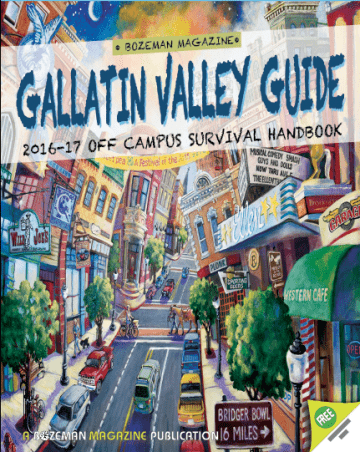
Coming Soon Gallatin Valley Guide

The Gallatin Valley Guide is the first introduction to Bozeman for many incoming MSU students, their parents, and other newcomers to the city.

Getting your business in front of these folks as soon as they arrive is invaluable, but our advertising prices won't break the bank!

Creative deadline is Aug 3 - don't wait save your space today.

How is GVG different than the rest? It looks way cooler with a glossy illustrated cover. It includes tons of useful information about where to register your vehicle, to vote, who's the mayor, and more. We tell readers where to get food, fix your car, do laundry, workout and more. We feature local venues & bands. We feature local parks, campgrounds and recreation. All of our content is written by local writers who know Bozeman inside and out and have created a perfect introduction to the valley.

Add a Comment »

Environmental historian named Wallace Stegner endowed chair at MSU

Mark Fiege, a historian known for his writing and thinking about the environment of the American West and the country’s national parks, has been selected as the Wallace Stegner Endowed Chair in Western American Studies at Montana State University.
 
Fiege, who is the author of critically acclaimed books in the area of environmental history, served as the Wallace Stegner Visiting Professor at MSU during the 2015 spring semester. His permanent appointment to the chair, a tenured full professorship, was announced by Nic Rae, dean of MSU’s College of Letters and Science. The Stegner Endowed Chair is housed in the college’s Department of History, Philosophy and Religious Studies.

“I am thrilled that we have been able to attract a scholar of Mark’s stature to MSU,” Rae said. “Mark’s appointment to the Stegner Chair in tandem with our new Western Lands and Peoples Initiative will establish MSU as a center of excellence for the study of the past, present and future of the North American West.”

Rae said that endowed chairs are the highest academic position universities can bestow upon faculty. They are usually funded and sustained by permanently invested funds and attract noted scholars in their fields, he said. In addition, endowed chairs help the university boost its reputation in academic and research programs.

Rae said he invites the public to learn more about Fiege and his scholarship and MSU’s Western Lands and Peoples: Perspectives on the American West Lecture Series when Fiege delivers his inaugural Stegner Lecture, set for 6 p.m. Monday, Oct. 3, at the Hager Auditorium in MSU’s Museum of the Rockies. The event is free and a reception preceding the lecture will begin at 5:15 p.m. in the museum lobby.

Fiege said he was “deeply honored to hold the Stegner Chair and thrilled to join the faculty at MSU.”
 
“I have long admired the outstanding scholars in the Department of History, Philosophy, and Religious Studies, and I couldn't be more pleased to work with them,” Fiege said. “I look forward to sustaining the memory and legacy of Wallace Stegner, a towering figure in Western American letters."
 
Fiege’s academic degrees, all in history, include a bachelor’s degree from Western Washington University, a master’s from Washington State University and a doctorate from the University of Utah. He has taught at Colorado State University since 1994. In 2015 he received the CSU Alumni Association Best Teacher Award. Fiege co-founded the CSU Public Lands History Center. He also was co-founder of Parks as Portals to Learning, an interdisciplinary research and learning project at CSU in collaboration with National Park Service staff at Rocky Mountain National Park. Fiege was also CSU’s William E. Morgan Chair of Liberal Arts from 2008-2013.

An imaginative and wide-ranging writer, Fiege recently co-edited the anthology, “National Parks beyond the Nation: Global Perspectives on ‘America's Best Idea,’” with Adrian Howkins and Jared Orsi. The book was published this year by the University of Oklahoma Press. He is the author of “The Republic of Nature: An Environmental History of the United States,” published in 2012 by the University of Washington Press and “Irrigated Eden: The Making of an Agricultural Landscape in the American West,” published by the University of Washington Press in 1999. That book was the co-winner of the Charles A. Weyerhaeuser Award from the Forest History Society.

Fiege has also published scholarly papers and articles about Western environmental history including “The Weedy West: Mobile Nature, Boundaries, and Common Space in the Montana Landscape,” published by the Western Historical Quarterly. The article won several prizes including the Theodore C. Blegen Award from the Forest History Society, the Wayne D. Rasmussen Award from the Agricultural History Society, the Alice Hamilton Prize from the American Society for Environmental History and the Oscar O. Winther Award from the Western History Association.

Fiege is working on the book “Elegant Conservation: Resource Management in a Time of Unprecedented Uncertainty,” which also was the title of Fiege’s Wallace Stegner lecture that he delivered at MSU in spring 2015. He is partnering on the book with Ben Bobowski, superintendent of Wrangell-St. Elias National Park and Preserve.

Fiege explained that the concept for the book is based on his observation that despite the dissension in the country about many matters – characteristic of the so-called “Age of Fracture” – there is considerable grassroots activity and cooperation in conservation and resource management. He has termed this phenomenon “Elegant Conservation,” which describes “efforts to foster pragmatic, pluralistic, socially responsive, process-oriented methods that rise above fears of collapse.”

The Wallace Stegner Endowed Chair in Western Studies at MSU continues the legacy of the late Wallace Stegner, the Pulitzer Prize-winning novelist, short story writer, environmentalist and historian who is now often called the “Dean of Western Writers.” Stegner spent part of his childhood in Montana, and he notably spoke at MSU shortly before his death in 1993. The MSU Wallace Stegner Endowed Chair in Western American Studies focuses on teaching and research in history, literature and philosophy with a concentration on pressing Western issues and is supported by the Stegner Chair Endowment.

The MSU Stegner Chair was last held by writer David Quammen, who makes his home in Bozeman and who held the position from 2005-2008.

Add a Comment »

Friday, Jul. 15th, 2016

New for winter 2016-17: Ski Butlers Ski Rental Delivery Service Expands to Big Sky, Montana

New for winter 2016-17, Ski Butlers ski and snowboard rental delivery service has added a Big Sky, MT location.

Entering its 13th year in business, Ski Butlers provides personalized service as it delivers ski and snowboard equipment and accessories to a hotel, condo or wherever is convenient for the customer. At prices competitive with most resort ski shops, Ski Butlers makes renting equipment convenient and hassle-free for patrons of 37 ski resorts in British Columbia, California, Colorado, Idaho, Montana, Utah and Wyoming.  Ski Butlers has earned multiple “TripAdvisor Certificate of Excellence” awards and coveted travel-industry accolades based on their industry leading customer service.

"Ski Butlers is proud to add Big Sky to our roster of iconic ski resorts," said Bryn Carey, president and founder of Ski Butlers. "It has always been our goal to add Big Sky, so our customers have more opportunities to use our award-winning service when they go on a ski vacation."
 
Ski Butlers package prices include delivery of boots, skis, snowboards, poles and a personalized fitting by a ski technician. It also includes any required on-mountain adjustments or equipment replacement within 30 minutes of a phone call and pickup of equipment on the final rental day. Equipment can be delivered from 7am-8pm on the hour.  Delivery of equipment that is 2pm or later will not be charged that day. Pick up usually occurs between 4-6pm on the final ski day, but can be arranged for the next day at no additional charge if it is 10am or earlier. By utilizing Ski Butlers, skiers and snowboarders are avoiding long lines at busy ski shops, which allows them to both spend more time on the slopes and less money on airline luggage fees - plus NO SCHLEPPING. Check out https://www.youtube.com/watch?v=LGukGfNe5mU to see the Ski Butlers rental process in action.

Ski Butlers 2016-17 equipment includes new Rossignol snowboards and 7-series skis introducing HD technology with Carbon Alloy Matrix -along with new Rossignol bindings and boots for both skis and snowboards. This gear will be offered at all Ski Butlers locations, so re-renting at any location is quick and simple with each location having access to customer profiles from all their markets.

Beyond delivering equipment, Ski Butlers is a full-service, virtual ski shop offering one-stop shopping from its online "Ski Butlers Store." Ski Butlers also rents the latest jackets, pants, gloves and other soft goods via its exclusive partnership with GetOutfitted.com.
 
"Providing convenience for our customers has always been the backbone of our customer service experience over the past 12 years at Ski Butlers, so we are expanding what we conveniently offer skiers and snowboarders," noted Carey, who founded Ski Butlers out of a single car garage in 2004 in Park City, UT. Carey was born into a skiing family and first skied at age one. He continued skiing  his way through high school at Carrabassett Valley Academy in Maine and The Winter School in Park City. He was captain of the NCAA Division I ski team at the University of New Hampshire, where he earned a bachelor's in business.

 
About Ski Butlers: For the same price or less than most resort ski shops, Ski Butlers ski rental delivery service makes renting ski and snowboard equipment convenient and hassle-free. Based on customer reviews, Ski Butlers has earned the coveted TripAdvisor Certificate of Excellence for providing personalized service at 37 ski resorts in British Columbia, California, Colorado, Idaho, Montana, Utah and Wyoming. With home offices in Park City, Utah, Ski Butlers has earned multiple US Chamber of Commerce Top 100 Blue Ribbon Awards and was named in 2015 as one of America's fastest growing businesses by INC. Magazine. Also, Ski Butlers is very actively involved in the snow sports community's work on climate change. In 2015, company founder Carey participated in the World Climate Summit "I AM PRO SNOW" Panel in Paris. Learn more about Ski Butlers' vision and plan to be a part of the climate change solution at http://www.skibutlers.com/climatechange.

Add a Comment »

Monday, Jul. 11th, 2016

Young Explorers Passport to Adventure

When Kevin Sylvester, Executive Director of Family Promise of Gallatin Valley, a transitional shelter program for homeless families, approached the Gallatin Valley Land Trust (GVLT) about the lack of outdoor and trail experience among his program’s families, a partnership formed to help more people feel comfortable exploring our area’s trails.

The Family Promise Day Center is located across the street from Bozeman’s most iconic trail and park, Burke Park (also known as Peets Hill).  Despite the proximity to the park, Family Promise clients were never getting outside.  Unfortunately, this isn’t surprising. Research has found that low income families are less likely to use and access public parks and trails.  Simply helping people understand where to park, where to walk, and what to expect on a trail experience can greatly increase their comfort and confidence while exploring outdoors. In such an outdoorsy place like Bozeman, we can forget that some people didn’t grow up climbing mountain peaks and may need Trails 101 to feel safe navigating trails with their family. “Our main goal at Family Promise is to create sustainable solutions for homeless families in our Valley, and a large part of that is supporting families in building a community,” says Sylvester. “Many of the families we serve have never been exposed to outdoor recreation. Bozeman’s trail system helps build a sense of responsibility and promotes healthy family interaction. We wanted a way to encourage families to take advantage of Bozeman’s outdoors while living on a limited income.”

GVLT and Family Promise worked together on a unique project to help remove barriers that keep families from getting outside. The project is the Young Explorers Passport to Adventure, a self-guided tour of activities and an introduction to the Main Street to the Mountains trail system. The 12-page booklet mimics a real passport and includes both a trail map of the Main Street to the Mountains system and a Streamline bus system for transportation to trailheads. The passport includes pages featuring 5 different parks and trails in town. Each trail page has a number of activities that the young adventurer must complete in order to accomplish “Peets Hill Pioneer” or “Gallagator Crusader” status.  Nothing motivates kids more than a prize so they’re eligible for rewards when they complete various numbers of pages in their passport.

The activities in the book are fun, first and foremost. But they also encourage kids to look around and engage with their surroundings. Trails are not simply gravel paths, they can be educational, inspiring, relaxing, and active places for kids to develop and grow. The passport is a great tool for parents who are seeking structured ways to start exploring the trails with their kids.

Family Promise and GVLT have distributed passports to local nonprofits who serve families.  Groups such as Thrive, Big Brothers and Big Sisters, YMCA, and HAVEN will be giving passports to children in their programs. “We’re really lucky in Bozeman to have such a breadth of accessible trails right in our backyard. Most of the Main Street to the Mountains trail system is easy and great for beginner explorers. This passport will give children a window into a world they can explore, regardless of income” says EJ Porth, GVLT Communications and Outreach Manager.

The passport is currently being distributed through local nonprofits but will be available for download and print on the GVLT and Family Promise websites. Family Promise will be handing out passports and helping kids complete pages during a GVLT Discovery Walk on Sunday July 10th at 2:00pm at the Gallatin Regional Park. This event is free and open to the public.

Add a Comment »

News Comments