Wednesday, Apr. 19th, 2017

MSU students train wild mustangs for Montana nonprofit that helps veterans

Nine wild mustangs stepped foot onto Montana State University’s Agricultural Research and Teaching Farm on Jan. 3. They came to MSU virtually untouched, hailing from Bureau of Land Management facilities in Burns, Oregon, then were adopted by the Montana nonprofit, Heroes and Horses, to ultimately be used for therapeutic mountain pack trips with combat veterans.

Heroes and Horses is a program that uses horses and the remote wilderness to challenge and inspire combat veterans suffering from post-traumatic stress disorder. The veterans learn horsemanship skills and wilderness survival, then embark on progressive, multi-day horse pack trips in order to overcome their difficulties and replace devastating memories with positive ones.

A handful of MSU students, with the help of local trainers and volunteers, assisted in gentling and training the adopted wild horses over the course of nearly 90 days as the first step in helping these horses transition into a life of mountain adventure. The horses, gelded males ranging from 2 to 6 years old, left MSU on March 28, headed to Arizona to begin the second phase of their training.

“The horses trained by MSU students, faculty and staff will ultimately serve as tools to teach military veterans new skills to start a post-military life,” said Dr. Shannon Moreaux, DVM and an associate professor of equine science in MSU’s Department of Animal and Range Sciences in the College of Agriculture.

“By using BLM feral horses for this service learning project, we are also providing a far-reaching service,” Moreaux said. “The horses will be uniquely repurposed and will have a better life than living in a long-term holding facility; we will have provided a significant amount of publicity for the BLM Wild Horse adoption program. And, ultimately, we save taxpayer money while helping to protect sensitive ecosystems from overpopulation.”

Professional trainers, including renowned horse trainer Buck Brannaman, along with his proteges Isaac Johnson, Noah Cornish, Wesley Fazari and Jon Ensign, began the gentling process, taking about a week to work with the mustangs upon arrival at MSU. During this initial phase, five horses were paired with volunteer students based on horse temperament and student experience, while the remaining horses continued their training under MSU equine faculty, staff and volunteers.

Each of the students selected to work with a mustang had prior horse-training experience, having taken MSU’s colt-starting class as part of their equine science studies. However, this was the first time several of the students had worked with mustangs.

Andrew Couch, a sophomore from Gardiner majoring in animal science and livestock management, said this was the first time he had worked with mustangs under guidance, learning how to prepare a horse for future situations.
Students worked with the horses for four hours, six days a week, beginning at 6 a.m. at MSU’s Bob Miller Pavilion, teaching the horses to stand quietly, accept a saddle and bit and respond softly to leg and bit pressure.

As the horses progressed, the students were also able to take them off campus to expose them to new surroundings, as well as varied terrain, said Stefanie Herrera of Helena, a 2016 fall graduate of the Department of Ecology in MSU’s College of Letters and Science. After graduating in December, Herrera began volunteering for the MSU Horsemen’s Club and was one of the students asked to work with the mustangs.

“Horses will show where the challenges are for veterans,” Herrera said, speaking on the connection between horse and rider. “If (a veteran) is angry or closed off, the horse will show it. This is (the horse’s) job. The horse has to be able to help that veteran out. Heroes and Horses is giving these horses and these people a purpose.”

Herrera added that the horses are rehabilitation horses as much as they are pack-and-saddle horses.

“I believe in the Heroes and Horses program,” Moreaux said. “It is important we honor the men and women who have suffered in foreign wars by ensuring they can reintegrate into a nonmilitary society.”

And, Moreaux said, it is important for students to participate in these types of service learning opportunities.

“Service learning is an educational application that integrates knowledge transfer with a social need,” he said.

“Service learning enriches the learning experience, teaches civic responsibility and strengthens communities.”

“It was a pretty neat experience,” Herrera said. “I learned a lot and it was very humbling to be able to work with something wild that puts that much trust in you. I’m quite happy I got to be a part of that, and impact a horse that will go on to affect so many lives.”

Add a Comment »

Artist LeeAnn Ramey Exhibits at the Bozeman Public Library

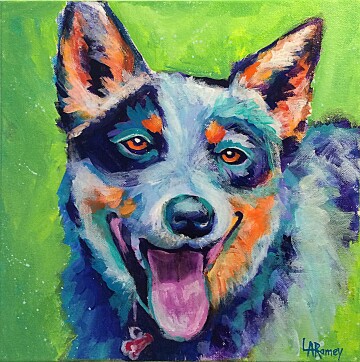
Contemporary expressions of color and texture highlight Bozeman artist LeeAnn Ramey’s paintings.  Ramey will exhibit her work in the Atrium Gallery at the Bozeman Public Library May 1 through June 30, 2017. The Bozeman Public Library Foundation, sponsors of the exhibit, will host an artist’s reception on Friday, May 5, 6:00 – 7:30 p.m., free and open to the public.


“My paintings are contemporary expressions of color and texture. I am curious by nature and love the prospect of discovering something new — whether it’s experimenting with different mediums, paint, texture, subjects or the effect of a varnish or ink, I want to have fun and explore,” states Ramey.  A native Nashvillian, Ramey worked as a graphic designer in the country music industry for over 25 years while also painting part-time. After relocating to Bozeman in 2014, she made the decision to pursue her life-long passion and focus her career on painting.

She is a self-taught contemporary acrylic painter.  Her work has been accepted in several juried shows in the South and she won first place in the 12th Annual Art’s Revive Juried Art Show in Selma, Alabama and Instructors’ Choice Award at the Alabama Art Colony Group Show in Alexander City.  She has also exhibited in Helena, Three Forks and Bozeman.  LeeAnn recently gave a nod to her new environment by saying “I am excited to call Montana my home and look forward to finding out how life in the West will influence my work!


”The exhibition will be on display during Library hours.  A percentage of sales will go to the Bozeman Public Library Foundation to ensure continuation of cultural programs at the Library for public benefit.  For more information about the exhibit or opening reception, please call Sarah DeOpsomer at 582-2425 or email sarah@bozemanlibraryfoundation.org.

Add a Comment »

International street artist’s mural launches MSU parking garage public art initiative


Where other people may see gray concrete ramparts, artist Marina Zumi envisions glittering constellations, the magic of the quantum theory and the human-nature connection.
 
That is the vision that Zumi, a South American graffiti muralist with an international following, is using along with more than 200 cans of spray paint to transform the first floor of the new Montana State University parking garage into a massive mural.
 
The Argentinian street artist, who is based in São Paulo, Brazil, is braving the inconsistency of Montana spring weather to paint a magical-realist vision that emanates from a giant bobcat head and radiates outward in waves of mountains, clouds and stars. Nearly a week into the 12-day project, the work is drawing interest, admiration and quite a few smiles.

“A lot of people stop by and like it,” said Zumi, who largely spray paints the design freehand as she goes. Zumi said that there is no way to learn how to do the large-scale murals other than by practicing it.
 
“I learned to do this in the street,” she said about the complex image. Zumi said she came to street art through the world of fashion, and “there is no university where you can learn to do this. You just have to do it.”
 
Zumi, who is used to a more tropical climate, bundled in a parka and gloves to paint in the garage during weather that has been unseasonably chilly. She has used a special type of spray paint adapted to adhere in weather extremes that is called “Montana.”
 
“This project reflects MSU’s vibrant energy and the transformational power of education,” said MSU President Waded Cruzado. “Turning a parking garage into a space for artistic expression helps our students see how creativity can shape their campus and make the world a more exciting place in which to live.”

 The project is the first of several installations of permanent public art planned for the garage, which opened in January, according to Royce Smith, dean of the MSU College of Arts and Architecture. Smith is the driving force to bring contemporary public art to the garage as well as other spots on campus.

 
Smith said when the subject of public art for the garage was first raised, he immediately thought of Zumi, with whom he had worked when he was the principal curator of the 2015 Asunción Biennale in Paraguay on a Fulbright Fellowship. This is the first project in the western U.S. for Zumi, who has made a name for herself with street art displays in Central and South America, as well as New York, Chicago and Miami.

“I like how her art combines philosophy, science, nature and human connections,” Smith said. He said one of the exciting aspects of Zumi’s project has been the interactions with people stopping by and conversing with the artist and admiring her work.
 
“The mural project has brought together all of the dimensions of the MSU family together. It’s gratifying to see how art can make us more aware of the beauty we have around us every day.”
 
Zumi said she jumped at the chance to work on the MSU mural. “When (Smith) said he had this project at MSU, I said, ‘Let’s do it,’” Zumi said.
 
During her time at MSU, Zumi was also a panelist in the 2017 MSU President’s Fine Arts Event, which was devoted to a discussion of the importance of public art. Zumi said that her art form – street art and graffiti – has grown in popularity in recent years. Among the most well-known artists in the discipline is the secretive artist Banksy.

 
Smith said the university is working toward future installations in the garage that will include Native American-themed murals to be created by Matika Wilber, a Seattle-based photographer from the Swinomish and Tulalip tribes, and a colored glass installation documenting some of Montana’s most prominent geographic features being planned by Tad Bradley, assistant teaching professor in MSU’s School of Architecture. Smith said each of the college’s four schools – the School of Music, School of Art, School of Film and Photography and School of Architecture – will have installations in the garage that will bring together sound, image and space.

 
“And, we’re going to be adding a few surprises, too,” Smith said. “The installations are going to transform the building and, eventually, our beautiful campus.”
 
Smith said the idea of a public art initiative has been well-received on campus.
 
“Our campus is really engaged and enthusiastic, and that makes sense. Universities, especially MSU, are all about supporting new ideas.”

Zumi is scheduled to finish up her work at MSU on Wednesday, April 19. She then travels to a solo exhibition in Berlin.

Add a Comment »

Tuesday, Apr. 18th, 2017

2017 Bozeman Cleanup Day – Saturday, April 22 at the Bozeman Library


The City of Bozeman will host Cleanup Day this Saturday, April 22 starting at 8am at the Bozeman Public Library with a welcome and kick-off from Mayor Carson Taylor. Cleanup Day is part of the worldwide Earth Day annual event. The City of Bozeman has coordinated this event locally for 33 years and successfully mobilizes hundreds of volunteers of all ages from community organizations, local businesses, and government agencies each year. Volunteers of all ages are encouraged to sign up to clean up online at www.bozeman.net/CleanupDay and will be given complimentary reusable totes with coupons, flyers, and giveaways in addition to cleanup necessities: gloves, vests, and bags for collecting trash and recyclables at the kick-off. The City of Bozeman encourages all Bozemanites to come together on Saturday to keep Bozeman clean and preserve it for future generations to enjoy. In order to coordinate such a large-scale event, the City of Bozeman is currently seeking community members and corporate volunteer teams to coordinate cleanup sites. 

This event is sponsored by the City of Bozeman Neighborhoods, Sustainability and Solid Waste Divisions and hosted by the Bozeman Beautification Advisory Board. 

For more information and to sign up for the cleanup, please visit www.bozeman.net/CleanupDay or contact Jessica Johnson, Bozeman Neighborhood Coordinator, at 582-2274 or jjohnson@bozeman.net.

Add a Comment »

Friday, Apr. 14th, 2017

Bozeman's Annual Spring Sweeping Project has been scheduled


Street sweepers will be in your area soon to clean the streets of sand left over from ice control during the winter months.  Moving anything in the street when we are going to be on your street will help considerably; no yard waste or brush should be put into the street.  To find out when we will be on your street please click the link below:

Subdivisions click here

Core Area click here

If you need help navigating the database feel free to call 582-3202 for assistance.

Thanks for your helping with this project, it is very much appreciated.

Add a Comment »

Easter Winter Farmers' Market - April 15th


With only two Saturdays remaining, the market will continue to impress. Montana's spring weather is notorious for being a mixed bag. Despite experiencing the four seasons each week, area farmers will be bringing fresh salad greens, micro greens, kale, bok choy, herbs, hakurei turnips, red radishes, over-wintered parsnips, onions, the last of the winter squash, carrots, potatoes & garlic. 

Shoppers will also find hot breakfast (biscuits & gravy) & baked goods (gluten free too!), coffee & tea, mushrooms, Easter hams & local grass fed meats (poultry too!), wild-caught fish, fresh eggs, cheeses, bread, mushrooms, fresh pasta, jams & preserves, Montana grown grains & oils, fresh flowers, soaps & salves, wool, live music, and much more, all under one roof in the Emerson Center Ballroom from 9 AM - 12 PM in downtown Bozeman.

Add a Comment »

MSU students the heart of annual powwow

Amid taking exams, readying for summer internships and planning future careers, American Indian students at Montana State University are at the heart of the 42nd annual American Indian Council Powwow, which on April 14-15 will fill MSU’s fieldhouse with drums, ceremony and colorful dress.
 
“To us, the powwow is about bringing our culture to life and sharing it with other people,” said Ty Show, a senior majoring in industrial engineering in MSU’s College of Engineering.
 
As president of MSU’s American Indian Council, Show is one of the lead organizers of the powwow, which costs the campus organization roughly $40,000 to host. Each year the AIC raises that money through food sales and other fundraisers throughout the year. “I made that a priority for us, so we could keep the admission free to the public,” Show said.

Ty Show, center, a Montana State University student from Blackfeet Reservation, attends a prayer ceremony for the new Native American Student Center on Friday, April 14, 2017 at Montana State University, in Bozeman, Mont. MSU Photo by Adrian Sanchez-Gonzalez

For Show, a member of the Blackfeet tribe who grew up in Browning, the powwow at MSU is a chance to connect with his family and with tradition.
 
“I grew up immersed in my culture,” he said. “I’ve found it important that we provide that home-away-from-home feeling to Native students (during the powwow),” he said.
 
Show is also a member of the MSU chapter of the American Indian Science and Engineering Society, and coordinating the event has put his industrial engineering skills to work, he said. “I used some project management techniques to keep us on track.”
 
Preceding the powwow on Friday was a ceremony to raise funds and attention for the proposed American Indian Student Center at MSU. Civil engineering major Dawson Demontiney, a junior who grew up on the Rocky Boy’s Indian Reservation near Havre, took a lead role in organizing the ceremony as founder of the Native American Development Group, an MSU student organization.

Through contributions from campus offices, Demontiney raised more than $2,800 for the event in hopes that some of the hundreds of people who come from around the state for the powwow will join in the ceremony. MSU President Waded Cruzado and members of the MSU Council of Elders attended the event, which began with a ceremony at the site of the proposed building, across from the College of Engineering’s Roberts Hall and then moved into the SUB Ballroom for a free lunch and presentations.

“I want to see ground broken, see the foundation poured and see this building going up,” said Demontiney, who plans to work in construction management after he graduates as a way to improve life on Indian reservations. “I’m taking the stuff I’ve learned in school and putting it into action.”
 
When the powwow begins with a grand entry at 6 p.m. Friday, Trisheena Kills Pretty Enemy, a senior majoring in microbiology in MSU’s College of Letters and Science and vice president of the American Indian Science and Engineering Society, will lead the hundreds of other dancers as they circle the arena.

Kills Pretty Enemy, a member of the Crow tribe who grew up in Pryor, began dancing at age seven. Later, her family made her an elk-tooth dress, a traditional outfit worn during Crow-style dance. “Dancing has always been a big passion for me,” she said.
 
As she looks ahead to a 10-week, paid summer internship at the University of Utah in Salt Lake City funded by the National Institutes of Health, Kills Pretty Enemy said that being voted head woman dancer by the American Indian Council is an opportunity to honor her family and her culture.
 
According to Kills Pretty Enemy, because she has faced the death of loved ones and other personal challenges during her time at MSU, her role at powwow is also a chance to honor the support she’s received, including from the EMPower program housed in MSU’s College of Engineering, the McNair Scholars Program and TRiO Student Support Services. She said she has also been supported by Seth Walk, assistant professor in the Department of Microbiology and Immunology, in whose lab she studies transmission of bacterial disease as part of a Montana INBRE research collaboration.

Powwow “is a chance to honor what’s kept me going. It’s meaningful,” she said.

At the powwow, Show will perform a “giveaway” ceremony to honor three of his instructors in the Department of Mechanical and Industrial Engineering: professor Durward Sobek and assistant professors David Claudio and Bill Schell. After giving each a Pendleton blanket, Show will circle the arena alongside them in an honor dance, with his family and other faculty joining in.

“They’ve showed that they care about my success and about me working toward my dreams,” Show said. “It means a lot to me to see someone step up and take on that role.”
 
There were 650 American Indian students enrolled at MSU in 2016, and the American Indian Council Powwow is one of the largest in Montana. A complete schedule and information about events and prizes can be found on the MSU American Indian Council website.

Add a Comment »

MSU/Moscow partnership improves transportation accessibility

The Western Transportation Institute (WTI) at Montana State University and Moscow State University for Transport Engineering (MIIT) in Russia have completed a unique, year-long collaboration designed to make transportation in rural communities more accessible to people with disabilities. 

In both countries, rural transit agencies struggle to meet accessibility requirements because of limited funding and large service areas, according to WTI program manager Susan Gallagher, the project’s principal investigator. 

“This project offered an opportunity to develop solutions from a cross-cultural perspective,” Gallagher said. 

The project has its origins in a chance meeting between MIIT professor Irina Karapetyants and Paul Foster, director of the Office of International Studies and Outreach at MSU Billings, who was visiting Russia in 2013 as part of a U.S. State Department program to foster educational collaboration between the two countries. After Karapetyants expressed interest in WTI’s work, Foster connected the two institutions.

At that time, WTI and MIIT were in the process of stepping up their roles in addressing regional transportation workforce needs. In 2014, the Federal Highway Administration selected WTI to lead the new West Region Transportation Workforce Center, created to help develop a well-trained transportation workforce across 10 Western states. Meanwhile, as Russia prepared to host the 2014 Winter Paralympics, Russia’s Ministry of Transport established a special Training Resource Center for Accessible Transportation at MIIT, with similar training goals. 

“Both parties recognized that we have a lot in common, in terms of serving large, low-population areas,” and that both would benefit from sharing research findings and other resources, Gallagher said. 

After securing a grant from the Eurasia Foundation in 2015 that allowed WTI and MIIT to discuss mutual goals, the partners decided to focus on increasing accessibility to people with disabilities in rural and small urban communities, according to Gallagher. 

“A primary focus of the project was on producing well-trained staff capable of providing quality assistance to passengers with disabilities,” Gallagher said. 

After WTI researchers collected information about different accessibility training programs, it shared the information with MIIT, as well as with transit providers in the U.S., both on the West Region Transportation Workforce Center website and through a series of webinars. During the project, the West Region Transportation Workforce Center added information about roughly 170 transit training programs to its online searchable database, and added links to over 50 relevant research papers and other resources to its website. 

The researchers also compared accessibility education programs and data from surveys of transit providers in their respective countries to identify barriers and successes to providing accessible transportation services. The results led WTI researchers to identify ways that they could improve regional training programs, according to Gallagher. 

“The success of the project partnership exceeded expectations,” she said.

“The team is eager to identify opportunities to continue these initial efforts.” The project was jointly sponsored by the Eurasia Foundation’s University Partnership Program and by the Small Urban and Rural Livability Center, a University Transportation Center supported by the U.S. Department of Transportation and led by WTI. The project team included transit training experts from Easterseals Project Action Consulting. The project is one of 20 international global initiatives with which WTI has been involved.


Add a Comment »

Thursday, Mar. 30th, 2017

Bozeman Club Wins Grant, Offering Free Adult Learn-to-Swim Lessons

With support from a $4,000 grant from the Swimming Saves Lives Foundation, the Bozeman Masters Swim Club will be offering free swim lessons for adults, beginning in April.

According to the Centers for Disease Control, more than a third of adults in the United States can’t swim the length of a pool, which puts them at risk of being one of the ten people who drown every day in this country. Swimming skills can save lives, both by preventing drowning, and by providing people with the skills needed to make swimming for fitness part of a long-term healthy lifestyle.

The Bozeman Masters Swim Club has joined U.S. Masters Swimming’s Adult Learn-to-Swim initiative to make more adults safer around water. To kick things off, the club will be offering four 30-minute adult learn-to-swim lessons during the Bozeman Parks and Recreation’s Free Water Safety Event this Saturday, April 1 at the Bozeman Swim Center. These lessons will be available on a first-come, first-served basis.

For adults who want or need more than 30 minutes, the club is also offering multiple-lesson sessions in April and May. All lessons will be taught by certified instructors, and there will be no more than three pupils for every instructor.

To reserve a spot or learn more about the program, please contact Sue Harkin at 406-600-9296 or suzetteharkin@gmail.com

About the Bozeman Masters Swim Club
The Bozeman Masters Swim Club has been an official U.S. Masters Swimming club since 2004. The volunteer-run, nonprofit program welcomes adult swimmers of all ages, abilities, and motivations, and the club’s membership represents a diverse cross-section of the Bozeman community. The club has three Level 2 USMS-Certified Masters Coaches who cater to the diverse needs of the membership, offering structured, full-body workouts to enhance fitness, core strength, aerobic conditioning, physical endurance, and stroke technique. For more information, visit http://www.bozemanmasters.org/.

About the Swimming Saves Lives Foundation
The Swimming Saves Lives Foundation, the charitable arm of U.S. Masters Swimming, raises awareness about the problem of adult drowning, and is a resource for adult learn-to-swim lesson providers. The foundation solicits charitable contributions and provides grants to programs and instructors that teach adult swim lessons. For more information, go to http://www.usms.org/giving/.

Add a Comment »

Friday, Mar. 24th, 2017

Hunters Education Classes Set For April

Registration is now open for Bozeman’s spring hunter education course. Online registration is required, and students under 18 years of age must have the consent of a parent or guardian.
 
The class will take place Apr. 10 through Apr. 14 at Chief Joseph Middle School (4255 Kimberwicke Street) from 7-9 p.m.  Students will complete a field day on Saturday, Apr. 15 at the Logan Range. A morning or afternoon time for the field day will be assigned to students in class.

Students may register by for this course going to FWP’s website at fwp.mt.gov, clicking on Education, then Hunter Education, then “Find a Class or Field Course.” Students must print, sign and bring the Student Agreement Form the first night of class. If the student is under 18 years old, a parent/guardian must sign the agreement. After online registration, classroom materials must be picked up at FWP’s regional office in Bozeman (1400 S. 19th Ave.).

Classroom hunter education courses in Montana are free to students. Students must be at least 10 years old to register.

Add a Comment »

News Comments