Thursday, Aug. 24th, 2017

MSU grad wins grand prize in university’s 125th anniversary poster contest

A Montana State University graduate now working a professional freelance designer won the grand prize in the university’s 125th anniversary poster design contest. Additionally, an MSU student, a Bozeman high school student and a member of the Bozeman community also received cash prizes.
 
Kelsey Dzintars, a graphic designer who graduated from MSU in 2009 with honors and is now a professional designer, won $1,000 for her design, which prominently features a bold line drawing of the head of a bobcat, the school’s mascot. Dzintars’s poster will be used to promote the anniversary throughout the state. Events begin Feb. 16, 2018, and will run throughout the year.

 
MSU President Waded Cruzado said that the contest drew 114 entries from across the region. The university was thrilled with both the number and the quality of the submissions, she said.
 
“We thank all of the entrants for their excellence. There were so many creative expressions of Montana State University that the judges had a difficult time making the final selection,” said Cruzado, who was one of the judges, whose number included other university leaders and design professionals.
 
Other winners and their categories included Anna Pierce, an MSU student from Lewiston, Idaho, who won first place in the MSU student category. She will receive a $1,000 cash prize.
 
Quaid Cey, a student at Bozeman High School, was the first place winner in the Montana high school student category. Cey also receives a $1,000 prize, as did Patrick Hoffman from Bozeman, who was the first place winner in the community category.
 
All of the entries will be on display at MSU’s Exit Gallery from Feb. 5-23, Cruzado said.
 
MSU’s two-day 125th anniversary celebration, set for Feb. 16-18, will begin with the university’s Awards for Excellence dinner honoring MSU’s top seniors and their mentors. The Bobcat Birthday Bash, an all-day event centered on the MSU Centennial Mall and Romney Oval, is scheduled Feb. 17, 2018. The event will feature ice skating, a Ferris wheel, music and food, tours of campus programs and inspiring lectures. In addition, the Associated Students of MSU will lead winter games for students, which will include an opening ceremony and other activities. All events are free and open to the public.

“We invite one and all to join us in what we believe will be a memorable event,” Cruzado said.
 
For more information about the Bobcat Birthday Bash, go to montana.edu/125.

Add a Comment »

Tuesday, Aug. 22nd, 2017

MontanaPBS director Eric Hyyppa tapped as president of National Educational Telecommunications Association

Eric Hyyppa, director and general manager of MontanaPBS based at Montana State University, has been selected as the president of the National Educational Telecommunications Association, the NETA board announced today.
 
Hyyppa will succeed Skip Hinton, who has served as NETA’s president for 28 years. Hyyppa begins his duties on Nov. 1 at NETA headquarters in Columbia, South Carolina.
 
“Eric is extremely well-respected among PBS station leaders and the national leadership,” said Tom Rieland, chair of NETA’s board of directors and president/CEO of WOSU Public Media. “I’m confident his energy and focus on NETA’s strategic goals, which he helped frame, will greatly enhance the value of NETA to stations across the country.”

 
Hyyppa, who is a Montana native, said he is honored to be asked to work on a national public media platform.
 
"I'm honored, and I'm grateful to the board for the opportunity to lead this exceptional organization of dedicated and talented professionals," Hyyppa said. "NETA plays an essential role in public media, supporting stations and increasing their service to their communities. I am passionate about NETA’s role in supporting stations and committed to our education mission."

Hyyppa has a bachelor’s degree in computer science from MSU. He began his career as the station’s computer system administrator in 1995. In 2003, he was named the station’s information technology manager. He became director and general manager of KUSM/MontanaPBS in January 2008, following a transitional year as its interim general manager.

 
During Hyyppa’s tenure, MontanaPBS grew from a single station to a statewide network of six stations, more than 20 translators and a satellite delivery service that reaches the smallest communities in the state. Hyyppa expanded local production, including a number of nationally distributed programs, developed statewide support and has been a leader in the use of technology for highly efficient station operations. As general manager, Hyyppa has overseen the launch of a major and planned giving program, increased coverage of local news and public affairs and placed a stronger emphasis on education, specifically leveraging the PBS LearningMedia platform in Montana.

 
Hyyppa currently serves on the Public Broadcasting Service board of directors. He is past chair of the board of directors of America’s Public Television Stations, the public television Affinity Group Coalition, the Organization of State Broadcasting Executives and NETA’s board of directors. He also serves on the board of directors of the Montana Broadcasters Association and the board of directors of the Friends of MontanaPBS, and he is a member of the Montana Ambassadors, a volunteer organization of state leaders in business and education. He is a former member of the Society of Motion Picture Television Engineers and the Society of Broadcast Engineers.

Aaron Pruitt, associate general manager and director of content for MontanaPBS, has been named interim director and general manager. Pruitt, who oversees programming, operations and content production, has been with the organization for 23 years.
 
MontanaPBS is an educational outreach service of the Montana University System, a partnership of MSU and the University of Montana. The service provides educational, historical, arts and civic programming, as well as related educational outreach services to the state, serving more than 400 Montana communities and reaching nearly every Montana home.

Add a Comment »

Monday, Aug. 21st, 2017

MSU students join teams across the country in launching balloons to view solar eclipse

As crowds jockeyed to watch the first coast-to-coast total solar eclipse in nearly a century, a team of Montana State University students focused on creating an unprecedented, 80,000-foot view of the celestial event for a worldwide audience as part of a project that MSU started in 2014.
 
At the airport here, the students pointed radio dishes at helium-filled balloons equipped with cameras, joining 54 other teams stationed along the eclipse’s path in an effort to livestream aerial video to NASA’s website.
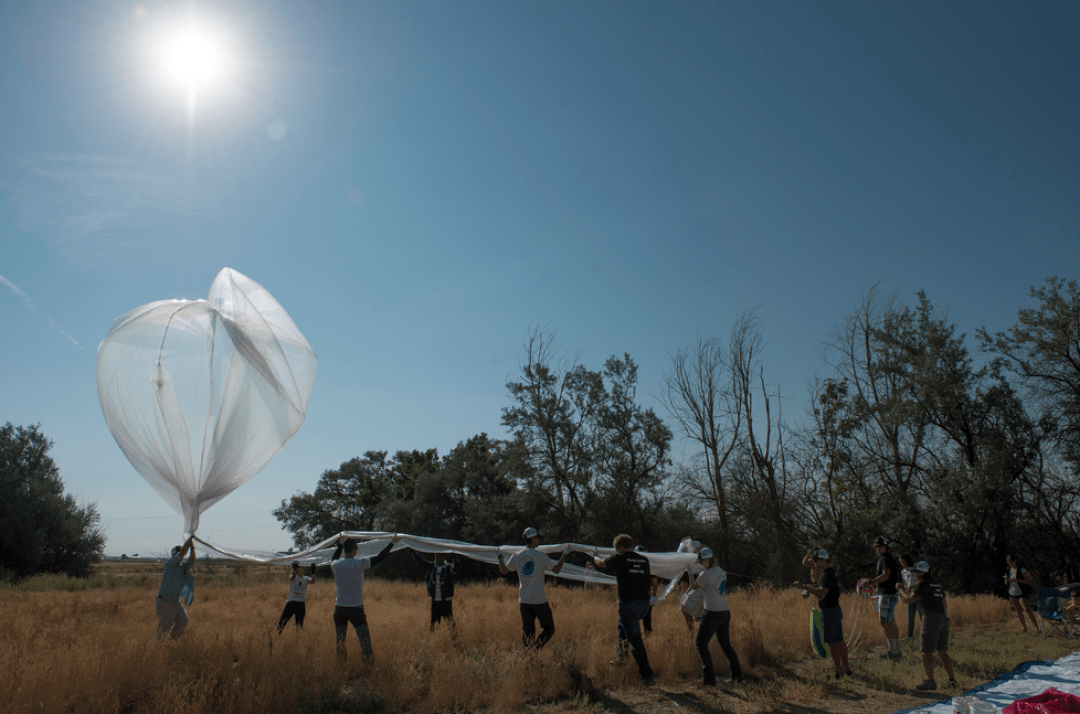
 

Teams from Oregon’s North Medford High School, New Mexico State University, Pellissippi State Community College in Tennessee and the University of Alabama in Huntsville were among those participating in the MSU-coordinated Eclipse Ballooning Project.
 
Like the other 54 teams, the MSU team launched their balloons about an hour before the peak of the eclipse so that the cameras would reach the desired altitude and have the best view during the roughly two-minute period when the moon completely obscured the sun.
 
"Everything on our end was successful," said Sara Stafford, a junior majoring in electrical engineering at MSU who helped launch the MSU balloons. Using predictions for prevailing winds, she helped select the MSU team's launch site at Camas National Wildlife Refuge, roughly 30 miles northwest of Rexburg.

"We got all our balloons in the air," she said.
 
The MSU team launched a total of four balloons: two equipped with the standard live video system, one with a specialized infrared camera for capturing images of the sun’s atmosphere as part of a student-led experiment, and one with a 360-degree camera provided by collaborators from University of Brasilia in Brazil who came to Idaho for the eclipse.

As the moon appeared to slowly consume the sun, the MSU team tapped away on laptops under an awning at the airport as they attempted to connect with the video signal from their balloons.
 
Meanwhile, other team members, friends and family watched a large television screen that displayed video captured by the Central Washington University team, which launched from Culver, Oregon. That video showed the curvature of the planet against the blackness of space, and the shadow of the approaching eclipse.

The MSU team, as well as the team from University of North Dakota that joined MSU at the Rexburg airport, struggled to establish their video connection, possibly because of an increase in radio noise that they observed.

 In this photo provided by Montana State University the corona of the first coast to coast total solar eclipse in over a century is captured Monday, August 21, 2017 at the Camas National Wildlife Refuge in Hamer, ID. (Kelly Gorham/Montana State University)

As the moon aligned with the sun and plunged Rexburg into eerie daytime darkness, the crowd here let out whoops of excitement, watching in wonder as the sun's wispy atmosphere, called the corona, became visible.
 
When the sun shifted enough to again reveal the sun's bright rays, the MSU team gathered around the display screen, watching the 80,000-foot view of the eclipse on video captured by the Wyoming Space Grant Consortium's team, called the Space Cowboys.
 
"I'm glad it worked for someone," said Casey Coffman, a senior majoring in computer engineering at MSU. "That's all I wanted."
 
"My favorite part was when we just decided to go out and watch the eclipse," he said.
 
"That was really cool," said Denise Buckner, student leader for the University of North Dakota high-altitude ballooning team who is earning her master's in space studies.
 
"Even though we didn't get live video, overall it was a success," she said, adding that their team used the opportunity to send an ozone sensor to near-space as part of an experiment to observe the atmospheric effects of the eclipse.
 
"We couldn't have done it without all of the teams coming together like this," she said.
 
"I'm excited that this was the first time that anyone has ever livestreamed aerial video of a total solar eclipse using high-altitude balloons," said Angela Des Jardins, an assistant research professor in the Department of Physics in MSU’s College of Letters and Science and director of the Montana Space Grant Consortium at MSU. "It was also the first time that there has been such a large-scale coordinated launch of high-altitude balloons from coast to coast.”

"One of the exciting things now is that the teams will retrieve their payloads and upload the video and photos," she said. The camera system on the balloons were designed to record, as well as livestream, the view of the eclipse from 80,000 feet, she explained.
 
Des Jardins first proposed the Eclipse Ballooning Project in 2014 as a way to bring together high-altitude ballooning programs across the country and provide a unique perspective of the 2017 solar eclipse while engaging students in hands-on learning.
 
One of the MSU balloons also carried a sample of bacteria as part of a NASA-sponsored experiment to better understand how such hardy microorganisms might fare on Mars after hitching a ride on spacecraft. The atmosphere at 80,000 feet resembles the surface atmosphere on Mars, and the dim lighting created by the eclipse adds further similarity, according to Des Jardins.

NASA distributed the bacteria samples, embedded on small metal tags, to 34 of the project teams and will collect the samples once the balloons’ cameras and other equipment parachute to Earth.

Since 2014, MSU students, primarily undergraduates in the College of Engineering, have worked to design and fabricate the cameras, balloon-tracking system, software, receiver dishes and other equipment. The project received a significant grant from NASA in 2015, and the live video ballooning system was distributed to the other teams at workshops held at MSU in 2016. Other teams helped to test and refine the system.

There was a sense that intensity of the experience crowned what has, for many of the students, been years of hard work.
 
"I was just excited to see the eclipse, and after that, to see video from teams across the country who had a successful video stream," said Micaela Moreni, a senior majoring in mechanical engineering at MSU. "That was amazing."


Add a Comment »

Friday, Aug. 18th, 2017

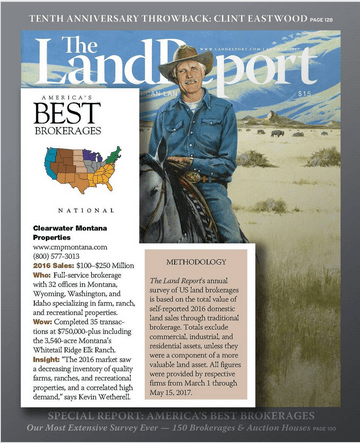
Clearwater Montana Properties Named One of America’s Best Brokerages

Clearwater Montana Properties was recently named as one of America’s Best Brokerages by The Land Report. This exclusive and highly coveted award recognizes a select group of best-in-class brokerages across the nation that specialize in land, recreational, farm, ranch, and investment properties. The America’s Best Brokerage award is among the most selective and prestigious accolades in the real estate industry. 

Why it matters: Clearwater Montana Properties is one of only a select number of non-national/non-franchise firms to be named as one of America’s Best Brokerages by The Land Report. The story of Clearwater Montana Properties serves as a testament to the hard work and dedication of average Montanans. This Montana-born company, founded by a 5th generation Montanan with deep working-class roots, has achieved an astounding level of growth and national recognition.  We are committed to giving back to our great state. We are honored that 23 years of hard work and dedication have culminated in such a great honor. 

Add a Comment »

Thursday, Aug. 17th, 2017

MSU professor recalls life-changing total solar eclipse experience

On the morning of Feb. 26, 1979, in the minutes leading up to the last total solar eclipse over the continental U.S. in the 20th century, Michael Sexson, along with an enthusiastic crowd of perhaps 2,000 others gathered behind the Museum of the Rockies, had resigned themselves to not seeing the rare and awe-inspiring celestial event.

Clouds blanketed the sky. “Every now and then you’d see a little ray of sunshine peaking in,” recalls Sexson, who at that time was an English professor at Montana State University. “It did not bode well for the many, many months of work we had put into this.”
 
By “this,” he means a three-day, MSU-sponsored celebration called Eclipse ’79, which Sexson organized with his wife and then-MSU professor of history and philosophy, Lynda Sexson. The event brought together poets, physicists, artists, musicians and scholars for what Sexson remembers as a “lively and intense” community conversation that explored the mythology, symbolism and science of the sun and moon, darkness and light.

The event featured movie showings at Bozeman’s Ellen Theater, art exhibitions, music performances and speaker presentations. The climax of the celebration was slated to be, of course, the roughly one-minute period when the moon would align perfectly with the sun, casting an eerie daytime darkness over much of Montana.

But the clouds threatened to turn that moment to anti-climax.
 
It was then that Northern Cheyenne spiritual leader John Woodenlegs, an invited speaker for the Eclipse ’79 event, took to the podium and began to chant a prayer in his native tongue. As he did, a small rift in the clouds began to widen.
 
Moments later, the full round of the sun revealed itself as the moon drifted into alignment, producing a ring of feathery light around the Earth’s star.
 
The crowd at the museum went silent, awe-struck by what was happening. Meanwhile, distant cheers erupted across the MSU campus and Bozeman, Sexson recalls.
 
“I can’t think of a more dramatic experience of the eclipse in 1979 – anywhere,” he says.
 
The extraordinary occurrence was memorialized in articles in the Washington Post, LIFE Magazine and others. But the legend, Sexson says, can’t compare to the experience.
 
“Even if one doesn’t ascribe to it the powers of the supernatural, it is a wonderful story to tell,” he says.
 
The unexpected eclipse viewing underlined what he and his MSU colleagues were trying to accomplish with Eclipse ’79: to bring people together and produce a memorable experience by sharing in a rare and otherworldly event.
 
“I can’t think of any other event in my life that has generated, to the same degree, what you would call common bonds,” says Sexson, now a retired emeritus Regents Professor in the Department of English in MSU’s College of Letters and Science.

The event may have set a high bar for eclipse-viewing, but the lesson for the upcoming eclipse is simple: Get out and view the eclipse, Sexson says. Do whatever it takes.
 
On Aug. 21, Bozeman will experience a partial eclipse in which the moon will obscure about 95 percent of the sun. The more dramatic total solar eclipse will take place over a tiny portion of southwest Montana, plus much of Idaho and Wyoming. The next total solar eclipses in the contiguous U.S. won’t take place until 2024 and 2045.

“Trust me, it’s a big deal,” Sexson says of the upcoming eclipse. “It is one of those experiences that you will remember for the rest of your life.”

Add a Comment »

Tuesday, Aug. 15th, 2017

Bolshoi Ballet Teacher in Livingston

Yellowstone Ballet Company, announces an unprecedented opportunity for area youth to study Russian Method Ballet with Nikita Kusurgashev a graduate of the famous Bolshoi Ballet Academy in Moscow. Kusergashev was one of 36 children selected to train at the famous Bolshoi Ballet Academy from a pool of 500 children who came from all over Russia for the audition. He studied Russian Ballet Technique at the Academy for 8 years. The program is rigorous and at the time of his graduation there were only 3 male students remaining in the class.  After graduation exams he was the only male student selected for the company by world-renowned Russian teacher and choreographer Yuri Grigorovich (then Artistic Director of the company). Kussurgashev was immediately promoted to soloist, though it was unusual for the theatre hierarchy policy. He danced with the company for 10 years and then danced and choreographed for the Imperial Russian Ballet Theatre (Marinsky Ballet) in St Petersburg He has been teaching and choreographing in Russian since 2007 . His students placed 1st and 3rd in the Moscow Art – Music Festival.  

Mr. Kusurgashev is delighted to come to Montana to share his knowledge of Russian Ballet Technique and also Russian Folk Dance.  He will be teaching beginner through advanced ballet in Livingston for the 2017-18 season, September 6 – June 1. The curriculum will include a men’s/boys class, all levels ballet technique, pas de deux, variations and Russian Folk Dance. He will also be teaching professional level ballet and pre-professional ballet classes which require an audition.

Beginner – advanced classes are open to students from all regional ballet schools. Students are welcome to continue training at their home dance school and supplement their training with classes with Mr. Kusurgashev’s classes. Classes will be held at Yellowstone Ballet School 109 S B St. Livingston MT.

For more information contact yellowstoneballet@gmail.com.

Add a Comment »

Monday, Aug. 14th, 2017

Fishing Restrictions Lifted on Two Sections of SW Montana Rivers

With nights getting longer and cooler, a couple of sections of rivers in southwest Montana have met the criteria for lifting fishing restrictions.
Effective immediately, the following sections of rivers (previously under “hoot owl restrictions”) are open to fishing daily:
    •    Big Hole River from Saginaw Bridge on Skinner Meadows Road to the Mouth of the North Fork Big Hole River;
    •    Lower Beaverhead River from Anderson Lane to confluence with Big Hole River;
 
For up-to-date information on restrictions related to drought, visit http://fwp.mt.gov/news/restrictions/.
 

Add a Comment »

The Salvation Army Appeals to the Public to Help Students-in-Need

“We are asking the community for help to ensure that every student in Bozeman goes back to school with a backpack full of supplies and mind full of dreams” shared Lt. Peter Oliver from The Salvation Army Bozeman Corps & Community Center. Students who are equipped with proper school supplies are more likely to stay focused and perform better throughout the year. It helps with self-confidence and keeps them motivated. Unfortunately, many students in our community return to school with empty backpacks or worn-out hand-me-downs.

If you are looking for back-to-school assistance for your family, please contact:
1.       The Salvation Army 406-586-5813
2.       Love, Inc. at 406-587-3008

Add a Comment »

Haven & Bridgercare Partnership: Bridge to Care for Domestic Violence Survivors Project

•    Bridgercare is partnering with Haven on a new initiative called “Bridge to Care for Domestic Violence Survivors Project”, which is often referred to as Havencare.

    •    The Bridge to Care for Domestic Violence Survivors Project is a partnership between two Bozeman non-profits: Bridgercare, a non-profit family planning clinic, and Haven, a domestic violence survivor agency.  


    •    Bridgercare has partnered with Haven whereby Haven will refer their participants in need of reproductive healthcare services to Bridgercare.  All Bridgercare services will be provided to Haven’s referrals free of charge.  In addition, Bridgercare will assist participants and their dependents with Medicaid or insurance enrollment as needed.  


    •    Preventing an intimate partner's reproductive choice is referred to as reproductive coercion. Research on contraception interference performed by males against female partners indicates a strong correlation between domestic violence and birth control sabotage. Research has also shown that domestic violence can increase a woman's chances of becoming pregnant and the number of children she has, both because the woman may be coerced into sex and because she may be prevented from using birth control.  The Bridge to Care for Domestic Violence Survivors Project increases access to reproductive healthcare by reducing financial and privacy barriers.

    •    Bridgercare’s mission is to provide excellent, affordable reproductive and sexual healthcare and education in a safe, supportive, empowering atmosphere.  Bridgercare’s work focuses on helping men and women from vulnerable populations achieve healthier lives and financial stability through family planning and preventative healthcare.  Accessing reproductive healthcare can be difficult for survivors of relationship and domestic violence due to financial strains and lack of confidentiality on family health insurance plans.  By offering free services to those individuals who are concerned about confidentiality and cost, Bridgercare serves its mission.

    •    This partnership is funded by a grant from the Doll Family Foundation.

Add a Comment »

MSU ranked best value among universities in Montana by Money magazine

Montana State University has been recognized as the best value of any university in the state, according to a ranking published Thursday by the magazine Money.
 
In its listing, the magazine notes that MSU is Montana’s largest university and attracts more than 40 percent of its students from out of state. MSU welcomed a record 16,440 students in fall 2016 and has seen continuous enrollment growth since 2008.
 
In addition to being ranked best in the state, MSU was also listed 364th out of 711 schools ranked on Money’s national Best Colleges for Your Money list.
 
“As a land-grant university committed to academic excellence, Montana State University is proud of its record of maintaining affordability while providing its students with a signature undergraduate education,” said Chris Kearns, MSU’s Vice President of Student Success.
 
To compile its lists, Money calculates the estimated cost of attendances, which includes tuition, housing, fees and other costs, minus the average financial aid to students. Early career earnings of recent graduates are also calculated, based on data from PayScale, a crowdsourced database of compensation information.

“Research spending typically exceeds $100 million, offering undergrads and grad students access to hands-on creative and research projects,” Money wrote in its profile of MSU. “It's also been recognized for its specific commitment to undergraduate research, in which the school invests more than $1.7 million annually.”

MSU is one of 222 U.S. universities – out of more than 4,600 – that has been designated as having higher or highest research activity by the Carnegie Foundation for the Advancement of Teaching.
 
Offering more than 225 academic options in its colleges and programs, MSU is among the top 3 percent of colleges and universities in the nation for research expenditures. It is also Montana’s largest research enterprise, conducting more than $100 million in research annually.
 
MSU is a national leader in producing winners of the Goldwater Scholarship, the nation’s premier award for undergraduates in math and science fields, according to the Barry Goldwater Scholarship and Excellence in Education Foundation. MSU has produced 68 Goldwater scholars.

Add a Comment »

News Comments