

Monday, Feb. 10th, 2020

5 Tips For Choosing Your Perfect Wedding Caterer

Your wedding is arguably the most important of all the events you are likely to have been involved in. It is, in fact, the most momentous day in your life. That is why you will make it the most memorable day ever to have happened. Just like any other event, you will need a theme, photography, theme decorations, music, food, and drinks as well as a memorable venue. Keeping all other factors constant, this article will take you through tips on how you can choose an excellent caterer for your wedding.

Prepare a budget

Before you start on the search, ensure you prepare your desired budget for catering. You should know that catering involves more than just food and drinks. It consists of the party linens- covers the tabled and other surfaces, the menu for the event which entails food and beverages, then the cost of the labor and service delivered, including cleaning and other small provisions. You can interview the caterers for the budget that well suits you. You can ask the caterers to provide packages that suit you or those that are tailored for your budget.

Dining style

Depending on the dining style you favor, you can get an excellent caterer to execute your design and like to get out of that special and unique feeling the day deserves. This comes as a reminder since a wedding can have more than one catering style combined or just one style which is executed to perfection. Some caterers are specialized in one or two styles. In contrast, others are open to providing whichever style the client is interested in. This factor is essential since it will define the class and stature of your wedding.

Ask for the suggestions

If you are low on options for catering, you can ask for some recommendations from your venue providers. The fact that they have been in business for some time suggests that they have had several caterers that have had contracts to deliver at their premises. They can get you a few suggestions as well from a pool of contacts they have kept as long as they meet your expectations. In case they do not have any credible suggestions, then you can get them to tell you the qualities and requirements they look for in the right caterer for the venue.

Furthermore, you can ask for referrals from friends and family. Chances are that they have come across right caterers from the events they have attended.

Online reviews

Technology has made it easier for companies to increase their visibility to the online community and globally. From this platform, you can easily launch a hunt for your desired caterer. Usually, companies create their online websites from which people leave their reviews and ratings of the company, your ideal candidate will be highly reviewed by most people. 

Test the best top candidates

From your research, get your best candidates then try them out. Trying your candidates involves getting to taste their food and serving techniques. You should be in a position to know what you expect at your wedding before the main event. 

Get your client on a contract

After you finish your interviews, draw up a contract for the candidate to sign up. This ensures accountability and beyond doubt responsibility. It would help if you had your prices accurate enough so that there won't be confusion afterward.

The Bottom Line

There isn’t anything more important than keeping your wedding day a day to always remember. Having the best of the services, including your caterer, serves to give you some peace of mind on your important day. Do not forget to hire an entertainment specialist.

Add a Comment »

Thursday, Feb. 6th, 2020

Contemporary Paintings of Carrie French Exhibited at Town & Country

Bozeman artist Carrie French is currently one of two featured artists at the campus location of Town & Country. Her work will be on display in the upstairs gallery through March 31, 2020.

Carrie French is a contemporary painter who's work reflects a wonder of the world, both natural and human-made. Working in oils and on occasion, mixed media, her paintings are a way of capturing and savoring fleeting moments, emotions and memories.

For more images and information, contact: carriefrenchpainting@gmail.com or 303.260.9431

Add a Comment »

Wednesday, Feb. 5th, 2020

HRDC to Offer Eighth Year of Tax Assistance Starting February 5

HRDC is set to begin their eighth season of providing tax preparation services through their Volunteer Income Tax Assistance (VITA) service run by IRS certified volunteers. Individuals and households with incomes of less than $56,000 are eligible for tax assistance through VITA.

Last year, HRDC assisted with 773 tax returns resulting in over $1 million in tax refunds back to the community. This tax season, HRDC will offer assistance in Belgrade, Big Sky, Bozeman, Livingston, and White Sulphur Springs.

HRDC’s VITA service will start on Wednesday, February 5 and go through mid-April. The majority of VITA sites operate by appointment only. Tax assistance will occur at a variety of locations, including at HRDC’s Bozeman Office, Fork & Spoon, many community libraries, and more.

Individuals and households seeking tax assistance must bring photo identification, Social Security cards and birth dates for each member of their family, and other relevant forms, like W-2 forms, 1099s, or a copy of the previous year’s tax return.

“VITA is one of the most effective ways to provide financial opportunity to individuals and families in our community. Of people we served last year, the average refund was around $1,500. That can mean a lot to a household,” says Marc Graham, HRDC Financial Opportunity Coordinator.

Those interested in receiving tax assistance should call or text the appropriate site location.

Phone numbers are listed at https://thehrdc.org/how-we-help/our-community/tax-assistance/. For more information about HRDC’s VITA service or any other HRDC program or service visit www.thehrdc.org

Add a Comment »

Tuesday, Jan. 21st, 2020

The Big Picture: New Initiative to Reduce Carbon Footprint, Promote Sustainability

Big Sky Resort has announced a new sustainability initiative, The Big Picture, with a long-term goal to reach zero carbon emissions by 2030. This net zero goal is shared by all of the ski and golf resorts in the Boyne Resorts family.

The Big Picture prioritizes reducing carbon emissions to net zero through emission reductions and offsets, as well as a focus on reducing waste. This initiative also focuses on preserving the beauty and health of the ecosystems where the company operates.

This fall, Big Sky Resort hired a full-time sustainability specialist and signed on to the 2019 National Ski Areas Association (NSAA) Climate Challenge, a voluntary program dedicated to helping ski areas inventory, target and reduce greenhouse gas emissions.

Many of the resort’s efforts won’t be obvious to customers. Buying energy from renewable sources, choosing high-efficiency snowcats and lifts, reducing energy use with smart lighting and thermostats, and supporting mass transit and on-site housing are key components of the resort’s initiatives that happen in the background. Other efforts are visible, such as how the new Vista Hall—the resort’s largest restaurant venue—has minimized single-use plates, bowls and silverware and transitioned take-out containers to compostable materials. Recycling efforts, already in practice, will be increased, specifically by eliminating 99 percent of glass, which cannot be recycled in the state of Montana, and focusing on proper sorting of cans and other recyclable materials in place of unrecyclable plastics.

Additionally, a composting program in Vista Hall will pilot diverting food waste from landfills to a local composting facility in Bozeman. This winter, Big Sky expects to keep more than one ton of waste out of landfills, and plans to expand the effort to other food and beverage operations in the near future.

"While we plan to put significant focus in efforts to reduce our greenhouse gas emissions, waste reduction is also an important step to take responsibility for our environmental impact,” said Kryn Dykema, sustainability specialist, Big Sky Resort. "Rather than sending organic material to the landfill, composting created by this waste diversion program contributes to local agriculture with healthy soil.”

“Our goal is to continue innovating and reimagining our approach to a changing climate,” said Big Sky Resort General Manager Troy Nedved. “We are dedicated to balancing our environmental footprint, social responsibilities, and growth. We believe that by honestly and openly evaluating our impact, and working together with other stakeholders, we can make a positive difference.”

Add a Comment »

Wednesday, Jan. 15th, 2020

Montana Science Center announces reopening in new location

On Monday, January 20th, Montana Science Center, will open doors to the public at the new, refurbished location: 2744 W. Main St. After temporarily closing the doors at 202 S. Willson on December 1, 2019, the staff at MSC is excited to announce that the new location is ready for families and community members to visit. Located across from the Gallatin Valley Mall, the new location is nearly double in size of their old location and will feature new exhibits, a new Science Station, expanded STEAMlab and larger meeting space for programs and events.

“It has been an incredible project to be a part of,” says Board President, Mandy Dredge, “Watching this location take shape with upgrades, additions and design enhancements is exciting. We are looking forward to inviting the community to become engaged in hands-on, creative experiences in STEAM topics in this new location.” Thanks to supporters all around the community, the former Children’s Museum of Bozeman is opening doors to a location that embodies their mission of ​providing hands-on learning experiences in science and technology that inspire creativity, innovation, and lead to real-world application.

In addition to new programs, the high-tech makerspace, STEAMlab will offer expanded opportunities due to its increased size. “Families from all over the Gallatin Valley gather at the Science Center to spend time together learning something new, build something, or experience science during a hands-on activity,” says Executive Director, Abby Turner. “We invite anyone that wants to engage with science, technology, engineering, art and math (STEAM), to join us. Our new location will expand on our mission and we are excited to be able to facilitate more exciting opportunities for students and families that visit.” Well known programming like Preschool Science, Open Lab in the STEAMlab and Free Friday Nights will resume as well in January.

With all of the new changes, Montana Science Center hopes to work with community members to engage in collaboration of what else could be added to enhance informal STEAM education in the future. ​​As a local, non-profit providing unique, hands-on experiences for families with kids of all ages, the Montana Science Center relies on supporters to lower barriers to access to science and technology discovery through hands-on exhibits and experiences. All questions and comments can be directed to the science center.

Add a Comment »

Fourth Annual Winter’s Bounty Farm to Table Feast

Winter’s Bounty Farm to Table Feast is a fundraising event in support of Gallatin Valley Farm to School. Proceeds support our efforts to: provide meaningful food, nutrition, and agriculture education in schools; integrate healthy, local food into school meal programs; and promote a vibrant local food economy through community partnerships. Gallatin Valley Farm to School is a Bozeman based nonprofit organization started in 2007.

Event Details
Date: February 28, 2020 Location: Firelight Farm in Bozeman
Attendees: Local food supporters, business owners and professionals, parents of school age children, school administrators and teachers, farmers, ranchers, and foodservice and healthcare professionals

Donation Opportunities
During Winter’s Bounty, we host both silent and live auctions. These include experiences and items from businesses and individuals across the Gallatin Valley. Donations to Winter’s Bounty show your support of healthy children and families as well as a stronger, more vibrant community in the Gallatin Valley. Gallatin Valley Farm to School will promote your support leading up to and during the event.

Deadline: February 14, 2020
Contact: Kate Emmerich, Associate Director, 406-830-5731, kate@gvfarmtoschool.org
Thank you for supporting healthy kids, vibrant farms, and strong communities.

Gallatin Valley Farm to School is a 501(c)(3) nonprofit organization - Tax ID #: 45-3528080 Sponsorships and donations are tax-deductible to the fullest extent of the law.

Add a Comment »

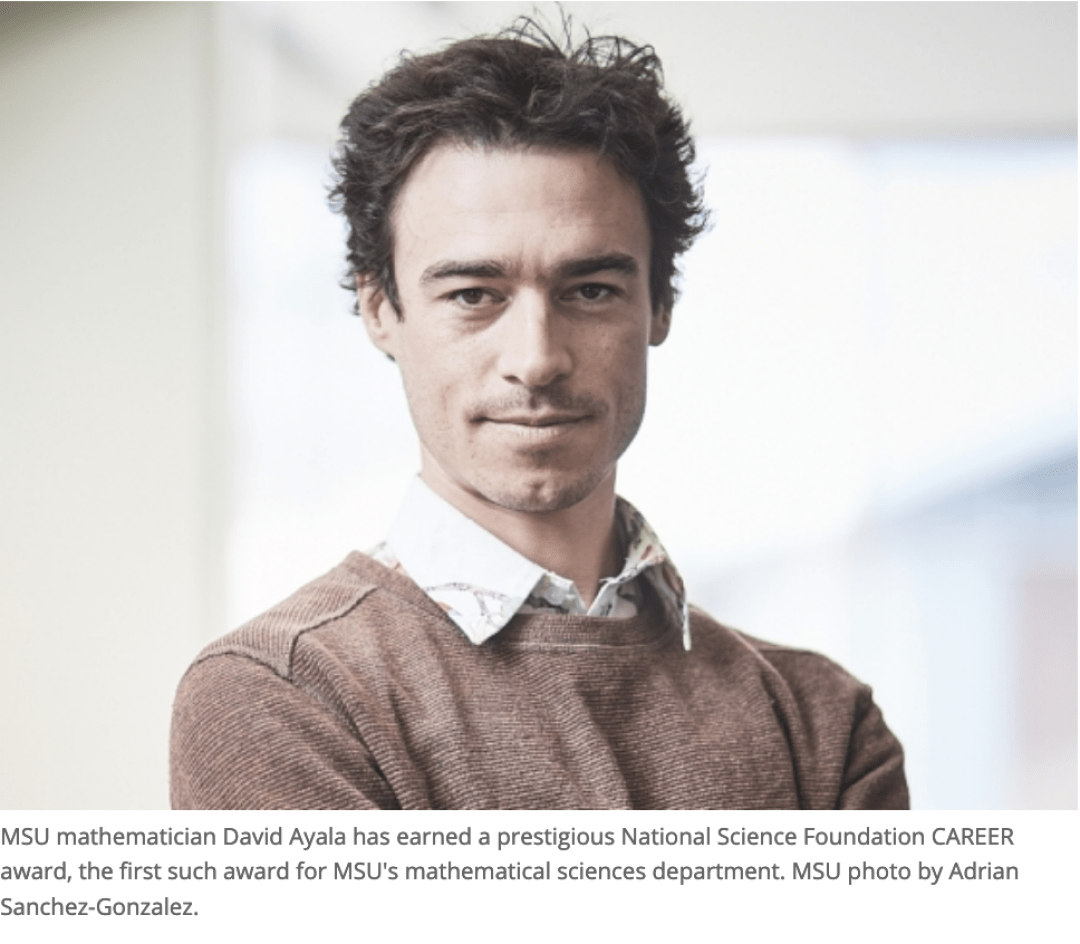
MSU mathematician receives prestigious NSF CAREER Award

A Montana State University mathematics professor who is nationally recognized for his work to solve a problem that may advance an area of quantum physics has just received a highly coveted National Science Foundation CAREER grant, the first such award received by a member of the MSU Department of Mathematical Sciences.

David Ayala works in a mathematical field called topology, specifically higher category theory that has important applications in quantum physics. The bulk of his $400,000 NSF CAREER award, given over five years, will fund two mathematical physics conferences around Bozeman, as well as support graduate students in the MSU Department of Mathematical Sciences in the College of Letters and Science, he said.

Ayala explains that higher category theory is a system of techniques for identifying patterns, or structure, held by certain arrays of information. Ayala's work applies these techniques to data that are the observables of certain quantum systems, with the goal of addressing the long-time, long-distance behavior of the system.

Ayala, 37, just began a semester-long appointment as one of three leaders of a program that hosts 200 mathematicians from around the world during a four-month program at the Mathematical Sciences Research Institute in Berkeley, California. The fall semester Ayala will travel to several other locations to work on his ongoing project before returning to MSU in January 2021.


When Ayala returns, the NSF grant will enable him to integrate research and education between students and researchers in Montana and surrounding states. He also will plan conferences that will bring renowned researchers in mathematical physics to the state.

While his field of mathematics may sound esoteric, his colleagues use more concrete words to describe his interactions.

“David is fiercely committed to people’s enjoyment of mathematics, whether it is himself, his undergraduate students or his graduate students. And he is fearless about trying new things,” said Elizabeth Burroughs, head of the MSU Department of Mathematical Sciences. “That’s what makes him a great teacher, but it also makes him a great mathematician, taking his research field in new directions.”

Although Ayala’s work is solitary and his field is complex, he often likes to work communally in local coffee shops, where he jots down complicated equations in large, unlined art notebooks. He also frequently spends several hours each day video chatting with his collaborators, who are located around the world.

A prominent researcher in his field, mathematician Haynes Miller at Massachusetts Institute of Technology, said that Ayala and his collaborator, John Francis, have led the exploration of a field of mathematics called factorization homology, which connects high-dimensional geometry with higher-category theory. Miller said the impact of Ayala and Francis’s work is only just beginning to be felt.
 
While Ayala’s work is garnering him recognition from colleagues in mathematics and quantum physics around the world, people in Bozeman are likely to recognize his name for his accomplishments as a trail runner. He has twice won the Bridger Ridge Run, including last August’s race. His arduous 93-mile run through Death Valley in 2013 was featured in Trail Runner magazine.

Ayala said that he runs not to think and solve equations. Rather, trail running allows himself to turn off his active brain.

“I run so I can’t think of anything else,” he said.
 
In fact, the landscape and community surrounding Bozeman was an important factor in his coming to MSU. The son of medical providers who worked in Zion National Park, Ayala grew up in Rockville, in southern Utah. He attended a two-room schoolhouse in which the first three grades were in one room and the other grades in another room. There were five students in his grade.

“It was precious,” said Ayala of his upbringing. He said he remembers being embraced by his entire community, since there weren’t many children. He was bussed to high school in Hurricane, Utah.
 
Ayala recalls spending a lot of time alone, running and hiking and skiing. He taught himself to juggle and then later started reading books on math and physics for fun. He attended the University of Utah. “I didn’t even think of going any place else.”

And then his education and passion for math jumped into high gear. He earned a bachelor’s degree in math in just two years. In the next two years, he earned another bachelor’s degree in physics as well as a master’s degree in math. His doctorate in mathematics is from Stanford. He was a post-doctoral fellow at the University of California, Berkeley’s Mathematical Sciences Research Institute, the University of Southern California, Harvard University and the University of Copenhagen.

“I really, really wanted to return to the Intermountain West after that,” said Ayala, who has been at MSU since 2014.

Ayala said that in addition to allowing him to pursue his research, his position at MSU provides him the satisfaction of working with intriguing undergraduate students, several graduate students and collaborators.
 
“I enjoy sharing an idea and seeing in a student’s eyes the moment they understand it,” he said.
 
Burroughs said the fact that Ayala already has worked at such a high level of scholarship for many years and produced a steady output of strong and innovative mathematics is just part of the Ayala equation.
 
“He finds joy in what he does. And he hopes other people find joy in it, too,” Burroughs said. “He has chosen to be here at MSU in the mountains doing the work he loves. And we at MSU are so fortunate.”
 

Add a Comment »

Monday, Jan. 13th, 2020

FWP seeking applicants to Region 3 Citizens Advisory Committee

Region 3 of Montana Fish, Wildlife & Parks is seeking applicants to fill vacancies in its Citizens Advisory Committee. 

The committee meets several times per year and operates in an advisory capacity to help FWP be responsive and effective resource managers within the constraints of the law. Citizen advisors help identify emerging trends and resolve conflicts, and they act as FWP ambassadors to various interest groups and geographic communities. 

FWP employees benefit from having a deeper understanding of public priorities and expectations with help from citizen advisors, who can function as a trusted sounding board for ideas and initiatives. People who volunteer in this capacity benefit from understanding FWP programs, priorities, administrative processes and limitations in a broader context. 

FWP is seeking applicants representing a variety of interests from communities across southwest Montana within Region 3. For more information or to apply, contact FWP at 406-577-7891 or send an email to Morgan.Jacobsen@mt.gov. The application deadline is 5 p.m. on Jan. 31.

Add a Comment »

Friday, Jan. 3rd, 2020

MSU librarian recognized with national public service honor

In the course of a semester, Montana State University research services librarian Mary Anne Hansen will work on myriad projects, including providing library instruction for dozens of courses, conducting individual and small-group research consultations, assisting students and faculty on literature reviews and more. She leads MSU’s Tribal College Librarians Institute, assists other library staff with on-call chat and email research assistance and works on special projects, such as the library’s popular Paws to De-Stress program, where therapy dogs visit the library before and during finals week each semester to interact with students.

“I love being a research librarian because I love helping people and teaching them how to become better researchers in their disciplines, as well as understand the information infrastructure, from Google Scholar to meta-search tools to databases specific to their discipline,” Hansen said. “I love being challenged, and, most of all, I love the relationships I form with faculty and students.”

Hansen, herself, is loved, too. She was recently named one of only 10 winners nationwide of this year’s I Love My Librarian Award from the American Library Association. The prestigious honor recognizes librarians for leadership in the profession and for their commitment to transforming lives. The ALA selects the winners from public nominations that showcase the lasting contributions of dynamic librarians working in public, school, college, community college and university libraries. This year, library users nationwide submitted nearly 2,000 nominations.

“It’s difficult to put into words how honored I am at receiving this award,” Hansen said. “I’m so grateful to all of the wonderful mentors and champions who have guided me along the way in my 20-plus years as a librarian.”

Hansen, who in addition to her work at MSU’s Library serves as president of the Montana Library Association, has a long association with MSU and its library.

Hansen is a Bozeman native, and both of her parents attended MSU. Her dad, a decorated World War II veteran, graduated in 1948, and her mother took courses at MSU to become a school librarian after earning a degree from the University of Montana.

Hansen also attended MSU and worked in the library during her undergraduate years. She graduated with a bachelor’s degree in modern languages in 1985 and then earned a master’s in adult and higher education in 1993. In addition to herself and her parents, more than 20 others in Hansen’s extended family have attended or graduated from MSU, she said.

Hansen began working as a staff member at MSU in 1987 and then, after earning a master’s degree in library science through an online program of the University of Arizona, became a faculty member in the MSU Library in 1996.

She calls the library an “incredible” place to work.

“I love working at MSU because it’s such a vibrant university with so many dedicated faculty and staff. Additionally, there is widespread understanding across campus that a well-supported and healthy library is essential infrastructure for MSU’s educational and research enterprise,” Hansen said. She added that the library provides a range of research and technology services to meet the needs of the MSU community, and it also works with partners across the state to advance research skills and education.

“I have a lot of great colleagues who are very service-oriented and student-centered,” Hansen said. “Whether in tech services or public services roles, everyone in the library deeply understands that we’re helping MSU accomplish its education mission.”

Hansen said that the highlight of her career has been her 22-year involvement with the Tribal College Librarians Institute, which provides free professional development opportunities for librarians serving indigenous college students.

Often, the tribal college library is the only library on a reservation, and it also fills the role of a public library, Hansen said. To ensure tribal college librarians can receive the training, Hansen has procured more than $800,000 in grants to help reduce travel expenses for librarians attending the institute. Over the 29-year history of the institute, more than 400 librarians and presenters have benefited from it; many attendees return multiple times and represent 25 states, four Canadian provinces and come from as far as New Zealand.

“I’ve formed deep and rewarding relationships with many of the tribal college librarians, and I’ve learned so much from them,” Hansen said.

In addition, Hansen is a leader in the library community, not only through her work with the Montana Library Association but also through her involvement with the American Indian Library Association, which has included working with the ALA to create an advocacy toolkit for rural, native and tribal libraries. And, she said it has been rewarding to serve as a Montana liaison to the regional medical library in Seattle, a relationship that has earned her health education outreach funding to train constituents across Montana, such as students at tribal colleges, K-12 science, technology, engineering and math educators, Montana librarians and others.

Kenning Arlitsch, dean of the MSU Library, said Hansen’s recognition is well-deserved.

“Mary Anne’s impact on the lives of students, colleagues, and public citizens is real and demonstrable,” Arlitsch said. “Whether she’s teaching students to critically consider information sources that shape their education, facilitating the professional development of her colleagues through (the Tribal College Librarians Institute) or delivering health information to the citizens of Montana, Mary Anne shows commitment and dedication in everything she does.”

Since the inception of the I Love My Librarian Award in 2008, the ALA has selected up to 10 librarians annually from a pool of hundreds of nominations. This year’s winners will each receive $5,000, a plaque and a travel stipend to attend the I Love My Librarian Award ceremony in Philadelphia on Jan. 25. The award is sponsored by the Carnegie Corporation of New York, the New York Public Library and The New York Times.  

Over the last decade, library supporters have shared more than 19,000 nominations for the award. Information regarding previous award winners can be found at ilovelibraries.org/lovemylibrarian.

Add a Comment »

MSU team quantifies the importance of storytelling in crisis communication

A Montana State University team has discovered that telling a story about a potential hazard engages the audience significantly more than delivering straight facts.

MSU political science professor Elizabeth Shanahan led the interdisciplinary team of seven MSU professors and two graduate students who investigated how a narrative-based risk communication might better prepare the public to avoid a natural disaster. Their paper, “Characters matter: How narratives shape affective responses to risk communication,” was recently published by the journal PLOS One in its special issue on science and story.

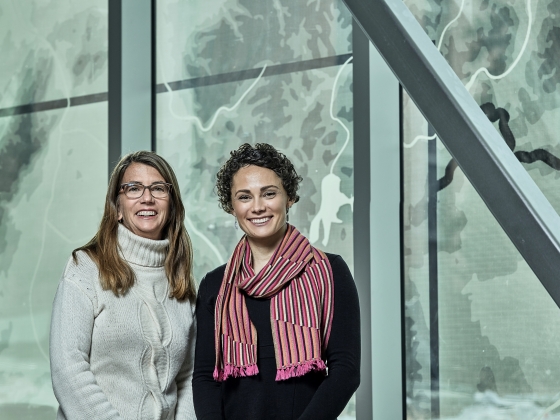
Montana State University faculty Elizabeth Shanahan, left, associate professor of political science and Ann Marie Reinhold, assistant research professor in land resources and environmental sciences, along with other MSU faculty collaborators, have co-authored a paper that will be published in PLOS One academic journal about the power of narrative in risk communications. MSU Photo by Adrian Sanchez-Gonzalez

Based on work funded by a National Science Foundation grant and with data garnered from flood-prone parts of Montana, the article demonstrates that the public pays more attention and internalizes risk best if the information is presented as a story, particularly if the public can visualize becoming a hero in that story by being prepared.

“We knew that narrative in general was important in risk communication, but this study adds precision by using innovative measures for how audiences respond to specific narrative mechanisms,” Shanahan said. “As our title reveals, characters matter in how audiences respond to risk messages, and narrative constructs are really important in communicating science.”

The investigation represents the initial results of more than two years of work from an MSU Institute on Ecosystem’s team composed of Shanahan; Ann Marie Reinhold, land resources and environmental sciences in the College of Agriculture; Eric D. Raile, political science; Geoffrey Poole, land resources and environmental sciences; Richard Ready, agricultural economics and economics; Clemente Izurieta, computer science in the Gianforte School of Computing in the Norm Asbjornson College of Engineering; and Jamie McEvoy, Earth sciences. MSU graduate students Nicolas Bergmann, Earth sciences, and Henry King, computer science, also contributed to the paper.

Shanahan said the strength of the MSU team was the members’ diverse viewpoints and distinct disciplinary approaches.

“Interdisciplinary research takes time and patience. For example, we even had to arrive at a similar language surrounding what a hypothesis is and how to analyze and visualize data,” Shanahan said. “We bring very different ways of knowing to science that have, in the end, produced a fantastic article that advances the study of hazards and risk preparation. None of us could have done this work as individual scientists.”

Working with emergency managers in 2017, researchers interviewed about 45 people in flood-prone areas along the Yellowstone River. From those interviews, the researchers developed a list of commonly used words associated with narrative characters and then built multiple risk-preparation messages.

In group sessions, respondents were given eight messages regarding flood risk. Two contained straight scientific facts; those were least favorably received. The remaining six involved using different character types, such as hero or victim, along with scientific information . The messages that elicited the greatest response were those where the participants could visualize becoming a hero in the face of a hazard. The biggest change in audience response occurred when messages called upon the listener to transform from a victim to a hero, she said.

“Conventional risk communication efforts are often ineffective at inducing people’s preparedness,” the group writes in the article. “One possible explanation is that scientists and the public do not share a common language to describe risk.”

Shanahan notes that audiences did not respond when characters were first portrayed in the message, but they became very engaged when characters actually did something. The team called this phenomenon the “Hobbit hypothesis.” That means the first chapter introducing the characters is not very exciting. However, when the characters become active, the audience also becomes engaged in the story.

Shanahan said the results of the study have important implications for all organizations seeking to deliver information about how to prepare for hazards such as floods, earthquakes and wildfires.

“Of great importance to agencies in the area of risk communication is that a message within a story narrative will move people,” she said. “To prepare people for a disaster, this is when you need story.”

Nic Rae, dean of the MSU College of Letters and Science and a political scientist, said Shanahan and the team are international leaders in demonstrating the importance of narratives in formulating public policy choices.

“Their results also have relevance for the debate of communicating science, one of the critical issues of our time,” he said.

Shanahan has been working for about 15 years developing what is known as the narrative policy framework, which quantifies how people tell and are influenced by stories. Her undergraduate degree from Dartmouth College was in comparative literature, so the idea of story theory came naturally. She said she began her work measuring political narratives while a doctoral student at Idaho State University. She now specializes in policy process and political communication.

That work has led to serving as the principal investigator and co-principal investigator of two NSF-funded projects about the importance of narrative in scientific communications. Her work often takes her to Australia, where she works with Raina Plowright, MSU professor of microbiology, on how to communicate information about Hendra virus, a zoonotic disease that can also be fatal to humans. She also works internationally on conflict communications involving humans and wildlife.

She said the next steps in the project are to test how narrative-based risk communication influences risk perceptions and decisions and to spread the information to emergency managers throughout Montana.

“We hope that with this work we can better align perceived risk with actual risk,” Shanahan said. “The point of the study is: If you know what you want people to do, the way to get them to prepare is to put the important science in a story form.”

Add a Comment »

News Comments