

Monday, Sep. 14th, 2020

The Salvation Army Sets Out to “Rescue Christmas” Due to Immense Impact of COVID-19

For the first time in 130 years, The Salvation Army is starting its annual holiday fundraising campaign early across the country in order to rescue Christmas. The funds raised through the organization’s iconic red kettles are at risk this year due to COVID-19 while requests for services are at an all-time high.

Based on the increase in services already provided in response to the pandemic, the organization could serve up to 155 percent more people in 2020 with Christmas assistance, including putting food on the table, paying bills, providing shelter and helping place gifts under the tree – assuming the resources are available.

At the same time, due to the closing of retail stores, consumers carrying less cash and coins, and the decline in foot traffic, The Salvation Army could see up to a 50 percent decrease in funds raised nationally through the red kettles, which would limit their capability to provide services for the most vulnerable. To put this in perspective, last year $126 million was raised nationally through about 30,000 red kettles.

“There are so many more people in need this year than we’ve seen in a long time. I invite our community to come together to rescue Christmas and support our neighbors,” says Lt. Rick Larson, The Salvation Army Bozeman Corps Officer.
 
Since March, The Salvation Army in Montana has provided more than 4,000 meals, 3,600 nights of safe shelter, and emotional and spiritual support to over 1,500 people in need. Now more than ever, they’re making it safer and simpler to donate in order to support the most vulnerable in Montana:
    •    The best way to ensure that these vital services continue is to enlist in Love’s Army with a sustaining monthly gift of $25 per month.
    •    To help ensure the safety of bell ringers, donors and partners, The Salvation Army has adopted nationally mandated safety protocols.
    •    Donate digitally with Apple Pay or Google Pay at any red kettle in Montana.
    •    Ask Amazon Alexa to donate by saying, “Alexa, donate to The Salvation Army,” then specifying the amount.
    •    Give any amount by texting “KETTLES” to 91999.
    •    Donate physical gifts in bulk.
    •    Adopt additional Angels to give hope and joy to kids and families in need through The Salvation Army’s Angel Tree program.
 
Every donation provides help and hope to those in need, and all gifts stay within the community in which they are given. Visit imsalvationarmy.org to donate or learn more about how you can help The Salvation Army rescue Christmas this year.

 

Add a Comment »

Sunday, Sep. 13th, 2020

Three artists selected to display work in MSU’s American Indian Hall

Three artists have been selected to display major pieces of their work in Montana State University’s American Indian Hall, which is slated to be completed next fall.
 
Artists Bently Spang, a member of the Northern Cheyenne Tribe who lives in Billings, Robert Martinez, a Northern Arapaho who lives in Riverton, Wyoming, and Stacia Goodman of Minneapolis were selected by a committee of eight members. The committee was composed of representatives from across MSU’s campus as well as members from Montana’s Native community.

Walter Fleming, chair of the Department of Native American Studies, said the committee distributed a call for artists for the building, which will open next year. Twenty-six artists responded to a request for proposals with projects that would represent the university’s desire to make the American Indian Hall reflective of Native culture as well as the building’s major themes of water, fire, earth and air.

“The major themes reflect the natural elements that many indigenous cultures revere,” Fleming said. He said each one of the artists are significant in their potential to engage visitors to the American Indian Hall and to generate deeper thought.
 
The 31,000-square-foot American Indian Hall will serve as a home to MSU’s Native American community as well as a bridge between American Indian culture and other cultures on campus. The building is planned to open in fall 2021, and classes will be held there beginning spring semester 2022.
 
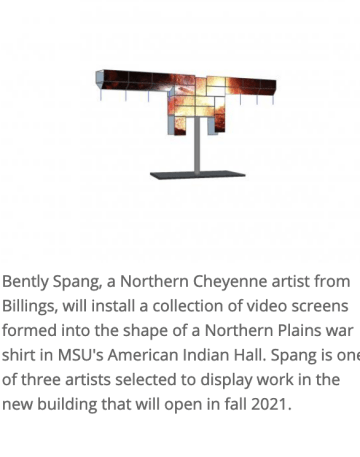
Spang is a Northern Cheyenne multidisciplinary artist, writer and curator whose art utilizes technology to tell timeless visual stories. His work has been exhibited in North America, South America and Europe. Spang’s proposal is to install a bank of video monitors onto a frame that will be built in the shape of a large Plains Indian war shirt. The screens will display synchronized videos that will include scenes of fire and water as well as highlights of the tribal communities in the region.

“(Spang’s) art will give the hall the ability to create new subject matter for the screens that will make his art timely,” Fleming said.
 
Martinez is a visual artist and designer who will use paintings in vibrant and contrasting colors that transform the standard photo studio style sepia portraits into vivid images.


“We want his paintings to reflect the whimsy and humor of Native culture and represent our students as hard-working and fun-loving,” Fleming said. “We want our students to be able to see themselves in his portraits.
 
Goodman is a non-Native artist who creates mosaic pieces of art glass and tile. Her work will cover a column in the AIH project.
 
“What is exciting about Ms. Goodman’s concept is that, as a column, visitors will be able to walk around it, providing art that visitors can engage in close-up,” Fleming said. “(Her) mosaic style gives her pieces the quality of movement, perfect for water and fire.
 
Fleming said that in addition to the featured artists, members of the community have been generous in donating art from their homes for potential use in the American Indian Hall.

“This has been particularly gratifying as we will have a lot of wall space in our new home,” he said.
 
Major Robinson, the cultural design liaison for the project who is also a member of the selection committee, said that public art is important for most buildings, but particularly the American Indian Hall, which he calls an “environmentally respectful building.”
 
“These art pieces represent and communicate values tribal peoples bring to the campus for the time MSU is their home,” said Robinson, a Northern Cheyenne architectural designer who has also served as a member of the Montana Board of Regents and is the owner and principal of Redstone Project Development.

“Besides creating a sense of home, these very same indigenous expressions of art welcome non-Native students and visitors to learn more about the original pre-Montana inhabitants' culture and values.”
Robinson said that he believes the entire building will be a living piece of art, from the Native plants outside the building that will greet visitors, the eagle feather canopy to the culturally infused drum room that will be crafted from 100-year-old “grandfather spruce, thoughtfully harvested and preserved on site to make room for the new American Indian Hall.”

“Each space one passes through is an invitation for all who enter to discover more about tribal peoples and hopefully realize the value they add to Montana State University,” Robinson said.
 
Swank Enterprises is the general contractor on the project, and the architect is ThinkOne Architecture.

Add a Comment »

Thursday, Sep. 10th, 2020

406Cirque announces partnership with Clowns Without Borders


Bozeman, MT:
 Today, 406Cirque announces that it has a signed Memorandum of Understanding with Clowns Without Borders. This Memorandum brings 406Cirque into a fiscal sponsorship agreement with Clowns Without Borders, and further states that a fiscal sponsorship of Clowns Without Borders is consistent with its organizational goals to make circus accessible to children worldwide.

Clowns Without Borders (www.clownswithoutborders.org) is a 501(c)(3) not-for-profit organization that sends small teams of professional circus artists to perform in refugee camps, conflict zones, and communities in crisis. Its mission is to promote resilience through laughter. 
 
Naomi Shafer, Executive Director at Clowns Without Borders, says: “We are thrilled to provide fiscal sponsorship for Cirque for All, 406Cirque’s scholarship program. Our organizations share a mission to use circus to inspire change. We are delighted to support this program.”
This fiscal sponsorship agreement enhances the mission of 406Cirque, which is to guarantee access to circus and performing arts to communities in the state of Montana, especially children. Through this fiscal sponsorship agreement, 406Cirque will be able to receive donations for scholarships and apply for grant funding for which it otherwise would not be eligible. Paúl Gomex, founder of 406Cirque says,“this program is a chance to share the magic of circus with everyone. In addition to scholarships for our afterschool and summer programs, we will also offer free training days for adults, as well as free shows for the community of Bozeman, when the circumstances allow for that to happen”.

406Cirque is headquartered in Bozeman, MT, and currently operates out of Petra Academy and the Emerson Center for Arts and Culture. The organization has just expanded to afterschool programming on Mondays, Tuesdays, and Wednesdays. Gomex comments “In times of crisis, we step up. The circus is about defying odds, inspiring awe, and coming together as a community. We developed COVID procedures for our summer camps so that kids and families could stay safe, while also having fun.”

About 406Cirque:
406Cirque is a school of circus and performing arts in Bozeman, Montana. It is a place where individuals of any skill level or background can explore their passion. More information at 406cirque.com.

Add a Comment »

Calling all fans of purple-haired fairies, pizza-loving dragons, and ticklish-aliens: The Gallatin Valley has a new Children’s Theater Company

BOZEMAN, Mont. —  The Gallatin Valley is home to a new children’s theater company called “Random Acts of Silliness” (RAOS). RAOS is a troupe of performers committed to creating magical theater experiences with and for children,  filled with rich storytelling, bold characters, and silliness to spare.

Random Acts of Silliness grew out of Verge Theater’s improv program, where RAOS founder Danielle Thomsen performs with the Bozeman Improverts and directs the “Silly Moose: Improv Show for Kids.” While public spaces were closed this summer the RAOS troupe performed socially-distanced pop-up driveway shows for small groups of children.

“We were so happy to make children laugh and provide a taste of live-theater for local families,” Thomsen said. “It doesn’t matter if we’re only able to perform for five people at a time, we are committed to providing fun, safe, theater experiences for Gallatin Valley kids.”

Rooted in improvisation, most performances are highly interactive, and feature characters and plots inspired by audience members. The unique shows are created entirely on the spot, based on suggestions from the audience. Kids naturally have funny, original ideas, and performers are excited to bring those ideas to life.

The company has several events scheduled for September in partnership with the Gallatin Valley Land Trust: two outdoor improv shows and a self-guided fairy village experience.

“Now, more than ever, parents are looking for creative ways to keep their kids engaged and active in the Gallatin Valley,” said GVLT Associate Director EJ Porth. “We are thrilled to partner with RAOS to bring fun, safe, socially-distanced activities for children to our parks and trails that will get the creative juices flowing again. Right now, everyone could use a little magic.”

Visit randomactsofsilliness.com or our social media channels for more information about upcoming events.

Details of Upcoming Events

Random Acts of Silliness in the Park* (in Partnership with Gallatin Valley Land Trust)

Saturday September 12 10:30-12 Lindley Park

Saturday September 19 10:30 -12 Dino Park


*Social distancing will be enforced and mask required for anyone age 5 or older.


Fairy Village Adventure (in Partnership with Gallatin Valley Land Trust)

(See RAOS or GVLT Website for Location Details)

Ten Bozeman artists have collaborated to create a magical fairy village on the Gallagator Trail. This is a self-guided experience, visit between September 22 and October 5.

--

Random Acts of Silliness: Inspiring Laughter & Play in the Gallatin Valley

Add a Comment »

Wednesday, Sep. 9th, 2020

Drainpipe cause of New Zealand mudsnails at FWP fish hatchery

Since New Zealand mudsnails were detected at Montana Fish, Wildlife & Parks’ Bluewater Fish Hatchery Tuesday, Aug. 18, the department continues to look at whether infected fish were stocked at lakes or reservoirs and what led to the infestation.  

The Bluewater Fish Hatchery, located near Bridger in southcentral Montana, is a trout hatchery and is the third largest production facility in the state. This is the first time New Zealand Mudnsails (NZM) have been found at an FWP hatchery.

The likely cause of the infestation is a drainpipe from the hatchery that drains into neighboring Bluewater Creek, which is positive for NZM. The operating procedures for the hatchery call for the pipe to be elevated above the creek, but over the years, the pipe has become submerged. NZM were likely able to make their way up the pipe and into the hatchery.

New Zealand mudsnails are an aquatic invasive species. It was first discovered in Montana in 1995 in the Madison River above Hebgen Lake Reservoir. Since then, New Zealand mudsnails have been detected in multiple locations across the state.  NZM can be eaten by fish and other animals, like birds, but unlike native snails, they are undigestible and can be spread by fish and wildlife into other waterbodies.

In a confined facility, like a fish hatchery, NZM can be quickly eradicated and the facility decontaminated. However, due to the detection, the fish at the hatchery – about 20,000 pounds – were euthanized and disposed of. FWP had about $85,000 into rearing the fish. FWP staff are working on a containment and mitigation strategy.

The plan is to make up the losses from Bluewater with surplus fish from FWP hatcheries. 

Prior to this detection the Bluewater hatchery had contributed to relatively few releases in 2020, all of them into state/public waters.  Monitoring for New Zealand mudsnails and other invasive species will continue in these waters and others. 

All hatcheries in Montana are inspected annually for AIS and fish pathogens. The mudsnails at Bluewater Fish Hatchery were detected during the hatchery’s annual inspection.

To help prevent the spread of AIS, people working and recreating in and around our waterways must practice clean, drain, dry. For more information on AIS, please go online to CleanDrainDryMT.com.

Comments 1

Tuesday, Sep. 8th, 2020

Beaver Populations on the Rise in Montana

Most home and farm owners perceive beavers as threats because of their digging and tree-eating habits. Beavers create dams and redirect waterways for their use. They have become common sights in suburban areas as a result of the deforestation habits of man. Human activities force beavers to co-exist with humans, and the beaver population has been on the rise in Montana in recent years.

BEAVER APPEARANCE, BIOLOGY, AND BEHAVIOR
Beavers are the second largest rodent in the world and can be 45 inches long and weigh up to 70 pounds. They have sharp incisions for chewing and felling trees and strong paws for digging tunnels and dams.

Beavers mate for life and do so during winter. They give birth to their young after winter, with their eyes open and the young can swim after the first 24 hours of life. The young reach maturity, become independent after about two years and leave their parents to create their families.

Beavers in a family colony mark their territory with urine in the puddles that surround their homes. They are primarily nocturnal animals, and so they sleep during the day and are active at night.
They feed on the bark of soft trees and store twigs and tree branches in their burrows for the winter. They are good at making interlacing tunnels and rarely use one exit out of the burrow. This helps them to escape from danger and reduce the traffic when bringing in food.

They alert the other beavers when there is danger by slapping their tails against the water to create some noise. The other beavers quickly take cover or escape from the exits in the tunnel. The maze of the tunnels shows that beavers are highly intelligent animals that display great engineering skills.

Beaver dams help many animal species that come to live in them, as well as farmers that benefit from the redirection of water.

BEAVER REMOVAL
Beavers feed on trees, and when their population is large, they can fell countless numbers of trees within a short period. Their burrowing activities destroy properties, damage, and weaken patios, structures, and roads. Therefore, many landowners choose to remove these critters from their yard and homes.
For tips on how to remove beavers visit howtogetridofbeaver.com and continue reading below:

Damage Beaver Dams: When you constantly destroy beaver dams and damage their lodges, they give up and leave your property.

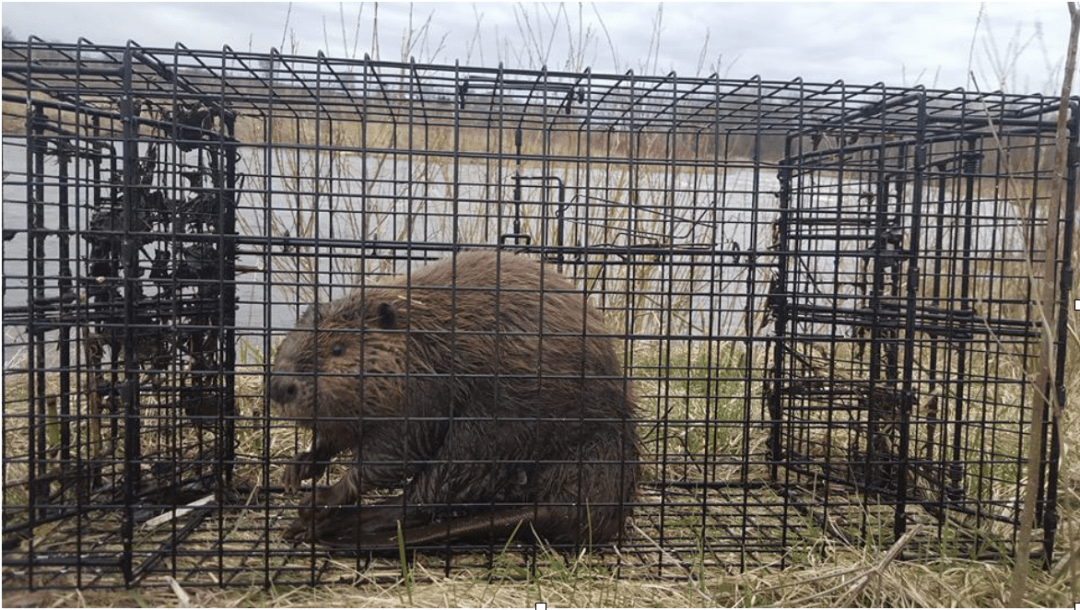
Use Live Traps: Buy appropriate live traps, place them at the exits and lodge entrance. Beavers can be difficult and tricky to catch, so you must be creative and patient to get rid of the beavers. Another challenge is that they are nocturnal animals and eat trees and so baiting might be counterproductive.

Build Fences: Beavers move through underground tunnels, so ensure that the fence is deep under the ground and can effectively keep out the beavers.

Call Wildlife Control Services: It is best to call the wildlife control service in your state to handle a beaver infestation because they have skills and knowledge for beaver removal and relocation. They can also give you professional tips on how to prevent future beaver infestations.

The Montana Department of Fish, Wildlife and Parks are proposing a project that will re-introduce six species of beavers into the Reservoir Creek, where the beavers will remodel the land and restore the landscape. Beavers are the best natural engineers, and their activities will create a new habitat for many animal species while expressing their innate behavior.

This development is welcome in Montana, as it will have a positive impact on the land and a new habitat for the rising population of beavers in Montana rather than them encroaching on homeowner’s properties.

Add a Comment »

Thursday, Sep. 3rd, 2020

HRDC’s Streamline to Host Public Meetings about Route Redesign

In August 2020, Transportation Management and Design, Inc. released the initial service recommendation report for HRDC’s Streamline Redesign 2020 project. Streamline is now looking for the public’s input on the proposed routes.

Streamline’s public meetings will give community members an important opportunity to ask questions, give feedback, and suggest changes. Community members can access a summary map of the proposed short-term routes and leave public comments at https://streamlinebus.com/about/redesign-streamline-2020/.

Streamline invites community members to join them for one of the following meetings:

  • ●  September 9 at 12 pm: Redesign Streamline 2020 Public Meeting via Zoom

  • ●  September 14 at 12 pm: Redesign Streamline 2020 Public Meeting via Zoom (This

    meeting is targeted at community stakeholders, but the general public is welcome to listen in).

    For more information about Streamline, visit StreamlineBus.com. For more information on HRDC, visit thehrdc.org.

    ###

  • ●  September 14 at 5 pm: Redesign Streamline 2020 Public Meeting at the Emerson. Masks are required.

  • ●  September 17 at 3 pm: Redesign Streamline 2020 Public Meeting via Zoom

All Zoom meetings can be accessed here: https://zoom.us/j/6215759599 or you can call 1-669- 900-6833 and enter the access code 6215759599# to listen in.

Add a Comment »

Wednesday, Sep. 2nd, 2020

Mountain whitefish mortality observed on Yellowstone River

Montana Fish, Wildlife & Parks has observed recent mortality of mountain whitefish in several sections of the Yellowstone River.

The cause of the mortality is still unconfirmed. However, these circumstances appear to be consistent with what has been observed in fish that die due to proliferative kidney disease, or PKD — a condition caused by a parasite affecting salmonids, such as mountain whitefish and trout. PKD has affected fish in the Yellowstone River in recent years, the most significant outbreak happening in 2016.

FWP has worked with other agencies to submit samples for testing to determine whether PKD is a factor in this most recent whitefish mortality.

FWP began receiving reports of dead whitefish last week. Since then, biologists have surveyed several sections of the Yellowstone River to gather more information.

  • On Wednesday, biologists observed seven dead whitefish over about 9 miles from the Springdale Bridge Fishing Access Site to the Grey Bear Fishing Access Site, upstream from Big Timber.
  • On Thursday, biologists counted 149 dead whitefish over almost 9 miles between the Pig Farm Fishing Access Site and the Springdale Bridge Fishing Access Site, downstream of Livingston.
  • On Friday, they counted 38 dead whitefish over 20 miles between the Pine Creek Fishing Access Site and the Highway 89 Bridge Fishing Access Site, upstream from Livingston.

No trout mortality was observed during last week’s monitoring efforts.

FWP will continue to monitor conditions on the Yellowstone River. At this time, no closures or restrictions are expected for the Yellowstone River or its tributaries.

Anglers can help reduce stress for fish by following these practices when catching and releasing fish: ​

  • Land the fish quickly.
  • Wet your hands before handling the fish.
  • Keep the fish in water as much as possible.
  • Remove the hook gently. Using artificial lures with single and barbless hooks can make hook removal faster and easier. If the fish is hooked deeply, you may have to snip the line at the fish's mouth or consider keeping it if regulations allow.
  • Let the fish recover before releasing it.

Add a Comment »

Monday, Aug. 31st, 2020

Montana State Elks Association Drug Awareness Program presented the "Enrique Camarena-What Heroes Do!" Coin to Susie & Gary Larson

On August 26, 2020, the Montana State Elks Association Drug Awareness Program presented the "Enrique Camarena-What Heroes Do!" Coin to Susie & Gary Larson.


Susie and Gary are being recognized for all their work to prevent the abuse of prescription drugs.

Through their efforts, Prescription Drug Take-Back Boxes have been placed at locations throughout Gallatin County in Southwest Montana.
  • Belgrade City Hall
  • Big Sky Sheriff’s Office
  • Bozeman Police Substation
  • Manhattan Police Department
  • Montana State University Police Department
  • Three Forks City Hall
  • West Yellowstone Police Department
Placing these drug take-back boxes has helped prevent the negative and toxic effects on our environment that can take place if the drugs are not disposed of correctly and prevented them from getting into the hands of people who shouldn’t have them.

Add a Comment »

Thursday, Aug. 27th, 2020

Montana Science Center will reopen on September 12th with new hours

On Saturday, September 12th, Montana Science Center, will reopen doors to the public at 2744 W. Main St. after temporarily closing the doors due to COVID-19 on March 16, 2020. Montana Science Center relocated to the Main Street location on January 20, 2020. The staff at MSC is excited to announce that the Center is ready for families and community members to visit safely again. Located across from the Gallatin Valley Mall, the new location is nearly double in size of their old location and features new exhibits, a new Science Station, expanded STEAMlab and a larger meeting space for programs and events. Current Members of the Science Center will be welcomed back starting Monday, September 7th, 2020. Montana Science Center has been working with the state, Gallatin County Health Department and all guidelines to reopen safely with limited capacity for a safe community.

Since the closure, MSC staff has been working full time to make necessary adjustments to the physical space, exhibits and safety protocols to reopen in the best possible way for community families. Adaptations to the Center include new exhibit pieces that focus on “hands-off” but “brains-on” exhibits, decreased materials for increased cleaning viability, and pre-registration programs to enhance attendance. Additionally, enhancements to the building’s HVAC system ensure hospital-grade filtering of the air. “It has been an incredible project,” says Executive Director, Abby Turner, “the staff’s efforts have taken shape with building upgrades, program additions and design enhancements that promote engagement with STEAM topics while keeping our patrons safe. We are looking forward to inviting the community to become engaged in interactive STEM experiences, classes again.”

In addition to new programs for students at home during the school year, the high-tech makerspace, STEAMlab will offer expanded opportunities. Programs include a weekly Science Class, daily STEAMlab Open Labs and coding clubs, STEM in the Park, and program partnerships with other area organizations. “We have been working collectively with all childcare providers in the Valley to create meaningful experiences for children of all ages as we navigate the waters during these times,” says Turner, “we hope to provide these experiences while meeting the needs of students no matter what mode of education they are learning by.” All programs will be registration-required via the website at MontanaScienceCenter.org.

As the community adapts to a flexible school schedule, MSC will flex STEM education offerings to meet the needs of parents, families, teachers and rural communities through programming. Additionally, MSC will be introducing two new exhibits for engagement this fall - a NISE Network exhibit entitled Sun, Earth, Universe and one developed by the MSC team called Dangerous Nature. Though the closure has left a gap this summer for activities for families with children, MSC looks forward to welcoming patrons back, safely, into the Science Center. New hours will include a “cleaning break” from 12 - 2pm, daily, and MSC will be closed on Wednesdays for field trips and cleaning each week.

Please contact the Montana Science Center for additional questions and clarifications. They can be reached at 406-522-9087 or info@MontanaScienceCenter.org

Add a Comment »

News Comments