

Thursday, Sep. 17th, 2020

MSU Steer-A-Year program seeks donations for 2020-21 academic year


Montana State University’s Steer-A-Year program is seeking financial support as well as donations of steers and feed for the 2020-21 academic year.

A student program in the MSU College of Agriculture, Steer-A-Year focuses on teaching students every element of the cattle management industry through hands-on experience feeding and managing cattle during the fall and spring semesters. Students care for the cattle through the winter and spring, collect data including feed efficiency and weight gain and study elements of livestock marketing. The program also incorporates academic courses such as Beef Production and Livestock Evaluation.

Donated steers are housed at the Bozeman Agriculture Research and Teaching Farm. Once they reach maturity and are ready for harvest, the cattle are sold to MSU Culinary Services, where the meat is served in both the on-campus Miller and Rendezvous dining halls.

Benefits are numerous for students in the program, according to Steer-A-Year manager Hannah DelCurto-Wyffels, an instructor in the Department of Animal and Range Sciences and the coordinator of MSU’s livestock judging team.

“Many of the students who join Steer-A-Year haven’t had the opportunity to raise cattle hands-on before,” said DelCurto-Wyffels. “There are so many elements to the process, and this program allows them to see all of them, from start to finish, while also learning about what factors maximize beef quality and important elements of cattle health at the same time.”

When Steer-A-Year cattle are sold, the proceeds fund travel and competitions for the livestock judging team, as well as facilitate trips for students across the College of Agriculture to attend producer events and meet with industry groups like the Montana Stockgrowers Association and the Montana Farm Bureau Federation. The trips allow for networking for students and the opportunity to learn about career opportunities after they graduate.

Steer-A-Year produced 33 steers during the 2019-2020 school year, which were all purchased by Culinary Services during the spring semester. While the onset of the pandemic required some adjustment of the curriculum and in-person activities, several of the program’s students stayed on through the spring semester to continue caring for the calves. Students who did not remain on campus monitored their steers’ progress through weight data and GrowSafe feed intake technology, which remotely measures how much a steer eats.

Producers who donated steers receive regular reports from the students, including growth and health information and more detailed results after the steers are harvested. Awards are given annually to the producer who donated the best initial feeder steer, the steer with the top rate of gain, the steer with the best feed efficiency and the steer that produces the best carcass.

“This program creates such important partnerships between MSU students and our producers around the state, and it’s so exciting to watch,” said DelCurto-Wyffels. “Now more than ever, we can’t support our local producers enough, and this is just a reminder of how critical these relationships are. Steer-A-Year has truly become a mutually beneficial project, and we are so glad to be bringing it back again this year. That’s one of the incredible things about agriculture: No matter what, it doesn’t stop.”

DelCurto-Wyffels said to ensure success in their new setting, calves should be weaned, castrated and dehorned before they are donated and should weigh 500-800 pounds. The ideal pickup period for calves is the first two weeks of November. Those interested in donating or learning more about the Steer-A-Year program can contact DelCurto-Wyffels at 406-994-3752 or hannah.delcurto@montana.edu.
Add a Comment »

Why Rodent Infestations Are More Common in the Fall and Winter

As the temperature begins to fall, humans put on thicker clothes and can easily turn on the heater or start a fire in a fireplace. While some animals also go into hibernation or migrate to warmer climates, other animals have no sophisticated mechanism and have to look for other means to survive. Rodents - especially rats, mice, and squirrels - find their way into homes. The constant chattering and squeaking sounds, along with the scratching and scurrying noise as they move behind the cover of the dark is enough to make any homeowner cringe. 


Let’s find out why rodent infestations are common during this period.

The Mechanism Behind Rodent Infestations in the Fall and Winter
During the summer, the wild is bubbling with life; squirrels scampering from trees to trees, mice, and rats running all over the place. The abundance of food sources, as well as the warmth, makes the wild favorable.

However, as we approach fall, the temperature begins to drop. Not only does it begin to get colder, but food sources start to diminish. Rodents know this and they begin to prepare ahead.

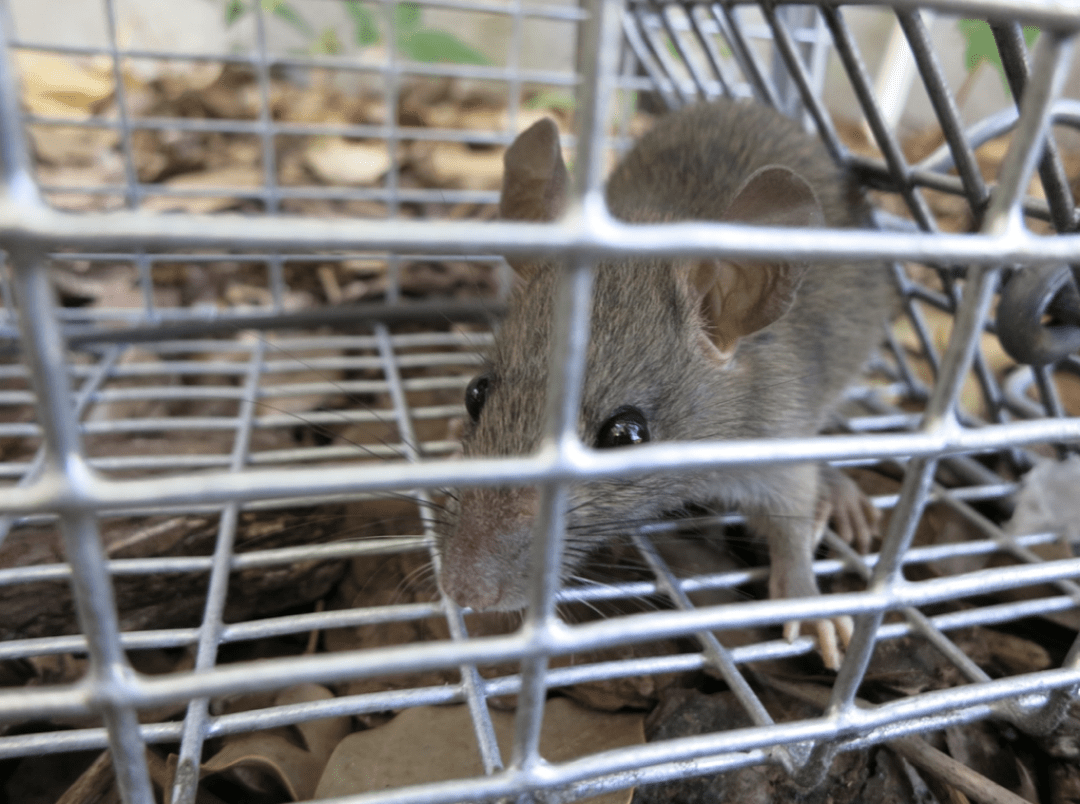
Rodents will begin to find ways to get into homes. A mouse can get through a hole about 6 mm in diameter, while a rat can get through one that’s about 20 mm. Even when there are no crevices or cracks, they’ll look for vulnerable points and gnaw through it to gain access. Squirrels, on the other hand, find their way into elevated parts of the home, like the attic or chimney. To learn more about squirrels in the attic visit squirrelattic.com.

Once they gain access, they build their nests from both external and internal materials. Over the next few months, your home will provide them safety from cold, predators, and it may even provide them with food.

Problems Associated with a Rodent Infestation
But if rodents are only interested in surviving the cold, why are they hostile guests?

√ Structural damages
Once they gain access, they’ll rip off insulation materials and any other material to make their nest. But it doesn’t stop there. They’ll keep chewing on woods, pipes, plastic, wires, and more just to keep the growth of their incisors in check. This reduces the structural integrity of your home.

√ Risk of fire
Rodents that chew on electrical wires open up the risk for the damage of appliances or fire incidents.

√ Diseases
Rats and mice are associated with filth, and with filth comes a plethora of diseases. Some of these include hantavirus, tularemia, lymphocytic choriomeningitis, among many others.

What to Do
Rodents are going to actively look for ways to invade your house as fall and winter approaches - there’s no question about that. What you can do is ensure they do not get access or incentives for staying there. Here are some tips.

√ Seal off all potential entry holes with hardware cloth or caulk and repair all weak points around your house that they can break into.

√ Eliminate all potential food sources. Secure all your foodstuff in aluminum cans. Make sure your trash cans are inaccessible. Clear away seed crumbs from under your bird feeder. Do not leave your pet food outside.

√ Keep a clean environment. Tall bushes or the accumulation of leaves provide them with potential hiding spots.  

√ Be vigilant. If you see droppings, gnaw marks, chewed wires, or you hear noises from the wall or attic, these are all common signs of a rodent infestation. Discovering the problem early enough will make it easier to implement control strategies to get rid of them.

Add a Comment »

Wednesday, Sep. 16th, 2020

Gallatin River to close temporarily near Nixon Bridge

A small section of the Gallatin River will be closed to recreationists next week during a phase of construction on Nixon Bridge, just north of Manhattan.

The closure will be in effect on Sept. 21 and 22, from 9 a.m. to 2 p.m. each day. The closure includes the section of the Gallatin River immediately surrounding Nixon Bridge, as well as Nixon Gulch Road. During this time, construction crews will lift and set the 122-foot-long concrete beams from the transport vehicles. Only beams for the south bridge span will be set during this time.

For more information about this project, contact the project engineers with Stahly Engineering, Kathy Thompson or Nate Peressini, at 406-522-8594.

Add a Comment »

Tuesday, Sep. 15th, 2020

Vote in the Bozeman's Choice 2021 Reader Poll thru Nov 7

Our big, giant, massive, Valley-wide Bozeman's Choice Reader Poll will be up and firing on all cylinders on October 1, 2020. The poll covers everything from local restaurants to local media to news issues to arts & entertainment and everything in-between. And remember! You get to add your own responses that can, in turn, be voted on by everyone else. We hope you like it.

The creative deadline for advertising in the October print issue of Bozeman Magazine is this Sunday 9/20. Please email angie@bozemanmagazine.com for best placement!


Add a Comment »

Monday, Sep. 14th, 2020

The Salvation Army Sets Out to “Rescue Christmas” Due to Immense Impact of COVID-19

For the first time in 130 years, The Salvation Army is starting its annual holiday fundraising campaign early across the country in order to rescue Christmas. The funds raised through the organization’s iconic red kettles are at risk this year due to COVID-19 while requests for services are at an all-time high.

Based on the increase in services already provided in response to the pandemic, the organization could serve up to 155 percent more people in 2020 with Christmas assistance, including putting food on the table, paying bills, providing shelter and helping place gifts under the tree – assuming the resources are available.

At the same time, due to the closing of retail stores, consumers carrying less cash and coins, and the decline in foot traffic, The Salvation Army could see up to a 50 percent decrease in funds raised nationally through the red kettles, which would limit their capability to provide services for the most vulnerable. To put this in perspective, last year $126 million was raised nationally through about 30,000 red kettles.

“There are so many more people in need this year than we’ve seen in a long time. I invite our community to come together to rescue Christmas and support our neighbors,” says Lt. Rick Larson, The Salvation Army Bozeman Corps Officer.
 
Since March, The Salvation Army in Montana has provided more than 4,000 meals, 3,600 nights of safe shelter, and emotional and spiritual support to over 1,500 people in need. Now more than ever, they’re making it safer and simpler to donate in order to support the most vulnerable in Montana:
    •    The best way to ensure that these vital services continue is to enlist in Love’s Army with a sustaining monthly gift of $25 per month.
    •    To help ensure the safety of bell ringers, donors and partners, The Salvation Army has adopted nationally mandated safety protocols.
    •    Donate digitally with Apple Pay or Google Pay at any red kettle in Montana.
    •    Ask Amazon Alexa to donate by saying, “Alexa, donate to The Salvation Army,” then specifying the amount.
    •    Give any amount by texting “KETTLES” to 91999.
    •    Donate physical gifts in bulk.
    •    Adopt additional Angels to give hope and joy to kids and families in need through The Salvation Army’s Angel Tree program.
 
Every donation provides help and hope to those in need, and all gifts stay within the community in which they are given. Visit imsalvationarmy.org to donate or learn more about how you can help The Salvation Army rescue Christmas this year.
 

Add a Comment »

Sunday, Sep. 13th, 2020

Three artists selected to display work in MSU’s American Indian Hall

Three artists have been selected to display major pieces of their work in Montana State University’s American Indian Hall, which is slated to be completed next fall.
 
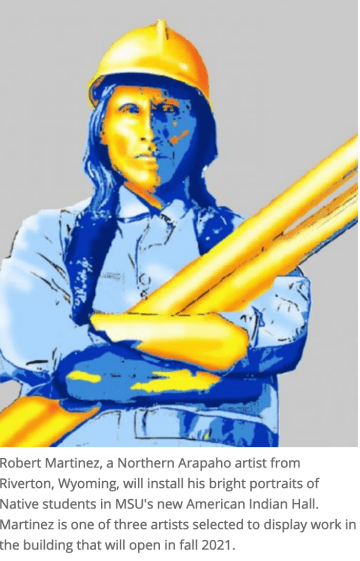
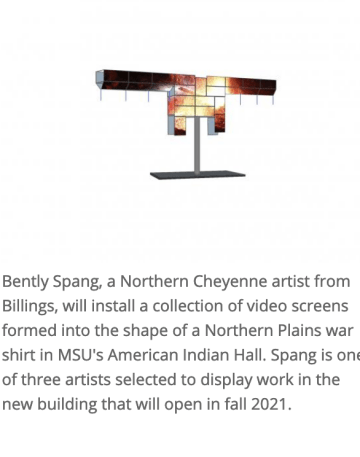
Artists Bently Spang, a member of the Northern Cheyenne Tribe who lives in Billings, Robert Martinez, a Northern Arapaho who lives in Riverton, Wyoming, and Stacia Goodman of Minneapolis were selected by a committee of eight members. The committee was composed of representatives from across MSU’s campus as well as members from Montana’s Native community.

Walter Fleming, chair of the Department of Native American Studies, said the committee distributed a call for artists for the building, which will open next year. Twenty-six artists responded to a request for proposals with projects that would represent the university’s desire to make the American Indian Hall reflective of Native culture as well as the building’s major themes of water, fire, earth and air.

“The major themes reflect the natural elements that many indigenous cultures revere,” Fleming said. He said each one of the artists are significant in their potential to engage visitors to the American Indian Hall and to generate deeper thought.
 
The 31,000-square-foot American Indian Hall will serve as a home to MSU’s Native American community as well as a bridge between American Indian culture and other cultures on campus. The building is planned to open in fall 2021, and classes will be held there beginning spring semester 2022.
 
Spang is a Northern Cheyenne multidisciplinary artist, writer and curator whose art utilizes technology to tell timeless visual stories. His work has been exhibited in North America, South America and Europe. Spang’s proposal is to install a bank of video monitors onto a frame that will be built in the shape of a large Plains Indian war shirt. The screens will display synchronized videos that will include scenes of fire and water as well as highlights of the tribal communities in the region.

“(Spang’s) art will give the hall the ability to create new subject matter for the screens that will make his art timely,” Fleming said.
 
Martinez is a visual artist and designer who will use paintings in vibrant and contrasting colors that transform the standard photo studio style sepia portraits into vivid images.


“We want his paintings to reflect the whimsy and humor of Native culture and represent our students as hard-working and fun-loving,” Fleming said. “We want our students to be able to see themselves in his portraits.
 
Goodman is a non-Native artist who creates mosaic pieces of art glass and tile. Her work will cover a column in the AIH project.
 
“What is exciting about Ms. Goodman’s concept is that, as a column, visitors will be able to walk around it, providing art that visitors can engage in close-up,” Fleming said. “(Her) mosaic style gives her pieces the quality of movement, perfect for water and fire.
 
Fleming said that in addition to the featured artists, members of the community have been generous in donating art from their homes for potential use in the American Indian Hall.

“This has been particularly gratifying as we will have a lot of wall space in our new home,” he said.
 
Major Robinson, the cultural design liaison for the project who is also a member of the selection committee, said that public art is important for most buildings, but particularly the American Indian Hall, which he calls an “environmentally respectful building.”
 
“These art pieces represent and communicate values tribal peoples bring to the campus for the time MSU is their home,” said Robinson, a Northern Cheyenne architectural designer who has also served as a member of the Montana Board of Regents and is the owner and principal of Redstone Project Development.

“Besides creating a sense of home, these very same indigenous expressions of art welcome non-Native students and visitors to learn more about the original pre-Montana inhabitants' culture and values.”
Robinson said that he believes the entire building will be a living piece of art, from the Native plants outside the building that will greet visitors, the eagle feather canopy to the culturally infused drum room that will be crafted from 100-year-old “grandfather spruce, thoughtfully harvested and preserved on site to make room for the new American Indian Hall.”

“Each space one passes through is an invitation for all who enter to discover more about tribal peoples and hopefully realize the value they add to Montana State University,” Robinson said.
 
Swank Enterprises is the general contractor on the project, and the architect is ThinkOne Architecture.

Add a Comment »

Thursday, Sep. 10th, 2020

406Cirque announces partnership with Clowns Without Borders


Bozeman, MT:
 Today, 406Cirque announces that it has a signed Memorandum of Understanding with Clowns Without Borders. This Memorandum brings 406Cirque into a fiscal sponsorship agreement with Clowns Without Borders, and further states that a fiscal sponsorship of Clowns Without Borders is consistent with its organizational goals to make circus accessible to children worldwide.

Clowns Without Borders (www.clownswithoutborders.org) is a 501(c)(3) not-for-profit organization that sends small teams of professional circus artists to perform in refugee camps, conflict zones, and communities in crisis. Its mission is to promote resilience through laughter. 
 
Naomi Shafer, Executive Director at Clowns Without Borders, says: “We are thrilled to provide fiscal sponsorship for Cirque for All, 406Cirque’s scholarship program. Our organizations share a mission to use circus to inspire change. We are delighted to support this program.”
This fiscal sponsorship agreement enhances the mission of 406Cirque, which is to guarantee access to circus and performing arts to communities in the state of Montana, especially children. Through this fiscal sponsorship agreement, 406Cirque will be able to receive donations for scholarships and apply for grant funding for which it otherwise would not be eligible. Paúl Gomex, founder of 406Cirque says,“this program is a chance to share the magic of circus with everyone. In addition to scholarships for our afterschool and summer programs, we will also offer free training days for adults, as well as free shows for the community of Bozeman, when the circumstances allow for that to happen”.

406Cirque is headquartered in Bozeman, MT, and currently operates out of Petra Academy and the Emerson Center for Arts and Culture. The organization has just expanded to afterschool programming on Mondays, Tuesdays, and Wednesdays. Gomex comments “In times of crisis, we step up. The circus is about defying odds, inspiring awe, and coming together as a community. We developed COVID procedures for our summer camps so that kids and families could stay safe, while also having fun.”

About 406Cirque:
406Cirque is a school of circus and performing arts in Bozeman, Montana. It is a place where individuals of any skill level or background can explore their passion. More information at 406cirque.com.

Add a Comment »

Calling all fans of purple-haired fairies, pizza-loving dragons, and ticklish-aliens: The Gallatin Valley has a new Children’s Theater Company

BOZEMAN, Mont. —  The Gallatin Valley is home to a new children’s theater company called “Random Acts of Silliness” (RAOS). RAOS is a troupe of performers committed to creating magical theater experiences with and for children,  filled with rich storytelling, bold characters, and silliness to spare.

Random Acts of Silliness grew out of Verge Theater’s improv program, where RAOS founder Danielle Thomsen performs with the Bozeman Improverts and directs the “Silly Moose: Improv Show for Kids.” While public spaces were closed this summer the RAOS troupe performed socially-distanced pop-up driveway shows for small groups of children.

“We were so happy to make children laugh and provide a taste of live-theater for local families,” Thomsen said. “It doesn’t matter if we’re only able to perform for five people at a time, we are committed to providing fun, safe, theater experiences for Gallatin Valley kids.”

Rooted in improvisation, most performances are highly interactive, and feature characters and plots inspired by audience members. The unique shows are created entirely on the spot, based on suggestions from the audience. Kids naturally have funny, original ideas, and performers are excited to bring those ideas to life.

The company has several events scheduled for September in partnership with the Gallatin Valley Land Trust: two outdoor improv shows and a self-guided fairy village experience.

“Now, more than ever, parents are looking for creative ways to keep their kids engaged and active in the Gallatin Valley,” said GVLT Associate Director EJ Porth. “We are thrilled to partner with RAOS to bring fun, safe, socially-distanced activities for children to our parks and trails that will get the creative juices flowing again. Right now, everyone could use a little magic.”

Visit randomactsofsilliness.com or our social media channels for more information about upcoming events.

Details of Upcoming Events

Random Acts of Silliness in the Park* (in Partnership with Gallatin Valley Land Trust)

Saturday September 12 10:30-12 Lindley Park

Saturday September 19 10:30 -12 Dino Park


*Social distancing will be enforced and mask required for anyone age 5 or older.


Fairy Village Adventure (in Partnership with Gallatin Valley Land Trust)

(See RAOS or GVLT Website for Location Details)

Ten Bozeman artists have collaborated to create a magical fairy village on the Gallagator Trail. This is a self-guided experience, visit between September 22 and October 5.

--

Random Acts of Silliness: Inspiring Laughter & Play in the Gallatin Valley

Add a Comment »

Wednesday, Sep. 9th, 2020

Drainpipe cause of New Zealand mudsnails at FWP fish hatchery

Since New Zealand mudsnails were detected at Montana Fish, Wildlife & Parks’ Bluewater Fish Hatchery Tuesday, Aug. 18, the department continues to look at whether infected fish were stocked at lakes or reservoirs and what led to the infestation.  

The Bluewater Fish Hatchery, located near Bridger in southcentral Montana, is a trout hatchery and is the third largest production facility in the state. This is the first time New Zealand Mudnsails (NZM) have been found at an FWP hatchery.

The likely cause of the infestation is a drainpipe from the hatchery that drains into neighboring Bluewater Creek, which is positive for NZM. The operating procedures for the hatchery call for the pipe to be elevated above the creek, but over the years, the pipe has become submerged. NZM were likely able to make their way up the pipe and into the hatchery.

New Zealand mudsnails are an aquatic invasive species. It was first discovered in Montana in 1995 in the Madison River above Hebgen Lake Reservoir. Since then, New Zealand mudsnails have been detected in multiple locations across the state.  NZM can be eaten by fish and other animals, like birds, but unlike native snails, they are undigestible and can be spread by fish and wildlife into other waterbodies.

In a confined facility, like a fish hatchery, NZM can be quickly eradicated and the facility decontaminated. However, due to the detection, the fish at the hatchery – about 20,000 pounds – were euthanized and disposed of. FWP had about $85,000 into rearing the fish. FWP staff are working on a containment and mitigation strategy.

The plan is to make up the losses from Bluewater with surplus fish from FWP hatcheries. 

Prior to this detection the Bluewater hatchery had contributed to relatively few releases in 2020, all of them into state/public waters.  Monitoring for New Zealand mudsnails and other invasive species will continue in these waters and others. 

All hatcheries in Montana are inspected annually for AIS and fish pathogens. The mudsnails at Bluewater Fish Hatchery were detected during the hatchery’s annual inspection.

To help prevent the spread of AIS, people working and recreating in and around our waterways must practice clean, drain, dry. For more information on AIS, please go online to CleanDrainDryMT.com.

Comments 1

Tuesday, Sep. 8th, 2020

Beaver Populations on the Rise in Montana

Most home and farm owners perceive beavers as threats because of their digging and tree-eating habits. Beavers create dams and redirect waterways for their use. They have become common sights in suburban areas as a result of the deforestation habits of man. Human activities force beavers to co-exist with humans, and the beaver population has been on the rise in Montana in recent years.

BEAVER APPEARANCE, BIOLOGY, AND BEHAVIOR
Beavers are the second largest rodent in the world and can be 45 inches long and weigh up to 70 pounds. They have sharp incisions for chewing and felling trees and strong paws for digging tunnels and dams.

Beavers mate for life and do so during winter. They give birth to their young after winter, with their eyes open and the young can swim after the first 24 hours of life. The young reach maturity, become independent after about two years and leave their parents to create their families.

Beavers in a family colony mark their territory with urine in the puddles that surround their homes. They are primarily nocturnal animals, and so they sleep during the day and are active at night.
They feed on the bark of soft trees and store twigs and tree branches in their burrows for the winter. They are good at making interlacing tunnels and rarely use one exit out of the burrow. This helps them to escape from danger and reduce the traffic when bringing in food.

They alert the other beavers when there is danger by slapping their tails against the water to create some noise. The other beavers quickly take cover or escape from the exits in the tunnel. The maze of the tunnels shows that beavers are highly intelligent animals that display great engineering skills.

Beaver dams help many animal species that come to live in them, as well as farmers that benefit from the redirection of water.

BEAVER REMOVAL
Beavers feed on trees, and when their population is large, they can fell countless numbers of trees within a short period. Their burrowing activities destroy properties, damage, and weaken patios, structures, and roads. Therefore, many landowners choose to remove these critters from their yard and homes.
For tips on how to remove beavers visit howtogetridofbeaver.com and continue reading below:

Damage Beaver Dams: When you constantly destroy beaver dams and damage their lodges, they give up and leave your property.

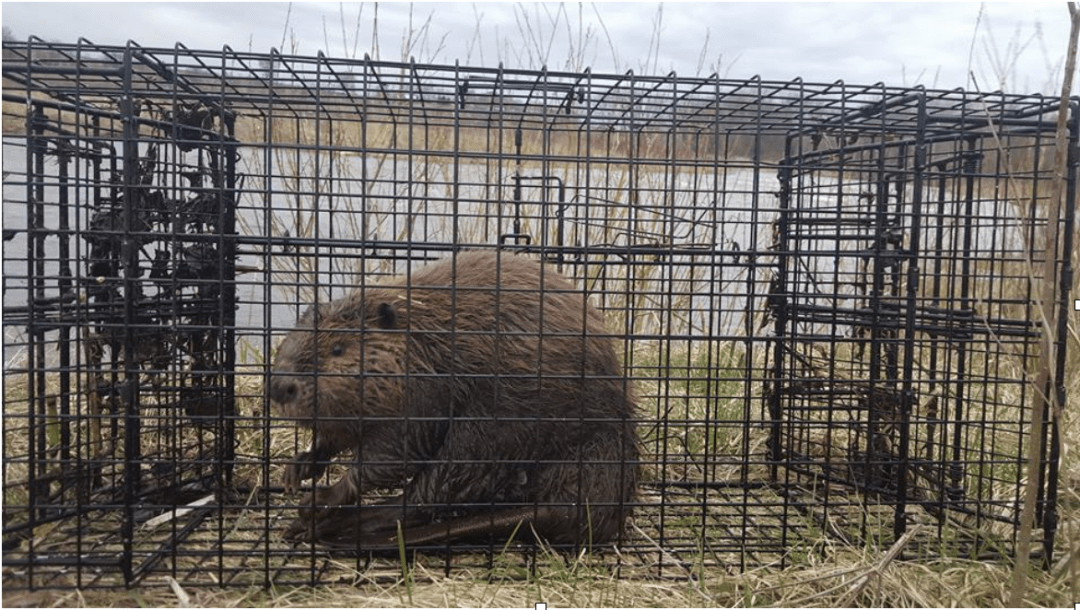
Use Live Traps: Buy appropriate live traps, place them at the exits and lodge entrance. Beavers can be difficult and tricky to catch, so you must be creative and patient to get rid of the beavers. Another challenge is that they are nocturnal animals and eat trees and so baiting might be counterproductive.

Build Fences: Beavers move through underground tunnels, so ensure that the fence is deep under the ground and can effectively keep out the beavers.

Call Wildlife Control Services: It is best to call the wildlife control service in your state to handle a beaver infestation because they have skills and knowledge for beaver removal and relocation. They can also give you professional tips on how to prevent future beaver infestations.

The Montana Department of Fish, Wildlife and Parks are proposing a project that will re-introduce six species of beavers into the Reservoir Creek, where the beavers will remodel the land and restore the landscape. Beavers are the best natural engineers, and their activities will create a new habitat for many animal species while expressing their innate behavior.

This development is welcome in Montana, as it will have a positive impact on the land and a new habitat for the rising population of beavers in Montana rather than them encroaching on homeowner’s properties.

Add a Comment »

News Comments