Thursday, Mar. 25th, 2021

FWP seeks public comment on proposed trail rehabilitation at Madison Buffalo Jump State Park


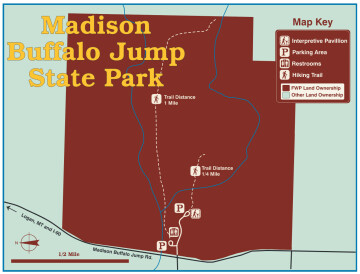
Montana Fish, Wildlife & Parks is requesting public comment on an environmental assessment for improving public access within the trail system at Madison Buffalo Jump State Park and protecting the resource from degradation.  

Proposed developments include rerouting two trails, revegetation of multiple social trails and delineation of the current trail system. The project would eliminate some of the excess social trails that are heavily eroded and lead to the same areas within the park.  

Rerouting the trails would eliminate some extremely steep grades, providing safer access to park visitors. A clearly defined and safer trail system would also discourage off-trail travel and minimize subsequent impacts to the many sensitive cultural sites that exist within the park.  
The environmental assessment can be viewed online at https://go.usa.gov/xsd5f.  

The public comment period will be open until 5 p.m. on April 8. Please submit comments by email to mark.filonczuk@mt.gov or by mail to:  
            Mark Filonczuk 
            Region 3 Parks Maintenance Supervisor 
            1400 S. 19th Ave.  
            Bozeman, MT 59718 

Add a Comment »

Can a Beginner Play the Electric Violin?


When a person sets a goal to do something, there is a big chance that they will be able to achieve it because it is part of human nature to persevere to reach the finish line. As a beginner who wishes to learn to play an electric violin or any other instrument, one should be determined and have the patience in learning it. If you immediately give up as soon as you encounter difficulties you will never progress. Consistency is always the key in learning to play a musical instrument.

Playing an electric violin might be a bit more complex than an acoustic one. An acoustic violin only has 4 strings, while an electric violin has 5 to 6, therefore, the more strings it has the more notes you’ll need to learn.  So it would be better to start off with an acoustic violin to get a better grasp of how they work. Although, you can still learn to play an electric violin first if you prefer, but it would take more effort to succeed. As long as you have the determination to learn how to play it as well as how to use it’s electric components, you’ll be able to play an electric violin in no time.

Pros and cons 
Aspiring violinists may encounter numerous things as they start with their journey. The following is a list of probable pros and cons that beginners might experience:

Pros

• Ease stress, depression, and anxiety.

• Produce happy hormones.

• Physical attributes improvement.

• Enhance brain capacity. 

• Help in boosting confidence.

• Earn money in the long run.


Cons

• Continuous maintenance of instruments and accessories.

• If not a fast learner, the person might lose patience.

• Rivalry or competition may occur during individual recitals.

• Frustrations may be visible after failing a performance.

• Expensive cost of the instrument.


After distinguishing the pros and cons of playing the electric violin, and you’re still set on in acquiring your own, here are some things you need to consider:
• Do a self-assessment to know how long you can learn to play the electric violin.

• Check your financial capacity or status before buying the instrument.

• Search for reliable and relevant information about the instrument.

• Choose the brand wisely.


If you finally have an instrument to use, below are some tips you can do in order to learn to play an electric violin:

Take Electric Violin Lessons
There are plenty of schools offering music lessons, especially for electric violin. Some are budget-friendly, and there are also that might cost a lot of money. As a beginner, it is relevant to ask someone who already knows where to enroll or look on the internet for probable schools that offer free tutorials or have a considerable discount to save money.

Practice by yourself to master your skill
Beginners must set a schedule for practice and to evaluate themselves. It is also advisable to ask someone like a friend or family member to watch you while playing the instrument, and afterward, ask them for feedback.
 
Look for Videos or Apps about Electric Violin Lessons
Another alternative way to learn how to play an electric violin is simply visiting YouTube for video tutorials. It is a hassle-free way of learning, and payment is not a problem because most videos are for free.

Hang out with other electric violin players
Besides self-monitoring, it will be an excellent way to join online groups or people near the vicinity who are already experts in the field and bond with them. Make friends and learn from them, and use their advice to grow more as a musician. 

Enjoy and have fun
During free time, beginners can join music jams and watch live performances to have more inspiration and motivation to continue learning the instrument. Music can relax the person and also be the reason for a new opportunity.

Conclusion
To sum it up, beginners can play the electric violin only if they have the means to do so. Dedication, patience, and perseverance are badly required when learning something new. 

Add a Comment »

Deadline for deer and elk permit deadline is April 1


Montana Fish, Wildlife & Parks reminds hunters that the deadline to apply for deer and elk licenses for nonresidents and deer and elk permits for everyone is April 1. The purchase deadline for spring black bear is April 14 without a 24-hour wait.

Hunters who are applying for special licenses and permits need to have a valid email address. Hunters can apply for permits on the FWP website; click on “Buy and Apply.” Most FWP offices will be open from 8 a.m. to 5 p.m., Monday through Friday.

Add a Comment »

The Bozeman Symphony's Montgomery, Mendelssohn, and Bach


The Bozeman Symphony returns to the Willson Auditorium for its final free livestream concert of the season, Montgomery, Mendelssohn, and Bach, featuring its very own principal flute Sue Makeever and the string section of the orchestra. To close a remarkable season of challenges and triumphs, the Symphony presents a thrilling array of music – from classical to contemporary – showcasing the talent of leading female composer Jessie Montgomery, the wildly celebrated J.S. Bach, and the genius of a young Felix Mendelssohn.

Opening this exciting program is acclaimed New York-based composer, violinist, and educator Jessie Montgomery’s contemporary work Strum, a piece that the Washington Post described as “...wildly colorful and exploding with life.” Principal flute Sue Makeever follows with her interpretation of J.S.

Bach’s Orchestral Suite No. 2, playing seven movements building to an epic finale with one of Bach’s greatest orchestra works. The concert finishes with Felix Mendelssohn’s Sinfonia No. 7, one of twelve string symphonies he wrote between 1821-1822. The audience will listen in awe to his piece when the realization hits that he was only 13-years-old at the completion of this work.

The Montgomery, Mendelssohn, and Bach concert will livestream to the Bozeman Symphony’s website, YouTube and Facebook pages on Saturday, April 17, 2021, at 7:30 PM. The Symphony wishes to thank David Ross and Risi for their season sponsorship along with Thomas J. Scanlin for sponsoring this performance. For more information about the free livestream concert, please contact the Bozeman Symphony at (406) 585-9774 or info@bozemansymphony.org.

Sue Makeever is the principal flute of the Bozeman Symphony, the Intermountain Opera, and the Montana Ballet Orchestra. She retired as the principal flute of the Billings Symphony in 2017, after 22 years of employment. She is a member of many chamber groups, including the Yellowstone Chamber Players and the Bozeman Far Afield ensembles. The highlight of her chamber music experience included a tour of Brazil, with the Kreutzer Trio, through a U.S. State Department grant. Sue teaches part-time at Montana State University. Prior to moving to Montana, she was an Assistant Professor at the University of North Texas. She has taught at MSU - Billings, the Red Lodge Music

Festival, Rushmore, Northwest, Illinois, and Northwestern Music Camps. Sue earned a Bachelor of Science Degree in Music Education from the University of Illinois, a Master of Music Performance from Northwestern University, and completed all her course work and recitals toward a Doctor of Music from Florida State University. She has studied with Geoffrey Gilbert, Walfrid Kujala, Charles DeLaney, Kenton Terry, and Jacob Berg. Sue has also had the privilege of attending master classes with James Galway, at the Royal Irish Conservatory in Dublin, Ireland, and Jean-Pierre Rampal, at the Academie d'Ete in Nice, France. Sue is married to retired MSU music professor, Jerry Makeever, and they have two talented children, Matthew and Megan.

Add a Comment »

Wednesday, Mar. 24th, 2021

HRDC to Benefit from Bridger Bowl’s Tenth Annual Carve Out Hunger Food Drive


Each year, Bridger Bowl and HRDC’s Gallatin Valley Food Bank team up to collect food and “carve out hunger.” This year, the partnership celebrates their tenth annual food drive.

On Saturday, March 27, individuals can donate food to the Gallatin Valley Food Bank by dropping it off outside of the Saddle Peak Lodge (by the ticket window) from 8:00 am to 2:00 pm. For each 15 cans of food (which must be nonperishable), individuals will receive one voucher good for a $25 lift ticket or a free child ticket, as well as one entry to win a 2021-22 Bridger Bowl Adult Season Pass.

“We rely on the community’s support, both during physical food drives and with monetary donations, to ensure that none of our neighbors go to bed hungry. We are so grateful for our partnership with Bridger Bowl. Bridger Bowl is truly a community ski area and Carve Out Hunger will help us provide much needed groceries to those struggling to make ends meet." says Jill Holder, HRDC Food & Nutrition Director.

For more information about Carve Out Hunger, visit https://bridgerbowl.com. For information about HRDC’s Food & Nutrition services, visit https://thehrdc.org/food-nutrition/ or https://gallatinvalleyfoodbank.org.

Add a Comment »

Tuesday, Mar. 23rd, 2021

Bozeman announces Jim Veltkamp as the new Police Chief for Police Department

The City of Bozeman is excited to announce that Jim Veltkamp has been selected to be the new Police Chief for the Bozeman Police Department. Jim Veltkamp has been serving as the interim Police Chief and will assume the role immediately.
 
The City of Bozeman conducted a nationwide search, several rounds of interviews, and two different community forums to find the best candidate for the position.
 
Jeff Mihelich, City Manager says, “The City received a number of highly qualified applicants from across the country for this position, but Chief Veltkamp continued to shine. We are ecstatic to have him continue his career at the city.”
 
City Manager Mihelich adds, “This process was thorough, transparent, and had significant engagement from the community. We’re confident in Chief Veltkamp’s leadership and ability to elevate the work of this department to the next level.”
 
Jim Veltkamp joined the Bozeman Police Department in 1999. Aside from his current positions, he has worked as a patrol officer, a drug detective with the Missouri River Drug Task Force, a patrol sergeant, the support services captain, and the patrol captain. During his time with the department, he had the opportunity to be involved in a wide variety of projects focused on connecting the department and community, upgrading technology, improving the overall well-being of officers and staff, and addressing the rapid growth of the City and department. Jim is a graduate of the Montana Law Enforcement Academy, the Montana Executive Leadership Institute, the FBI National Academy, and is a member of the Montana Association of Chiefs of Police and the International Association of Chiefs of Police.

Add a Comment »

Monday, Mar. 22nd, 2021

5 Diseases That Household Pests Can Spread To You and Your Family


Household pests can spread many serious diseases. Household pests can spread diseases because they naturally carry the agents that cause infections. They could carry pathogens internally or externally. The diseases they spread are thus another reason for preventing household pest infestations.

In this article, we highlight five diseases that household pests can spread to you and your family. Read on and click here to learn more.

Lyme disease
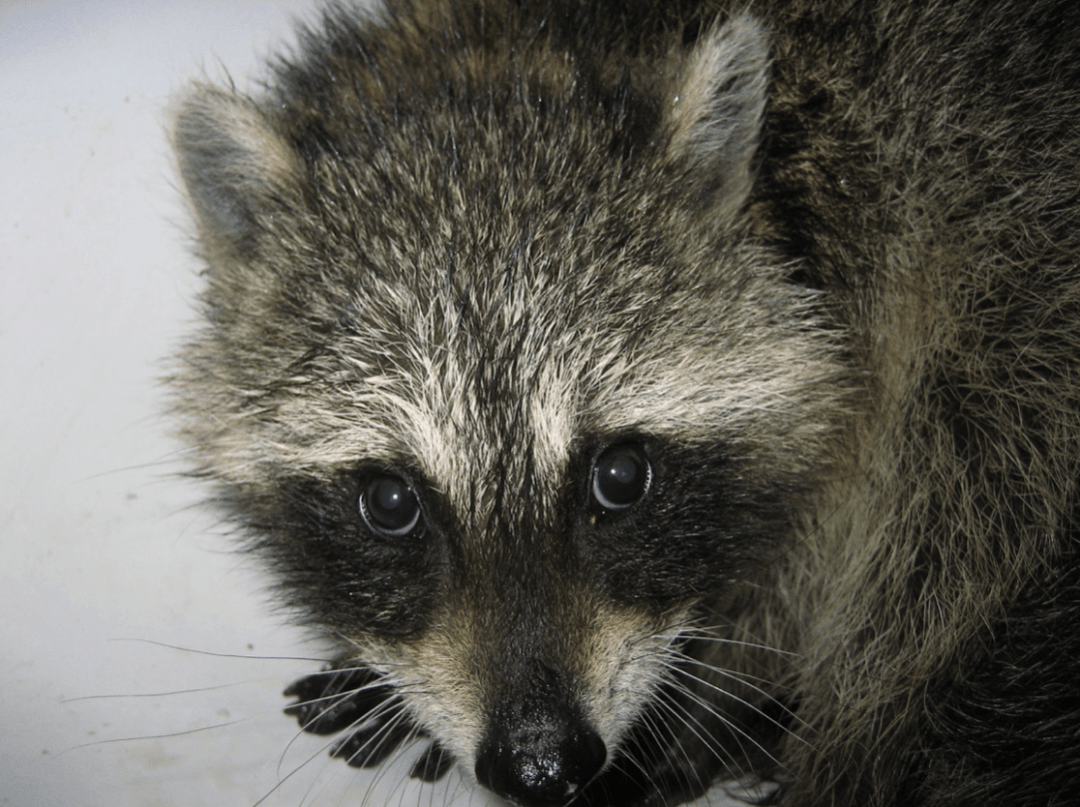
Ticks cause Lyme disease. The disease is spread through the bites of ticks. Household pests could carry Lyme disease and contribute to the spread of ticks. Ticks are blood-sucking animals that attach to the fur of different animals like raccoons. Ticks can attach to the fur of raccoons while the critters move in tall bushes.

Lyme disease presents with symptoms such as skin lesions, chills, fever, and fatigue. Serious complications like neurological and cardiac issues can also result. Lyme disease can also lead to joint pains and arthritis.

Leptospirosis
Household pests like rodents carry the causative agent of leptospirosis. The disease is spread through the urine of infected animals. Humans can contract the diseases through direct contact with the urine of infected animals.

The disease occurs after direct contact of soil or water that has the urine of the infected animal with the skin or mucous membranes of the nose. The disease could also be contracted from the consumption of food and water contaminated with the urine of infected animals. The critters can directly release their urine on uncovered foods.

Since the disease occurs from the contact of urine with mucous membranes, it can be contracted from the inhalation of the urine of infected animals from contaminated surfaces.

Leptospirosis is a serious disease that presents with symptoms such as body pains, jaundice, and fever. Rats are a common household pest that spreads leptospirosis.

Tularemia
Different rodents can spread tularemia. Wild rodents are particularly involved in the spread of the disease. The disease has a worldwide spread and is caused by a bacterial agent. The bacterium that causes tularemia is called Francisella tularensis.
Humans contract tularemia from handling the carcasses of infected animals, consumption of contaminated food and water, and inhalation of the causative agent. Insects like deerflies and ticks also spread the disease through their bites. Symptoms of tularemia include intermittent fever and lymph node inflammation.

Rabies
Rabies is a viral disease that is spread through the bites of animals like bats, raccoons, coyotes, and skunks. The rabies virus is in the saliva of infected animals. Apart from bites, contact of infected saliva with open wounds can also cause the spread of the disease. Contact of the infected saliva with the mucous membrane can also cause an infection.

This potentially fatal disease presents with symptoms such as fever, headache, difficulty swallowing, hallucinations, and agitation.

Rabies is a vaccine-preventable disease. Vaccination helps to prevent the spread of the disease. On contact with any of the animals that spread the disease, it is advised that you seek medical attention.

Salmonellosis
Household pests like rats and mice cause the spread of salmonellosis. Salmonellosis is spread through the consumption of foods and water contaminated with the feces of mice and rats. Rats and mice naturally carry this disease and will spread it in the areas they infest.

Salmonellosis causes gastroenteritis, which is the inflammation of the gastrointestinal system. The disease affects the gastrointestinal system as well as other systems such as nervous and cardiac systems. These symptoms include endocarditis and meningitis. Salmonellosis also causes systemic manifestations as septicemia.

General methods through which household pests spread diseases include contaminating food and water with urine and feces, and through bites. Household pests also spread diseases that can be contracted through direct inhalation.
Different household pests can cause serious diseases to you and your family. Preventing the infestation of these pests and removing them when present will help protect you and your family. Learn more about wildlife control and removal at nuisancewildliferangers.com.

Measures for preventing household pest infestations should be instituted to prevent the spread of the different diseases the critters carry. Measures for preventing household pest infestations include identifying and blocking all possible entry points. Keeping a clean environment also helps to prevent the infestation of the critters.

Because household pests can spread different diseases to you and your family, keep them out of your home.

Comments 2

MSU Extension offers Alzheimer’s disease awareness storybooks for children

Montana State University Extension is offering an Alzheimer’s disease awareness program for children that provides a storybook and a reading guide for parents or guardians, teens, aunts, uncles or grandparents who want to help young children understand the disease.

According to Jennifer Munter, grant manager for the MSU Extension Rural Prescription Opioid Misuse Education and Awareness program, the guides contain questions to encourage conversations about the storybook and activities for children. They also offer information on the common emotions children may feel regarding Alzheimer’s.

“The goal of these guides is to help the reader fully engage themselves with the child while at the same time following with the concepts of the book,” Munter said. “By doing so, the reader and the child may gain a better understanding of the feelings children encounter and the perceptions they may have about the behaviors a person with Alzheimer’s disease may show. When children can gain knowledge about the disease and ask questions, they may have an easier time adapting to the changes they see and experience.”

Munter and Marsha Goetting, MSU Extension family economics specialist, collaborated on this project. Both of them have had experiences with dementia-related diseases taking away members of their families. Goetting lost a parent to Alzheimer’s disease, the most common type of dementia, and Munter’s father-in-law lived with Parkinson’s disease.

Munter is a recent graduate in community health from MSU’s College of Education, Health and Human Development. She volunteered to develop the reading guides during her senior year at MSU. Prior to returning to college, she had a 15-year career as an early childhood educator. 

“Jennifer had over a decade of experience working with children and their families, so her ideas for questions and activities to enhance the storybook’s lessons were invaluable,” Goetting said. 

Individuals who know someone with Alzheimer’s and have a young child who would benefit from gaining an understanding of unusual behaviors their loved one may have can receive one free storybook. An order form can be found at https://alzheimers.msuextension.org/parentmaterials. 

A grant from the Montana Geriatric Education Center at the University of Montana provided funding to purchase the storybooks. Additional support came from the Alzheimer’s Association Montana Chapter and the Montana Alzheimer’s Disease/Dementia Work Group.

Comments 1

Kenny Chesney Bobcat Stadium Concert Moves to 2022

With so much progress and so many positive developments, the world is moving back towards normal. For Kenny Chesney, who postponed his 2020 tour, that has meant an incredible adjustment to the way he brings his music to No Shoes Nation.
 
While many possibilities were weighed, with the varying local statutes and practices and social distancing, touring in 2021 would mean that a good percentage of people would not be able to come to the show. Rather than disappoint any of the fans, especially with safety precautions varying from city-to-city, he has decided to move his tour to 2022.

ALL of the stadiums on the 2021 itinerary will still host Chesney’s 2022 tour. It will be a completely new show with a new name, new line-up, lots of new music and plenty of the songs people come to hear. The details are being finalized now, however fans can expect details very shortly.
 
ALL current tickets will be honored for the rescheduled show date. If you love your seat, do nothing. You’re all set. Beginning today, March 22, patrons unable to attend the rescheduled shows may request a refund at the original point of purchase.
 
“We have waited for so long, I can’t play knowing I would disappoint a portion of No Shoes Nation who wouldn’t be able to get into the stadiums and the amphitheaters,” Chesney says. “There’s no way around that this year. As much I hate postponing further, I would hate telling people who waited we won’t be able to let them come due to capacity restrictions. That’s just not fair.”

 
Messina Touring Group will announce the rescheduled dates for Chesney’s 2022 tour shortly.
 
      No Shoes Nation --
      It has been too long, and I miss you guys.
      You know how you feel when the music starts, the show open rolls, the lights spin?
      And it builds, and then... I walk out and see you?!
      That is the greatest moment, and it starts the biggest rush I’ve ever experienced.
 
      We have waited, and we have hoped...
      Talked to medical experts, stadium people, local officials across the country.
      I hate what I’m about to tell you.
      With all the progress being made around the pandemic, there is still too much unknown.
      What we’re hearing changes daily... anything is possible...
      But if we can only do two-thirds of the audience?
      Who decides who doesn’t get to come to the show we’ve all been waiting for?
      If we have to have social distancing measures, how far apart will you be?
 
      I have held on all these months,
      thinking I was going to get to see your faces soon.
      On bad days, that thought made me smile, gave me patience, inspired me to be my better self.
      Seeing your faces, though, reminds me of what I said when we postponed last year:
      I won’t take chances with people I love.
      I also don’t want to come out there after all this time and not deliver the best show I ever have to all of you!
      If I can’t give you more than you expect, it feels like I’m letting you down.
      And I’d rather let me down than any of you.
 
      So, here comes reality.
      We’re moving to 2022...
      Where I feel better about us all being together safely.
      I’d rather keep everyone safe + know we can rock for years to come.
      -- Kenny

Add a Comment »

Wednesday, Mar. 17th, 2021

FWP reminder: Be bear aware when recreating outdoors

Bears are emerging from dens with the onset of spring, and people are reminded to “Be Bear Aware.”

Bears can be found throughout Montana. In recent years, grizzly bear populations have expanded and bears are sometimes found in historic ranges beyond western Montana

As bears begin foraging for food, Montana Fish, Wildlife & Parks is asking residents to remove or secure food attractants such as garbage, bird feeders and pet food. The most common human-bear conflicts involve unsecured food attractants.

People venturing into the outdoors should “Be Bear Aware” by following these precautionary steps:

  • Carry and know how to use bear spray.
  • Travel in groups whenever possible and plan to be out in the daylight hours.
  • Stay on trails or rural roads.
  • Avoid carcass sites and concentrations of ravens and other scavengers.
  • Watch for signs of bears such as bear scat, diggings, torn-up logs and turned over rocks, and partly consumed animal carcasses.
  • Keep children and pets close.
  • Make noise, especially near streams or in thick forest where hearing and visibility is impaired. This can be the key to avoiding encounters. Most bears will avoid humans when they know humans are present.
  • Don't approach a bear.

If you are camping in bear country, follow these guidelines:

  • Camp away from areas where you see grizzly signs.
  • Keep a clean camp at all times. Keep tents and sleeping bags free of food.
  • Follow all food storage regulations. Contact the applicable land management agency to learn what food storage rules apply where you’re recreating. Hang all food, trash and other odorous items well away from camp and at least 10 feet above ground and 4 feet from any vertical support, or store in a bear-proof container. Livestock feed should be treated the same as human food.

Anglers also need to practice safe behavior in bear country:

  • Don't leave fish entrails on shorelines of lakes and streams.
  • Sink entrails in deep water.
  • If you don't properly dispose of entrails you increase danger to yourself and to the next person to use the area.

Add a Comment »

News Comments