Tuesday, May. 18th, 2021

New Montana state record walleye caught in Holter Lake

Montana anglers have landed six new state record fish since last August. On May 10, Trevor Johnson of Helena added a seventh whopper to that list when he reeled in a nearly 3-foot-long walleye from Holter Lake near Helena. Johnson’s fish weighed in at 18.02 pounds on a certified scale, measured 32.25 inches in length, and 22 inches in girth. He caught the record-setting fish on a jig.

The previous state walleye record was set in 2007 with a 17.75-pound fish from Tiber Reservoir.

Other recent state record fish include a chinook salmon caught last August, a smallmouth bass in October, a yellow bullhead in December, a brown trout in February, a longnose sucker in March, and a largemouth bass in April.

With a total of 91 native and introduced fish species found in Montana, interest in fish records has increased in recent years. Montana Fish, Wildlife & Parks maintains the list of record fish, and it is available on FWP’s website at https://fwp.mt.gov/fish/anglingData/records

Anglers who think they caught a state record fish should keep the following things in mind:

  • To prevent loss of weight, do not clean or freeze the fish. Keep the fish cool — preferably on ice.

  • Take a picture of the fish.

  • The fish must be weighed on a certified scale (found in grocery stores or hardware stores, etc.) and witnessed by a store employee or other observer. Obtain a weight receipt and an affidavit from the store personnel if no FWP official is present. Measure the length and girth.

  • Contact the nearest FWP office to have the fish positively identified by a fisheries biologist.

Add a Comment »

HRDC to Begin Kids’ Summer Lunch in June

HRDC will start their Kids’ Summer Lunch Program beginning Monday, June 14, 2021.

With the school year over, summer can be a stressful time for families on a budget. HRDC’s Kids’ Summer Lunch provides important access to nutritious meals while offering a safe, supervised location where kids and teens can stay active and spend time with their friends.

This service is run through the nonprofit’s Gallatin Valley Food Bank. Kids’ Summer Lunch is open to all kids and teens aged 18 and under. Free, healthy meals are available at eight meal sites across Bozeman. Meals served follow USDA nutrition guidelines and help all families save money. There are no applications or proof of income requirements. All meals will be grab and go and will include lunch, as well as breakfast for the next day. Meals may be picked up at any meal site by a parent or guardian, children do not need to be present. Families outside of Bozeman can text “Lunch” to 877-877 to find a meal site near them.

Kids’ Summer Lunch Locations operate Monday through Friday, June 14 to August 27.

Beall Park -- 11:15 AM - 12:15 PM
Kirk Park -- 11:30 AM - 12:30 PM
Gallatin Valley Food Bank -- 1:00 PM - 4:00 PM
Bozeman Public Library -- 12:00 PM - 1:00 PM
Irving School -- 12:00 PM - 1:00 PM
M.S.U. Family and Graduate Housing -- 12:00 PM - 1:00 PM Story Mill Park -- 12:00 PM - 1:00 PM
Walton Homestead Park -- 12:00 PM - 1:00 PM

For information about HRDC’s Gallatin Valley Food Bank, visit https://gallatinvalleyfoodbank.org/. For more information about HRDC’s response to hunger, visit https://thehrdc.org/food-nutrition/.

Add a Comment »

Friday, May. 14th, 2021

The 4 Commercial Truck Driver Requirements


Nearly every driver has been out on the highway at some point and seen the huge commercial trucks that go lumbering by. These vehicles transport all kinds of goods from one end of a state to another or even travel between the East Coast and the West Coast. They help to sustain this nation, and without them, life as we know it would break down.

However, because they’re so enormous, not just anyone can handle one. You can’t get behind a commercial truck’s wheel and drive it just because you have a standard driver’s license.

Let’s talk about the four specific things commercial truckers need before they can enter this profession.

You Need a Commercial Trucker’s License
The average commercial truck is 20-30 times larger than a passenger car. Because of this, it makes sense that you would need some special training to operate one. You will require something that the industry calls a CDL.

CDL stands for commercial driver’s license. To get one, drivers generally attend a trucking school, and they also take safety competence courses.

In addition to the technical training required to operate these massive vehicles, the courses teach would-be truck drivers that they shouldn’t drive after ingesting alcohol or drugs. They teach them never to text or talk on the phone while driving. They also instruct them to stay levelheaded at the wheel and never to involve themselves in a road rage incident.

Some trucking industry companies require a HAZMAT endorsement before they hire you. They may also need you to undertake some additional training sessions of various kinds.

Age Requirements
You have to be at 18 at a minimum to drive a commercial truck. However, some trucking companies will hesitate to hire you at that age, even if you have a commercial driver’s license. At 18, some individuals don’t make the best decisions, and a company might feel like you aren’t mature enough yet to handle your own rig.

If you’re under 21, you cannot haul any hazardous material, but there are no further age restrictions. What’s interesting is that you don’t have to turn in your commercial driver’s license if you get to a particular age. Ageism is a problem in certain professions, and some companies will certainly hesitate to let you continue driving if you’re past the conventional retirement age.

Physical Requirements
There are also some physical requirements if you want to be a commercial truck driver. You do have to be able to sit behind the wheel for many hours at a time. If you have eyesight or hearing problems, that’s probably going to impede you from entering this profession.

You also usually have to load and unload heavy cargo from the truck, so you have to be physically fit for that. The Department of Transportation tests you to make sure there’s nothing obvious from a physical standpoint that might stop you from driving. If you have something like sleep apnea, you’d better look for another job.

A Background Check and Clean Driving Record
Lastly, you’ll need to pass a background check to ensure there’s nothing questionable in your past. You also need to have a clean driving record.

If you have multiple felonies in your past or something along those lines, a company will likely think twice about hiring you. If you have several DUIs, it will be the same.

Someone can hold a company legally responsible if they hire a driver with a checkered past, and then that driver does something illegal or inappropriate. If you have a criminal record or you’ve made a couple of driving mistakes, that probably will not disqualify you automatically. Still, if it’s a choice between you and a driver with a squeaky-clean record, don’t let it surprise you if the company picks the other candidate over you.

Truck driving can pay pretty well, and as you can see, a college degree is not one of the requirements. Because of that, many individuals try to get into this profession, and they’re right to do so. It seems likely that this nation will continue to need truck drivers for many years to come, even though some companies are testing self-driving trucks at the moment.

If you do become a trucker, you have a certain degree of freedom. You have a boss to whom you must answer, but you can get out on the open road and enjoy watching the sun come up, which many would argue beats sitting behind a desk.


Add a Comment »

Full fishing closure in place for portion of Ruby River

TWIN BRIDGES – A full fishing closure is in effect for a portion of the lower Ruby River due to low flows.  The closure extends for about 14 miles, from the confluence with the Beaverhead River to Duncan District Road crossing.

Flows on the Ruby River at a U.S. Geological Survey gauge near Twin Bridges fell below the 5th percentile of daily flow values on May 12, meeting established criteria for the closure.  

The river will remain closed to fishing until daily mean flows exceed 20 cubic feet per second for seven consecutive days, or until Sept. 15, 2021. 

Closures and restrictions of this nature are designed to protect fish that become more susceptible to disease and mortality when conditions such as low flows combine with additional stressors.  

Add a Comment »

MSU Extension discusses estate planning aspects of common law marriages

A MontGuide published by Montana State University Extension aims to help residents understand the ins and outs of common law marriage.

In Montana, a common law marriage means two partners could be considered as being married even if they have not gone through a legal ceremony or signed a marriage contract, according to Marsha Goetting, Extension family economics specialist.

The Montana Supreme Court has established three elements for creating a common law marriage, she said, and anyone asserting the existence of a common law marriage must prove the three elements in district court.

First, the parties must be competent to be married traditionally — not related, not already married to someone else, and have the mental capacity to enter a marriage. 

Second, the parties must have assumed a marital relationship by mutual agreement, meaning they expressed consent and intent to be married to each other. The couple can decide on the date they were “married.” It could align with when they moved in with one another or by retroactively picking a date. 

“Others observe mutual consent from the conduct of the parties,” Goetting said. “Ways of expressing mutual consent varies from marriage to marriage.”

Third, the parties must have confirmed their marriage by cohabitation and public repute, meaning they let the others know they are married by referring to one another as husband or wife. Common law marriages validated by the Montana Supreme Court typically have focused on this element, Goetting said. While cohabitation is one issue the court will consider, Goetting said it is not the determining factor.

“The perception that if a couple lives together for a certain number of years, they automatically have a common law marriage is wrong,” Goetting added. “There is no specific length of time of living together that creates a common law marriage in Montana.”

In some court cases, only one or two of the factors existed for the marriage to be common law. The clearer the proof, the more likely the district court will rule the marriage to be  common law. Examples of proof include neighbors believing a couple is married, both wearing wedding rings or having the same last name.

However, Goetting said, two competent individuals could live together their whole adult lives and never form a common law marriage. If they never represented themselves as spouses, never acted as if they were married and never said, “We are married,” then a common law marriage would not exist. District courts and the Montana Supreme Court consider all the facts presented in each case. 

The lack of a common law marriage could cause issues when it comes to estates. Take, for example, an unmarried couple who lived together for 15 years prior to the man’s death. They never obtained a marriage license or had a wedding. They did not have any children together, however, he had children from a previous marriage. All property was in the man’s name, and he died without a will. Does his property pass to the man’s children or to the woman with whom he lived? Goetting said it depends.

In one outcome, the woman could file in district court as the surviving spouse because she believed she and the man had a common law marriage. If the court agrees, she would be granted some inheritance along with the man’s children. If she is not a “wife,” all of his estate would pass to his children.

Information about common law marriages is available at http://store.msuextension.org/publications/FamilyFinancialManagement/mt201408HR.pdf. Paper copies are also available at local county and reservation Extension offices.

Add a Comment »

Application deadline extended for participants on Madison River Work Group

People with Madison Valley business interests encouraged to apply

The Montana Fish and Wildlife Commission is seeking additional applicants for the Madison River Work Group. The general application period closed April 23, however more applications are needed from people with Madison Valley business interests. The application deadline for these positions will be extended to May 26.

In accordance with the Madison River recreation rule, adopted last year by the Fish and Wildlife Commission, the group will be made up of 12 people. In addition to two people with Madison Valley business interests that are not connected to commercial outfitting, the group will include three commercial outfitters with current Madison River Special User Permits; three non-commercial river users; one person trained in natural resource management not employed by FWP; one at-large person whose experience fall outside the descriptions for other work group members; a Fish and Wildlife Commissioner; and a representative from the Bureau of Land Management. 

The work group will focus on developing recommendations to the commission regarding: 

  • The allocation of commercial-use trips to outfitters
  • A process to permit new outfitters on the Madison River
  • Rule language to address all recreational use on the Madison River, including the walk/wade and rest/rotation sections
  • Consequences of permit violations.

FWP staff will forward all applications and any recommendations to the Fish and Wildlife Commission, which will make a final decision on work group membership at its June meeting.

To apply for the two remaining positions on the Madison River Work Group, fill out the application found at fwp.mt.gov and submit electronically by midnight May 26, or have it postmarked no later than May 26.​

Add a Comment »

Thursday, May. 13th, 2021

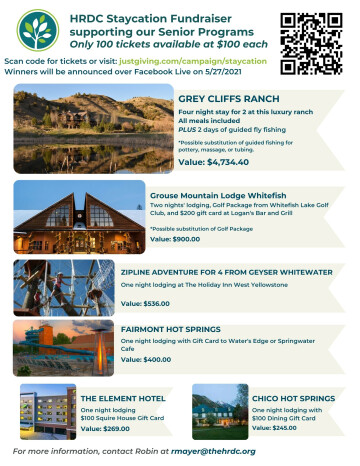
HRDC Hosts Staycation Fundraiser to Serve Seniors

Now over a year into the COVID-19 pandemic, HRDC continues to provide crucial services to Southwest Montana’s older adults. To respond to an increasing need among older adults, HRDC is hosting a Staycation Fundraiser to raise dollars for their senior services.

HRDC’s Staycation Fundraiser allows donors to purchase tickets for their chance to win a stay at one of six local accommodations. Each staycation includes one or more overnight stays, with onsite activities and local fare. A total of 100 tickets will be sold at $100.00 per ticket, with 100% of the proceeds going to HRDC’s services for older adults. Tickets are available for purchase through Tuesday, May 25. A Facebook live drawing will be held on May 27 at 7:00 pm. To purchase a ticket, visit https://www.justgiving.com/campaign/staycation.

In 2020, HRDC served more than 1,900 seniors in Southwest Montana. The nonprofit focuses on providing wraparound services to help seniors remain self-sufficient and engaged within the community. In a typical year, HRDC would host their annual Bingo event to raise awareness and funds to support their programming. Due to COVID-19, however, the organization is unable to hold this annual fundraiser and has instead opted for their virtual Staycation Fundraiser.

HRDC offers a broad-range of services geared towards seniors, from food and meal assistance to help at home and behavioral health counseling. Without these services, seniors can easily fall through the cracks. Oftentimes, these residents are on fixed incomes, have a limited social network, and must navigate complicated processes, like Medicare, without proper resources.

HRDC's Staycation Fundraiser is generously sponsored by: Grey Cliffs Ranch; First Security Bank; PayneWest Insurance; Kelley Connect; Element Bozeman; Dust Bunnies; and Geyser White Water. For more information about HRDC work with seniors, visit https://thehrdc.org/senior-services/. For information about HRDC, visit https://thehrdc.org.

Add a Comment »

MSU researchers advise on protecting fruit from moths during spring


As trees bloom across Montana, many backyard apple and pear growers wonder when they should spray their trees to avoid having worms in their fruit when harvest comes. Montana State University specialists with MSU Extension and the College of Agriculture work to answer that question annually, based on temperature and pest emergence.

The worm most frequently found in fruit like apples or pears is the larvae of the codling moth, a common pest across the state. Because moths are cold-blooded, their life cycle from egg to adult is influenced by environmental temperatures. To accurately gauge when producers should implement control methods, researchers use models or traps baited with pheromones to determine where the moths are in their life cycle and extrapolate when they may become a threat to fruit.

“When trees start to bloom, folks get excited about protecting their fruit,” says Katrina Mendrey, orchard program manager at MSU’s Western Agricultural Research Center in Corvallis. “But spraying insecticides during bloom not only doesn’t control the target pest, it harms bees and, hence, reduces fruit pollination.” 

Mendrey advises that growers be patient and wait for temperatures to rise until moths reach the appropriate life stage for various controls to work. Those controls include wrapping and bagging fruit as well as conventional pesticide spraying.

Scientists at the WARC and MSU Extension monitor temperatures and moth emergence in several areas across the state, including the Flathead, Gallatin, Clark Fork, Missoula and Bitterroot valleys. As more data become available, they will post information about when to apply chemical controls, as well as various ways to reduce the number of worms in your apples, online at agresearch.montana.edu/warc.

Additionally, WARC hopes to work with local garden centers and nurseries selling chemical products to advise growers on accurate timing and use of controls while also protecting important pollinators. 

“As with any pest, growers must use several different tools for preventing damage. Spraying alone is never the answer,” says Mendrey. She said bagging whole trees or individual fruit may be an important option for backyard growers hoping to grow a few pristine apples for fresh eating. The WARC has conducted trials for two years exploring the potential for bagging fruit and will be building on this research in the coming months using whole tree bagging methods.

To find out more about Montana orchards, growing apples in Montana and codling moth control, visit www.mtapples.org/grow.

Add a Comment »

The Bozeman Symphony presents Current Commotion

The Bozeman Symphony presents its first-ever contemporary music series, Current Commotion, for its inaugural performance at the Rialto, a concert venue on Main Street in Bozeman’s bustling downtown district. This unique series aims to explore new music by living composers from across the globe, including the Symphony’s Composer-in-Residence Scott Lee’s Hurry Up and Wait, Andrei Pushkarev’s A Little Jazz Waltz, Kimberly Osberg’s Interplay, and much more. This hour-long program curated by Music Director Norman Huynh and Scott Lee is presented in a cabaret-style format featuring musicians from the Bozeman Symphony orchestra. 

 
“It is our duty to push the limits of our musicians, listeners, and genre. Current Commotion is an experimental series that allows the Bozeman Symphony to be on the cutting edge of our industry,” said Huynh. 
 
Huynh is honored to welcome fellow Peabody Institute graduate and dynamic composer Scott Lee to co-curate the Current Commotion program. Lee was announced as the Bozeman Symphony’s first-ever Composer-in-Residence in early February 2021, and will begin his week-long residency in Bozeman on May 22, 2021. 

“I couldn’t be more excited for this concert of incredible and exciting music, and to have the opportunity to experience the wonderful people and beautiful scenery of Bozeman for the very first time,” said Lee. 
 
During his residency, Lee is commissioned by the Symphony to write a piece inspired by the unique spirit and energy of Bozeman that will open the much-anticipated 2021 – 2022 concert season. Lee believes opportunities like Current Commotion and writing this world premiere piece for the Bozeman Symphony are pivotal for composers to keep symphonic music alive for decades to come. 

 
“Living composers are the lynchpin that keeps classical music connected to our current age, writing in contemporary idioms that speak directly to modern audiences. It’s essential that orchestras champion new music by living composers, as otherwise they become irrelevant as institutions dedicated only to performing the music of ancient history,” said Lee. 

 
As Music Director Huynh plans to expand the Symphony’s concert offerings each season, Current Commotion will be a staple to attract new audiences beyond classical to this new and innovative series featuring living composers. 
 
The free livestream concert, Current Commotion, will premiere on the Bozeman Symphony’s website, YouTube, and Facebook pages on Thursday, May 27, 2021, at 7:30 PM. Limited in-person Current Commotion tickets are available to purchase on the Bozeman Symphony website (bozemansymphony.org), or via (406) 585-9774 or info@bozemansymphony.org. The Symphony wishes to thank Rob and Lynn Maher for sponsoring this performance series in addition to Donald B. Gimbel and Ben and Barbara Phinney for sponsoring the Composer-in-Residence program. 

 
Norman Huynh, Music Director - American conductor Norman Huynh continues to establish his reputation as one of classical music’s most adventurous ambassadors. Hailed for the exuberance with which he leads orchestras across Europe, Asia, and North America, Huynh has received equal renowned for his ability to attract new audiences to the orchestra. The 2020 season inaugurated his tenure as Music Director of the Bozeman Symphony Orchestra, joining an existing appointment as Associate Conductor for the Oregon Symphony.

Huynh has attained international prominence in the first years of his career, most recently through an invitation to the Bruno Walter Young Conductor Preview, a selective showcase hosted by the League of American Orchestras. 
 
Scott Lee, Composer - Praised as “colorful” and “engaging” (The Philadelphia Inquirer), Scott Lee's music often takes inspiration from popular genres, exploring odd-meter grooves and interlocking hockets while featuring pointillistic orchestration and extended performance techniques. His music marries the traditional intricacy of classical form with the more body-centered and visceral language of contemporary popular music, creating complex music of the present with broad appeal. The Berkshire Edge described the world premiere of his Slack Tide at Tanglewood Music Center as having “moments both of calm and maximum tension...we’ve never heard anything like it.”  

 
Lee has worked with the Baltimore Symphony Orchestra, the North Carolina Symphony, the Portland Symphony Orchestra, Symphony in C, the JACK Quartet, yMusic, the Da Capo Chamber Players, and pop artist Ben Folds. Recent commissioners include the Tanglewood Music Center, Aspen Music Festival, Atlanta Symphony Youth Orchestra, loadbang, and the Raleigh Civic Symphony. Notable honors include a Charles Ives Scholarship from the American Academy of Arts and Letters and two ASCAP Morton Gould Young Composer Awards. Lee is currently Assistant Professor of Composition at the University of Florida School of Music. Lee earned a PhD in Composition at Duke University, and also holds degrees from the Peabody Institute and Vanderbilt University. Learn more at scottleemusic.net. 

Add a Comment »

How Much Does Your Student Hobby Cost? A Guide to the Priciest Collectibles

 Have you ever had a low-key obsession with collecting something? If so, your shelves are probably packed with collectibles. Or, they sit somewhere in a box waiting for their time. In case you’re not attached to those items, you might be wondering if someone’s willing to pay handsomely for old toys or comic books. The good news is, the answer is most probably yes. Keep in mind, though: the cases of selling an item for several million dollars do happen once in a while, but they are rare. Still, a toy that costs a buck or two at a second-hand store can easily turn out to be worth several hundred dollars.

Where to Find Pricey Collectibles

Going straight to eBay may be tempting, but finding something valuable for $1 would be impossible there unless you know exactly what you are looking for. And money can be scarce in a student’s life, especially if you need to get help with studies, turning to the essay writing service EssayPro, or hiring a tutor. So, instead, check these places out:
• Your (or your parents’) attic. You probably collected something when you were a kid. These nostalgia-inducing items will likely find buyers who miss their childhood.

• Flea markets. Depending on the market itself, you can meet people selling old books, coins, etc. The price will depend on your luck: some items can be almost free while others will cost quite a fortune.

• Garage sales. This is another way people get rid of stuff they don’t need, so there can be a sweet deal hiding in there somewhere.

• Second-hand/charity/thrift stores. Prepare to get stuck there looking for rare items for hours. Contrary to popular belief, though, many of them are either a bit used or in mint condition.

4 Types of Collectibles that May Be Worth a Top Dollar

Say, you have a bit of money and you want to turn it into hundreds of dollars with a good investment. Apart from getting professional help with your studies (like hiring essay writers), consider getting into the collecting game. Here are four collectibles you should look out for.

1. Comic Books
Action Comics #1 featuring the first appearance of Superman holds the current record for the most expensive comic book. It was sold off an eBay auction for $3.2 million in 2014. Another copy of the same issue is worth $1.5 million – although the content is the same, this copy wasn’t in such a mint condition as its more expensive counterpart.Of course, it’s unlikely your childhood collection has such an expensive specimen. But if your old comic books are in good condition, they can easily be worth several hundred dollars. As always, the key is to find the right buyer.

2. Action Figures & Toys
The list of action figures and toys that can turn out to be worth hundreds or even thousands of dollars is very, very long. Some limited-edition Beanie Babies were sold off for hundreds of thousands of dollars, like the one commemorating the death of Princess Diana ($500,000). Other honorable mentions include complete LEGO sets and separate rare LEGO pieces, Happy Meal toys, Star Wars action figures, and Barbie dolls. For example, something as small as a red LEGO Darth Vader helmet was sold off for $400.

3. Stamps
They are the most clichéd collectibles out there. When you hear someone’s a collector, your mind is 99% likely to present you with a mental picture of an album filled with stamps. However stereotypical collecting stamps is, they can be worth millions, too. (This would be enough not only to cover anyone’s tuition fees but also to get help with studies at EssayPro.com whenever needed.) The most expensive stamp ever sold off was the British Guiana 1c Magenta – it cost its buyer $10 million! Yet, some stamps may turn out to be practically worthless. To avoid putting together a collection only a bit more expensive than stamps’ original price (or underselling what you already have), you need to know your way around the topic. Still, most old - and rather rare - stamps can attract a buyer ready to give you a couple of hundred bucks for them.

4. Coins & Banknotes
The most expensive coin, the Flowing Hair dollar, was sold off for more than $10 million. The priciest banknote (1890 Grand Watermelon Bill), in its turn, cost its buyer around $3.3. million. When looking for the rarest coins and banknotes, keep an eye out for the ones that came as a limited edition (to commemorate an anniversary of a historic event, for example). Funnily enough, coins and banknotes made with some sort of imperfection are probably going to be worth more than their perfect counterparts.

What Makes the Price Tag So High?

Why do some toys get sold off for half a million while others can bring $10 in the best-case scenario? Well, three factors come into play when it comes to pricing:

• Rarity. If it was or still is a dime a dozen, forget about putting up a high price tag for it. The rarer the item is, the more it’s worth – that’s the basic rule. So, look out for limited-edition items or the ones that have some sort of imperfection.

• Condition. Tear-and-wear is inevitable if it was someone’s childhood toy, but it decreases the price. Make sure the items you intend to sell are in mint or at least good condition. The priciest items are the ones that are as good as new.

• Demand. Just because something is rare and in good condition, there’s no guarantee you’ll find a buyer. So, it all depends on who’s interested in what you have to sell.

How does one understand how much a collectible is worth? Turning to experts can help out. However, the most efficient way to know how much something is really worth is by putting it up on eBay.

At the end of the day, it’s not so much about what you think it’s worth; it’s all about how much someone is willing to pay for it.

Add a Comment »

News Comments