


Monday, May. 11th, 2026

Gallatin College MSU brings Law Enforcement Academy to Bozeman
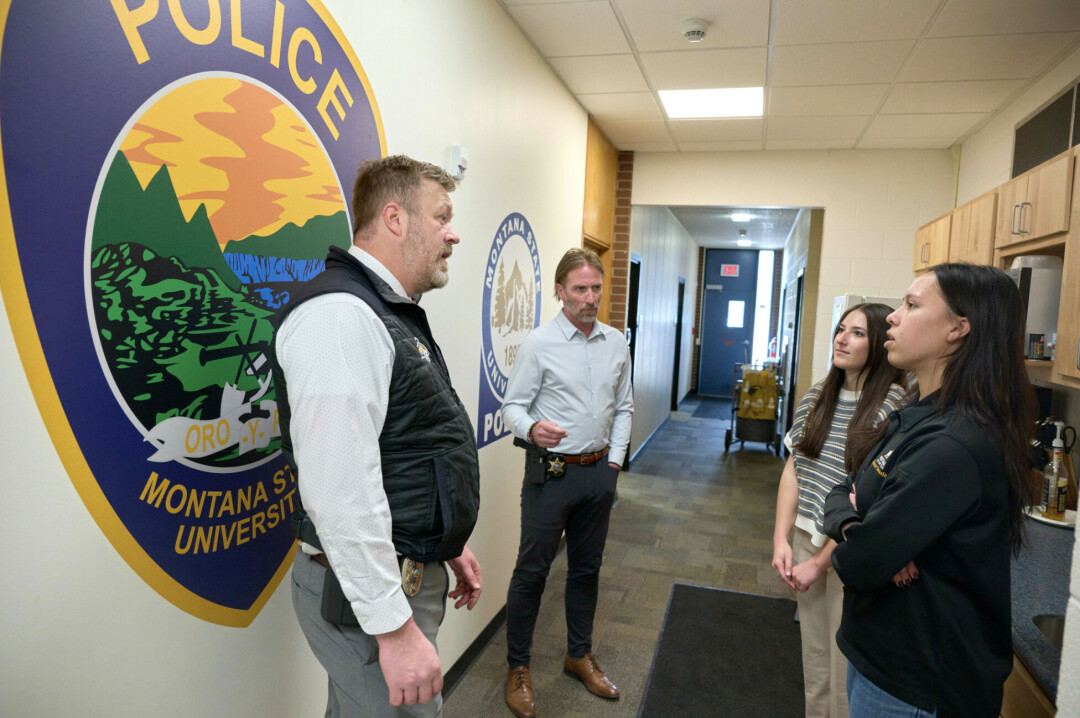
Montana State University police assistant chief Adam Pankratz, left, and Gallatin County Sheriff department Sgt. Mike Chickos instructors with the new Gallatin College Law Enforcement Academy talk with MSU students Tuesday, April 7, 2026, in Bozeman, Mont. MSU photo by Colter Peterson

BOZEMAN
— Law enforcement in Montana takes a village.  

As the fourth largest state in the U.S. with the sixth smallest population, each agency relies on another for niche expertise, whereas bigger agencies can potentially accomplish everything on their own, said Adam Pankratz, deputy chief of Montana State University’s police department. These relationships start to form during basic training, which 14 future officers from across Montana will undergo this summer at Gallatin College MSU’s new Law Enforcement Academy

Whether they are just starting their journey in law enforcement or are entry-level officers sponsored by Montana agencies, students will work alongside each other for more than 570 hours in pursuit of a Certificate of Applied Science in law enforcement before entering the field. The academy’s inaugural class starts on May 11.  

“We're sending these officers out there not just to be police officers, but to be active members of whatever community they join,” said Pankratz, who is also program coordinator for the academy. “In our profession, you don't have to wear a rank insignia to be a leader. Every law enforcement officer is a leader within their community.” 

Gallatin College MSU’s Law Enforcement Academy is only the second law enforcement training school in the state. The first is Helena’s Montana Law Enforcement Academy, which was previously housed at MSU from 1959 to 1976.  

As the number of entry-level officers requiring basic training increases in Montana, so does the need for infrastructure to accommodate that growth, Pankratz said. In the last 10 years, Montana has added more than 400 new law enforcement officers, according to the Montana Board of Crime Control.  

A statewide law enforcement advisory committee identified a two-year college setting as a practical option for additional training space and instruction, based on a national trend of academies becoming housed in such settings. The committee selected Gallatin College MSU to host the academy, which received $320,000 in federal funding this year for startup costs.  
Students will spend 14 weeks in training, receiving instruction from active officers employed at MSU’s police department, the Bozeman Police Department and the Gallatin County Sheriff’s Office, among other Montana agency representatives and MSU faculty. The local agencies will host students for mock scenarios, firearms training and internships, though most classes will take place on the MSU campus.  

“You want to make sure that the person behind you is going to be better than you were,” said Clint Harper, captain at the Gallatin County Sherrif’s Office who oversees the academy’s curriculum. “So that's our goal: When we leave this profession, we leave it in good hands.” 

That’s why students’ coursework will emphasize the value of public trust with Montana criminal code, ethics and communication, Pankratz said. Then, students will apply their knowledge in mock scenarios, such as responding to theft calls or domestic disputes. The scenarios will build in complexity, from a case-based discussion to an on-campus virtual simulator to acting out a scenario with volunteers.  

Gabe Saunders, a newly hired deputy sheriff in Gallatin County, is looking forward to learning case law and investigation strategies from the individuals he will be working with in the future, especially since they helped design the program’s curriculum. Saunders, a 24-year-old from Bozeman, joined the sheriff’s office to serve his community after leaving the U.S. Marine Corps.  
“This community was very good to me when I was growing up, and it would only be right to try to give back and better it in any way I can,” said Saunders, whose long-term career goals include joining the Missouri River Drug Task Force or Gallatin Valley SWAT team. 

Jacob Gamnerdsiri, a 19-year-old from Henderson, Nevada, felt a similar pull to community service when joining the Law Enforcement Academy. His parents both work in the medical field and raised him to “be a good human,” he said. After graduating, he plans to work for a local agency while being a full-time student at MSU in mechanical engineering technology and pre-law, with the long-term goal of attending law school.  

“When you're in a position to help others, you do it,” Gamnerdsiri said. “I want to be part of something that's bigger than me and create the relationships officers have with the community.” 

Students like Gamnerdsiri, who are not already employed by a law enforcement agency, will intern for a Gallatin County department toward the end of their 14 weeks while taking their final classes online. They will also have opportunities to network and job search during a career fair.
Entry-level officers will complete training at their home department in place of an internship.  

Once students complete in-person courses on Aug. 7 and are hired in Montana, they will be eligible to pursue a state-recognized Public Officer Safety Training certification within five years. Certificates from Gallatin College MSU are applicable only to Montana agencies. In Bozeman, police officers often earn about $76,500 annually. 

“Gallatin College is proud to support and train officers responsible for protecting and serving their communities across Montana,” said Stephanie Gray, dean of Gallatin College MSU.

Add a Comment »

Wednesday, May. 6th, 2026

Graduating student pursuing medical career excels during two years at Montana State

BOZEMAN – From an early age, Bailey Mainolfi was so accustomed to family members requiring inpatient care that she began to envision herself working in a hospital someday. She made a plan to become a doctor, and when she graduates from Montana State University with a bachelor’s degree in biochemistry on Friday, she will have passed a significant milestone on the way to reaching that goal.

“I grew up with exposure to medicine quite young, because my grandparents had a lot of complex health conditions,” Mainolfi said. “As I’ve gotten older, I want to be able to reciprocate back to the community, so that’s kind of where I belong. My heart is in medicine.”

Mainolfi began her studies at MSU as a junior after transferring from Flathead Valley Community College in Kalispell, where she earned an Associate of Science degree. From the very beginning, though, she planned to become a Bobcat. She followed the course plan from MSU’s Department of Chemistry and Biochemistry to ensure that all her credits would transfer seamlessly.

Mainolfi’s organized approach has contributed to her noteworthy success, said her professor and research mentor Mary Cloninger. For her academic and research achievements, Mainolfi was named the Outstanding Graduating Biochemistry Student at the department’s annual award ceremony last week.

"Bailey pays attention to the details in her course curriculum, and she has demonstrated her ability to relate subjects she learns in her coursework to her research projects on multiple occasions,” Cloninger said. “She has made important contributions to my research group for the entirety of her time at MSU.”

In Cloninger’s group, Mainolfi worked to isolate the protein galectin-3 from various types of cancer cells. A main goal of the research was to learn more about the protein’s involvement in cellular aggregation and tumor formation. Mainolfi and her undergraduate teammates also formulated a research procedure so that students who succeed them in the lab will be able to achieve consistent results.

“Our project has gone hand-in-hand with graduate student projects, so I really enjoyed the lab,” Mainolfi said. “As opposed to one undergraduate working under one grad student for one project, we all worked together as one big happy family.”

Finding that dynamic particularly rewarding, Mainolfi said she wants to work as part of a care team rather than as a sole practitioner once she finishes her medical training. At her hometown hospital, Logan Health Medical Center in Kalispell, she participated in the student observation program, shadowing doctors in specialties ranging from cardiology to anesthesia. When she was selected for Logan’s Neuroscience and Spine Sorini and DeBartolo Internship last summer, she was able to closely observe team dynamics between physicians.

“For example, with neurosurgery, there’s a certain number of neurosurgeons and they all work together,” she said. “It’s not just about you being able to treat patients – it’s about being able to hear other ideas. I got to observe more of the relationships that go on behind the scenes versus just the patient-physician relationship.”

At MSU, Mainolfi has pursued both academic and non-academic opportunities to work in team situations. She is a member of the student Pre-Med Club, Phi Kappa Phi honor society and Alpha Epsilon Delta, the national honor society for pre-professional health students. During her senior year, she served as a student ambassador for the College of Letters and Science, representing the college at orientation and recruitment events and working to build connection between the letters and science sides of the college.

“In the chem and biochem department, we’re such a tight-knit family. But being a student ambassador, I got to meet a lot more people and be involved in the college. We plan a lot of different activities and ways to bring students together,” she said.

Her mentors say she brings humor and kindness to all her interactions. Judi Haskins, assistant dean of the College of Letters and Science, said Mainolfi’s work as a student ambassador has contributed directly to the success of the program.

“She willingly goes above and beyond to take time to connect with people, whether it be high school students and their families visiting campus, encouraging peers to be the best they can be or meeting with alumni on the CLS Advisory Council,” Haskins said. “She is a true joy to have as a CLS ambassador, and she and her humor will be greatly missed when she graduates.”

Rob Walker, head of the Department of Chemistry and Biochemistry, said, “Bailey has been a pillar of our department for two years, and I’m both thrilled and saddened to see her graduate.”
In her free time, Mainolfi indulges her artistic interests by drawing and playing piano and violin. She has illustrated three soon-to-be-published children’s books by author Carla Chapin, who presents serious themes that help young children understand themselves and their place in the world through animal characters and human companions.

As Mainolfi has demonstrated, such understanding can inspire children to channel their talents for good.

“I’ve wanted to go into medicine ever since I was little,” she said.

After graduation, Mainolfi plans to work in medicine for the next couple of years to gain more experience before applying to medical school.

Add a Comment »

Montana State professor Elizabeth Johnson wins national award for healthcare design education

BOZEMAN — Montana State University assistant nursing professor Elizabeth Johnson has earned recognition by the magazine Healthcare Design for her outstanding leadership in pushing the industry of healthcare design forward.  

The publication hosts annual HCD 10 awards to recognize individuals and organizations across 10 categories for advancing the field of healthcare design, which focuses on how architecture and design elements of physical healthcare spaces shape patient experience and health outcomes.   

Johnson, who teaches in the Mark and Robyn Jones College of Nursing, won the HCD 10 award in the “educator” category. Other categories included architect, building professor, interior designer, researcher and more. A list of the awardees is available here.  

Coverage of the winners and their achievements will be featured in the June/July issue of Healthcare Design, available in print and online. Additionally, honorees will be recognized at an awards gala in June and during the 2026 Healthcare Design Conference and Expo in New Orleans this October.  

At MSU, Johnson has mentored many students pursuing healthcare design research, and this academic year she co-led a team with architecture professor Jordan Zignego to compete at the invitation-only American College of Healthcare Architects student design competition. 

The competing students, TJ Dubler and Jeff Lee, presented their interior and exterior renderings of a remodeled Phillips County Hospital in Malta, based on real-world feedback from providers at the hospital and the space’s current limitations. Johnson instructed the students on how design choices such as signage, colors and the way in which doors open play a key role in both patient experience and employee workflow. For example, sliding doors help create more space and flow in a room, compared to traditional doors that swing open on hinges. The MSU team earned an honorable mention at the competition.  

Johnson’s work in Malta has gone beyond theoretical design, though. She's researched physical design changes at the Phillips County Hospital and tested patient responses to them, such as a projector that allows dark rooms more access to natural light and an earth-toned wall covered in green plants. Her “Kind Room” concept was featured this year in an international exhibit on healthcare design at the Florence Nightingale Museum in London.  

In addition to this external award, Johnson received an internal MSU Founders Day award titled the Vice President for Research’s Award for Meritorious Technology/Service. This award recognized her invention of TrialWear, a device that improves communication between providers and clinical trial patients that was refined at MSU and is now being commercialized.  
Johnson has been an assistant professor at MSU since 2022. She received her Ph.D. in nursing from the University of Arizona.  

“We are extremely proud of Dr. Johnson for earning recognition from Healthcare Design for her impressive work mentoring and educating students in the field of healthcare design,” said Sarah Shannon, dean of the nursing college. “Liz exemplifies the power and benefits of interdisciplinary work in her collaboration with engineering, architecture and computer science. Her work benefits communities across Montana and truly exemplifies the goal of our land-grant mission.”  

Add a Comment »

She’s got the vim, she’s here to win: Montana State senior reflects on marching band legacy

BOZEMAN — The muffled roar of 24,000 fans trickled into a tunnel where more than 200 Spirit of the West members lay in wait.  

Brianna Rainey turned to face the sea of blue and gold for the last time, donning a white cowboy hat indicating her leadership role in Montana’s largest collegiate marching band. She was about to conduct her peers during Montana State University’s Football Championship Subdivision game in Nashville, and she couldn’t believe how far she’d come. 

Just five years prior, Rainey was one of only five musicians in Forsyth High School’s band program. She had never marched a day in her life, nor had she attended a college football game.  
It was inconceivable that her last performance would take place on a national stage. She ascended a podium on the championship field, raised her gloved hands in the air, and gave musicians their cue to play “How the West is Won.” 

“Yelling ‘Go, ’Cats, Go’ with thousands of other people was surreal. I was trying not to cry because I knew that no matter the outcome, this was my last game,” she said. “That was definitely the best way to go out.” 

Hanging up her uniform that day, enthused by a win for the Bobcats, Rainey closed an important chapter in her life. But another begins on Friday, May 8, after she graduates from MSU’s College of Arts and Architecture with a degree in music education. She hopes to teach middle school or high school students in central Montana.  

This region of the state is where Rainey feels at home, she said, having grown up in Havre and Forsyth with frequent travel to Bozeman for Future Farmers of America events. When she started college, however, she was traversing unfamiliar territory.  

It didn’t matter that she taught herself multiple instruments in high school — preferring the flute — or earned a music scholarship to MSU: Rainey said she felt like an imposter among other students who had played for longer at bigger schools. Then, she began to form her own community of musicians and switched majors from nursing to music education. Everything started to click.  

She joined several ensembles including Wind Symphony, the Voces Luminis choir, University Band and — the chief reason she came to MSU — the Spirit of the West. 

The 42-year-old marching band performs at games, campus events and community gatherings. Rainey said the band represents MSU rain or shine, sometimes performing in sub-zero temperatures during the winter, and embodies the energy aptly described in the fight song played at every game: “We’ve got the vim, we’re here to win.”  

As a drum major, Rainey was the band’s student director. She conducted performances and was the first musician audiences saw when the band entered a space. She led performances with co-drum major Jordan Jensen, a biochemistry student from Townsend. She said there was nothing quite like performing in Bobcat Stadium with her parents seated behind her — she often heard her dad cheering her name over the crowd — and watching her peers’ hard work come to fruition in real time.  

She added her own artistic flare to conducting hand motions, which must be seen by musicians 50 yards away and remain perfectly in sync with those of other student conductors. If MSU had a conducting hall of fame, Rainey would certainly be in it, said band director Nathan Stark.  

“We want everyone to be bold and brave on the field. Having a leader like Brianna who inspires that energy and encourages students to try is just invaluable,” he said. “Younger students see Brianna, and they think, ‘I want to be like her.’” 

Providing a safe space for younger students was Rainey’s goal when she stepped into a leadership role for the band, first as a piccolo section leader, then as an assistant field captain and drum major. She recalls how intimidating it was as a freshman to keep time and form complex shapes on the field while playing an instrument. She remembers being terrified for her first Gold Rush game, the home opener for the football season. 

“I remember walking out of the tunnel and seeing the crowd, and I was just in awe,” she said. “I was like, ‘I'm going to forget everything.’ But as soon as we started, I just focused.” 

As a drum major, Rainey became a friendly face for students entering an annual band camp. She also held mentoring sessions for aspiring drum majors this year, having a heart-to-heart with those who worried, like she did, that they wouldn’t live up to the pressure the position requires.  

The experience has transformed her, so much that people remark on her self-assured demeanor when she is student teaching, Rainey said. She spent the spring semester instructing 120 students in several of Gallatin High School’s bands and preparing them for a district music festival. Before heading into the field, music education students spend time observing and teaching in three local schools. They also learn how to perform the basics on nearly every instrument. 

Rainey plays each instrument like it’s her specialty, said Derek Bannasch, assistant teaching professor of music. Off campus, Bannasch conducts Rainey in the Gallatin Valley Concert Band and has hired her for the Ellen Theatre’s pit orchestra.  

“Brianna is very intelligent, and she takes her craft seriously,” Bannasch said. “I sound like I’m fangirling a bit, but she really is an excellent student.” 

Rainey said she is eager to teach the next generation of music students. 

“At MSU, I've really been able to step up and grow into the person I'm supposed to be,” she said.

Add a Comment »

Bozeman Doc Series Wraps Up Its Eleventh Season


Thanks to everyone for coming out and being a part of the eleventh season of the Doc Series. It was another great year for docs, and we loved sharing some of the best with you.

If you missed some of the films, keep an eye out on streaming platforms in the coming months as most of them will start to be made available. And if you're looking for more great docs to check out, have a look at our ARCHIVE. It represents a collection of some truly excellent docs from the past eleven years - most of which can be found online now.

Keep an eye out for early-bird season pass and punch card sales starting in August and the announcements of the first films in Season Twelve's lineup in September. And we'll see you in October for opening night!

If you can't wait until fall to get your documentary fix...


This Wednesday, May 6th, at 6 pm at the Emerson Center, The Montana Plan presents a free showing of Dark Money, an award-winning documentary featured on PBS as part of the 31st season of POV.

A real-life political thriller, Dark Money examines one of the greatest present threats to American democracy: the influence of untraceable corporate money on our elections and elected officials. The film takes viewers to Montana—a frontline in the fight to preserve fair elections nationwide—to follow an intrepid local journalist working to expose the real-life impacts of the US Supreme Court’s Citizens United decision. Through this gripping story, DARK MONEY uncovers the shocking and vital truth of how American elections are bought and sold. This Sundance award-winning documentary is directed/produced by Kimberly Reed (PRODIGAL SONS) and produced by Katy Chevigny (E-TEAM).

The film will be followed by a panel discussion about how Montanans are fighting back with The Montana Plan, a bold citizen's initiative to ban corporate money, dark money, and billionaire money from Montana elections. Attendees will be able to sign the initiative and volunteer to help get it on the ballot.

Dark Money at the Emerson Cultural Center, Wednesday May 6 at 6 p.m., at no charge.

Add a Comment »

6 Refrigeration Tips for Gallatin Valley Food Trucks


Gallatin Valley is the perfect place to be during the summer, especially if you have a food truck business. The landscape is breathtaking, and there are plenty of opportunities to showcase your culinary skills. Bozemanites are fun people who love festivals and outdoor events, so you’ll never lack clients. Whether you’re part of the Music on Main festival or participate in the CSCMT Food Truck Festival, Gallatin Valley offers plenty of opportunities for foodie entrepreneurs.

As long as you have your recipes and the right refrigeration system, your food truck can take your brand and business to new heights. We can’t help you with the recipes (those are entirely your responsibility), but we do have a few tips about proper refrigeration in food trucks:

1. Choose the Right Equipment

A food truck prepared to service all the events in the Gallatin Valley needs reliable refrigeration equipment that can withstand the challenges of life on the road. One such challenge is the heat.  In a food truck, the combination of summer sun on a metal shell and multiple cooking appliances (fryers, grills, ovens) can push internal temperatures to 100°F or higher. Under such conditions, you need a refrigeration unit with high-density polyurethane insulation and stainless steel.

Then, there’s the movement. Every time the truck moves, your fridge is subjected to constant vibration and jarring impacts from potholes or uneven roads. Vibration causes stress fractures in the joints, leading to slow leaks that are difficult to diagnose until the unit stops cooling entirely.

The best refrigeration unit for your food truck must withstand these challenges while making life a little easier for you. A reach-in unit like those from Empura uses vertical height, allowing you to store significantly more inventory. With the right unit, you can even go a full 10-hour shift without restocking.

In fact, Empura food prep equipment is a strong choice for mobile food service operations. As a Restaurant Supply brand, Empura reflects the level of quality and thoughtful design that goes into these units.

2. Install Dedicated Circuitry

Never daisy-chain your refrigeration with other appliances like blenders or heat lamps. The primary refrigeration unit must be on its own dedicated 15A or 20A circuit. Otherwise, voltage drops caused by other appliances cycling on can cause the fridge's sensitive electronic controllers to reset or fry.

It’s best to install an isolated ground receptacle (usually orange) for your refrigerator. These outlets have a dedicated ground path that is separated from the rest of the truck's metallic structure, ensuring the fridge’s electronics aren't affected by interference from other motors (like your vent hood fan).

3. Prevent Short-Cycles

When everyone is hungry and impatiently waiting for their food, your fridge’s door may open several dozen times per hour. Just like your father used to say when you were looking for snacks, this is not good for the unit.

The main issue is with the compressor. Frequent door opening, especially in a 100°F truck kitchen, causes the compressor to short-cycle (turning on and off rapidly), which kills the motor. But you can’t just ask people to wait until it’s safe to open the door again, right?

The trick is to install plastic strip curtains behind the fridge doors. They act as a thermal barrier, keeping the cold air inside even when the door is wide open during a rush.

4. High-Amperage Startup Management

Commercial refrigerators prefer stable, clean power from a municipal grid. Food trucks have no such luxury, as they rely on generators or shore power (extension cords). You need a generator that’s powerful enough to support your unit’s compressor.

Compressors require a massive surge of power to start. If your generator is already strained by a vent hood and an espresso machine, the fridge compressor may stall or burn out. To avoid such a tragic scenario, install a soft start kit. It smooths out the power demand, allowing the fridge to kick on without tripping your breakers or stalling the generator.

5. Pre-Chill the Food

Never load room-temperature prep items or warm sauces directly into your truck's fridge. Loading warm items directly into a small reach-in can cause a thermal spike that may pose a food safety hazard. And the refrigeration equipment won’t be happy either. But you can’t let it cool down at truck temperature either. Instead, use a stationary commissary fridge to chill everything to 38°F(3°C) before loading. A food truck fridge is designed to maintain temperature, not to lower it rapidly.

6. Plan B on Stand-By

With all the vibrations, movement, and unstable power, mechanical failure of your unit is a matter of when, not if. And if your fridge manages to withstand all that, you never know when power might go out. The secret to your success? A solid plan B! Always keep a high-performance, rotationally molded cooler on the truck, pre-filled with ice packs. If the power goes out, you have a 4-hour window to move your most expensive proteins (scallops, wagyu, dairy) into the cooler to save your margins.

Enjoy Your Food Truck Adventure!

Now that you know how to choose the right refrigeration unit and how to protect it from the challenges of life on the road, you’re ready to conquer the food truck scene in Gallatin Valley. Get your recipes ready and start cooking!

Add a Comment »

Monday, May. 4th, 2026

Made for Michelin: Gallatin College MSU graduate takes culinary talent overseas


BOZEMAN
— Brandon Swenson had a limited grasp on the German language, but the applause he received from Michelin-star chefs in Munich last year needed no translation.  

As he soaked in the praise on his last day interning for the three-star Michelin restaurant JAN, however, his mind couldn’t help but wander to the scrap paper on his nightstand 5,000 miles away in Bozeman. 
It was a 7-week-old packing list. Scrawled at the bottom was a message of encouragement to himself, betraying his nervousness and excitement for pursuing his dreams abroad: “Knock ’em dead, baby.” 

“I was thinking back to that piece of paper like, ‘I did it,’” Swenson said. “I did it.” 

And his culinary career is just beginning. Swenson, a 25-year-old from Bozeman, is invited to return to JAN for three months this summer after graduating in May from the two-year culinary arts program atGallatin College Montana State University

The restaurant and its modern German cuisine hold the record for the second-fastest accumulation of three Michelin stars in the world, receiving the highest honor awarded to restaurants only six months after opening in 2023. While Swenson worked there in 2025, JAN’s stars were renewed for another year, and it was also the only German restaurant to be included in rankings for The World’s 50 Best Restaurants. 

Michelin kitchens attract only the most dedicated chefs — the ones who are willing to spend 13-hour days scrubbing the kitchen and preparing edible works of art, Swenson said.

With tweezers and a steady hand, he laid dainty purple flowers and peeled almonds atop glass orbs filled with caviar. He helped plate dozens of JAN’s signature caviar dish in the restaurant’s cold kitchen, as well as other appetizers and desserts. Each menu item is served within five minutes of completion and is part of a three-hour, 12-course dining experience. 

“It's all tweezer fever,” Swenson said. “It's so much tweezing, so many garnishes, so many intricate details. It was really hard the first week, but then, after a while, you get surgical.” 

Surrounded by a smattering of German conversation, of which he only caught every third word, it was like he was in his own world. The restaurant’s pastry chef often gave him a word or phrase of the day, however, like “behind” — hinter — or “Can you please repeat that” — Kannst du das wiederholen bitte. His efforts to learn the language and replicate JAN’s specific culinary style helped him earn the respect and friendship of his colleagues, he said.  

The ability to recreate dishes was a skill he picked up as a 16-year-old who helped care for a full house of five children, quickly absorbing books and videos to make shepherd’s pie and tilapia. At first, Swenson’s concoctions ranged from undercooked to burnt — time management was not on his radar. But he said he enjoyed the mental challenge. His experimentation continued in college, where he spends nearly 48 hours each week in the kitchen during the school year.
Swenson enrolled at Gallatin College MSU two years after earning his high school diploma, realizing he felt more at home behind a stove than in his stepfather’s construction company.  
The effort Gallatin College MSU students put into their craft is what they get out of the culinary program, said instructor Alex Hrabovsky. He believes Swenson’s drive to constantly improve his skills has allowed him to gain a deep understanding of flavors, textures and aesthetic appeal, making a lasting impression with a single bite of food.

“It shows that, even with very little financial backing, you can still achieve excellence through your own work and dedication to what it is that you have,” Hrabovsky said. “Have that dream. Move in that direction. It doesn’t matter what your background is.” 

Swenson was independent from his family at age 18, so Gallatin College MSU’s affordability was key in earning a degree that would demonstrate his employability to high-end restaurants. He was taught to be self-reliant, having been in foster care for a little over a year and joining four different families as a child before being adopted by his aunt.  

“It's you versus the world, essentially. That's the mentality I've had since I was 8,” he said. “But the lesson that I've come to recognize is that needing support from others is not a weakness. It's a strength.” 

A supportive kitchen is especially important at Gallatin College MSU, where students work with peers of all experience levels and styles in class and at Thyme Bistro, Hrabovsky said. As part of the on-campus restaurant, students run their own kitchen and design a full menu for about 60 people every Friday from February to April in Hannon Hall’s dining room.  

Swenson’s first-year menu featured pinwheels of pork mince wrapped in Swiss rolls and bacon, sitting on whipped mascarpone and goat cheese. He said the restaurant provided him with the building blocks for the business side of the food industry, such as managerial skills and calculating purchasing costs. 

The experience marked another step toward his “plan A” of taking over a European restaurant once he gains Michelin kitchen experience across countries like France, Belgium and Denmark. But first, he will return to Germany’s JAN in May.  

“I’m itching to see the front door and just walk right in,” he said.

Add a Comment »

Saturday, May. 2nd, 2026

Crawford Fellows present new methods of conserving, managing wildlife habitat

BOZEMAN — Butterflies can be “wicked fast,” Kaylee Guajardo Sullivan discovered three summers ago.  

The second-year master’s student who studies statistics at Montana State University recalled swinging her butterfly net and sprinting across a field in Glacier National Park. Surveying the insects in 23 locations was part of a research effort assessing change in butterfly species diversity from nearly 40 years ago to present day, and she is determining the best way to model the data accurately. 

A statistician may seem like an unlikely addition to wildlife habitat research, but Guajardo Sullivan is one of 57 graduate students at MSU pursuing such interdisciplinary work. The students share a common goal: to study how humans can better protect and manage their environment to support wildlife.  

“If you’re driven and you want something, this is a school that’s going to support you,” said Guajardo Sullivan, who is originally from Chicago and has lived in Montana for nearly six years. “I have no words, only gratitude.” 

This gratitude, she said, is for Kathy Crawford and her late husband, Thomas H. “Tim” Crawford, creators of the Crawford Wildlife Habitat Graduate Fellowship for graduate students and the Crawford Wildlife Habitat Scholarships for undergraduates, which will begin supporting students in the fall. The $30 million gift, awarded to MSU in 2025, is the largest scholarship endowment in the university’s history. 

On April 16, Kathy Crawford and MSU’s Graduate School celebrated the Crawford Fellows with a research showcase, organized by graduate assistant Kade Woolverton. 

“It’s exactly what I had hoped for,” Crawford said. “The enthusiasm is huge for taking care of wildlife habitat, and I’m overwhelmed with appreciation for what the students are doing.” 
Denali Stetson, a second-year master’s student from Corvallis who studies animal and range sciences, presented research on stream characteristics that are the most suitable for beaver colony reintroduction in Montana. 

The U.S. Forest Service has pursued reintroduction initiatives since the 1980s to combat disease and trapping that plagued Montana’s beaver populations. Stetson analyzed a 40-year data set on 11 stream sites across the Absaroka-Beartooth Wilderness, Custer Gallatin National Forest and Yellowstone National Park. She found that beavers are likely to remain near streams that are meandering, have lower slopes and have an average width-to-depth ratio.  

She will continue the research in the fall before graduating in December with what will be her second degree from MSU, the first being a bachelor’s in fish and wildlife management that she earned as a Hilleman Scholar, a program for Montana residents who demonstrate academic and leadership potential. 

“I have always known I wanted to be a wildlife biologist, but actually finding a master’s project and continuing my education means a lot,” she said.  

Sundas Iftikar, a second-year doctoral student studying computer science, said continuing her education was made possible, in part, by the Crawford fellowship. As an international student from Attock, Pakistan, visa restrictions prevent her from finding employment off campus during the school year.  

“I was able to focus on my research without the stress of, ‘How can I manage my rent? How can I manage my debt?’” she said. 

Iftikar studies how unmanned aerial vehicles, or UAVs, can help detect wildfires earlier and prevent the loss of life, ecosystems and property in the U.S. Traditional fire detection technology is unsuitable for large spaces because it experiences delays in dense areas, has limited range and is sensitive to factors like dust that cause false alarms.  

Her research team is training and testing UAV technology, integrated with machine learning algorithms, using more than 48,000 images of wildfires. The images are rotated, cropped or flipped to test the detection models’ intelligence. Iftikar will spend the next three years at MSU working with larger and more diverse wildfire datasets, with potential to explore thermal drone sensors and artificial intelligence-generated weather predictions.  

Another research endeavor presented at the showcase studied how livestock managers can better use their land to feed beef cattle in Montana. Housed in the Department of Animal and Range Sciences, the study covers nearly 11,000 acres between the Madison River and MSU’s Red Bluff Research Ranch in Norris, and researchers followed hundreds of beef cattle over six years of winter grazing. 

Noah Davis helped complete the project as a doctoral student last semester and is now an assistant professor of grazing ecology and management at MSU. He studied changes in forage protein and fiber availability, as well as how livestock interact with the plants they graze. Researchers also gave protein supplements to 318 cattle along their grazing paths and, using GPS collars, tracked how cattle traveled further and grazed less after receiving the supplement.  
“Understanding how animals use the landscape, disturb the landscape and how we can manipulate that is critical,” said Davis, who is from Ventura, California, and has lived in Bozeman for 12 years. 

Many studies like these are making important strides in the conservation field, but they lack outlets to share information with the public, said Timothy Mooring, a second-year student in the Science and Natural History Filmmaking program. Mooring, who is from San Diego, aims to bridge this gap with two short films he presented at the showcase, both featuring the Zambian Carnivore Programme. 

He shadowed the program’s Greater Liuwa Ecosystem branch in western Zambia, which tracks wildebeest migration patterns and where the animals avoid human contact. He said this information will inform conservation efforts that protect areas key to wildebeest passage, a necessity given the animal is a vital food source for Zambian predators.  

Mooring said he was awestruck by the environment his mother described when he was a child — she was born in Zambia and moved to the U.S. at age 26 — and the conservationists’ passion that emanated from the screen.  

“I would finish interviewing someone, and sometimes I would cry,” Mooring said. “I couldn’t believe how inspiring some of these stories and the research were.”  

Add a Comment »

First-generation student Kayla Fuller wins ‘life-changing’ scholarship to continue accounting education

BOZEMAN — When Montana State University junior Kayla Fuller heard news that she won a $15,000 national accounting scholarship, allowing her to pursue a master’s degree when she would have otherwise been unable to do so, two words came to mind.  

“Life-changing. This scholarship is genuinely life-changing to me,” said Fuller, who is majoring in accounting and marketing with a minor in finance in MSU’s Jake Jabs College of Business and Entrepreneurship. She is also a first-generation student, meaning she is the first person in her immediate family to pursue higher education.  

Fuller, who is from Pine, Colorado, received the scholarship from the Public Company Accounting Oversight Board in April. The money is designated for tuition for students pursuing a future career in accounting.  

Earlier in April, Fuller said she was on the phone with her mom discussing her career options, given the expense of a master’s degree. If she could not afford it, Fuller planned to work full time at an accounting firm and study for the certified public accountant exam independently, but that is less ideal than a graduate program, she said. In Montana, a one-year master’s program reduces the work experience hours required to sit for the exam, and it carries the benefit of institutional support and guidance from faculty.  

A master’s program “will allow me to put more time into studying for my CPA exam as I try to become the most knowledgeable financial professional that I can be,” Fuller said. 

Upon completion of her bachelor’s degree, Fuller now plans to stay at MSU and apply for the Master of Professional Accountancy program, or MPAc. She said she is thrilled to remain in Bozeman and continue working with some of the same professors who have taught her already. 
“Kayla displays high ethical standards, focusing on independence, acting fairly and with professional skepticism, carefully questioning assumptions and being thorough,” said Angela Woodland, the accounting professor who administered the award. “She knows when to ask for guidance or a second opinion to ensure decisions are correct.” 

Fuller, who has always been drawn to studying business, said she became interested in accounting after taking an introductory class with assistant professor Brad Kamreth. She found the accounting field spanned areas she was interested in, and she also appreciated the job security. According to university data, MSU’s MPAc program routinely boasts a 100% job placement rate for its graduates.  

This summer, Fuller will intern as a credit analyst for Opportunity Bank in Bozeman. She landed the opportunity thanks to Jabs Networking Night and the Bracken Center at MSU, which prepared her for networking and interviewing, and helped hone her resume. 

“I’m eternally grateful for Jabs,” Fuller said. “I think the classes, professors and all the resources available have really set me up for success.”  

Fuller has also been an involved student outside of the business college. She is a Western Undergraduate Exchange Scholar, one of the most prestigious merit-based scholarships offered by MSU, earned a CABLE scholarship her freshman year and is a current TRIO Scholar, a designated support system for first-generation and low-income students.  

Additionally, she is a regular member of Cats Catholic, is president of MSU’s Backcountry Squatters chapter – a space for women and nonbinary athletes pursuing outdoor recreation activities – and works as the communications director for the university’s student government, the Associated Students of MSU. Outside of school, she enjoys mountain biking, climbing, swing dancing and generally being outside. For the past three summers, she has worked as a multi-sport instructor and last summer as assistant director for a Colorado-based outdoor education company, Avid4 Adventure.  

“I just feel super blessed to have this opportunity,” Fuller said. “I’m so excited to be able to continue my education and hopefully contribute to the accounting world.”  

Add a Comment »

Thursday, Apr. 30th, 2026

How to Choose a Home in Bozeman That Works for You Long Term

Buying a home in Bozeman takes a little more thought than it once did. Prices remain high, demand stays steady, and the area continues to attract people who want a different pace of life. That has changed the conversation for many buyers. It is no longer only about finding a home that works today. It is about finding one that will still feel like the right choice a few years from now.

That shift has made homeownership feel more intentional. Buyers are looking beyond square footage and price range and thinking about how a property will support their lives over time. A home that fits now should still offer comfort, stability, and room to adapt if routines or priorities change.

Looking ahead does not have to make the process feel overwhelming. It simply helps you make a clearer decision and gives you more options for the future. 

Start With the Way You Actually Live

Before you think about resale value or future plans, take a close look at your everyday life. Bozeman offers a wide range of neighborhoods, each with its own feel, pace, and access to the outdoors. The best fit often starts with a basic question: what do you want daily life to look like?

For some buyers, living close to downtown is the priority. They want to be near restaurants, shops, events, and the places they visit most often. For others, the better fit is a quieter area with more space, less traffic, and easier access to trails or open land. Commute times, school options, and winter driving conditions can all shape how a home feels after the initial excitement fades.

It also helps to be honest about how much space you really need. A larger home can be appealing, but it also brings more upkeep, more expense, and more to manage throughout the year. A smaller home that fits your routine may feel easier to maintain and more comfortable in the long run.

When a home suits the way you already live, it has a better chance of continuing to work as life gets busier.

Think Past the First Few Years

It is easy to focus on immediate needs, especially in a market where decisions can feel urgent. Still, the strongest home purchases usually come from thinking a little further ahead.

Jobs change. Families grow. Priorities shift. A layout that feels ideal now may feel limiting later if it does not leave room for a home office, guests, storage, or a different daily rhythm. Even details that seem small at first, like yard size, stairs, or an extra room, can matter more with time.

The same goes for how long you expect to stay. Even if you think you may move eventually, it helps to choose a home that will continue to appeal to future buyers or still serve a purpose in your next chapter. A property with flexibility tends to give you more confidence from the start.You do not need to predict every turn your life may take. You just want a home that leaves room for change.

Location Shapes Long-Term Value

Where you buy matters just as much as what you buy. In Bozeman, location influences everything from your daily routine to long-term value as the city continues to grow and shift.

Some buyers are drawn to neighborhoods near downtown and established community spaces. Others care more about access to trails, quieter streets, or a little more room to spread out. Schools, nearby amenities, and future development can all affect whether an area continues to feel like a good fit over time.

It is worth paying attention to neighborhoods that show steady appeal without losing the qualities that made them attractive in the first place. A location with lasting draw often makes ownership feel more secure, whether you plan to stay for years or move on later.

A good location does more than meet your needs today. It keeps making sense as your life and the community around you continue to evolve.

Planning for Flexibility Down the Road

One of the most valuable things a home can offer is flexibility. Even if you plan to stay for a while, it helps to choose a property that gives you options if your plans change.

Some homeowners relocate for work or family and decide to keep the home rather than sell right away. Others reach a point where renting it out makes sense for a season. That may not be part of your plan today, but it is still worth thinking about while you are buying.

Once you start considering future rental use, financing starts to matter in a different way.  Not every property works well as a future rental, and not every loan makes that transition equally smooth. For buyers who want to keep that option open, it can help to look into the best lenders for rental property and get a clearer sense of which financing options may support that kind of long-term flexibility.

Thinking ahead like this does not commit you to one path. It simply makes it easier to adjust if your circumstances change.

Understanding the Financial Side of Ownership

A home’s price is only one part of the picture. Over time, the full cost of ownership shows up through property taxes, insurance, maintenance, utilities, and the repairs that tend to arrive when you least expect them. In Bozeman, winter can add another layer of wear and expense.

That is why it helps to look at the full financial picture early. Buyers who plan for monthly costs, upkeep, and a repair reserve often feel more comfortable once the purchase is behind them. A little preparation at the beginning can spare you a lot of stress later.

For a broader look at the expenses of homeownership, this guide to the costs of buying a home offers useful context.

A home that fits your finances realistically is much more likely to remain the right fit over time.

Making a Choice That Still Feels Right Later

The best home purchase is rarely about finding something perfect. It is about finding something that fits your life, your priorities, and the future you can reasonably see ahead.

When you weigh daily livability, flexibility, location, and the real cost of ownership, the decision becomes clearer. You are not only buying for the version of life you are living today. You are choosing a home that can continue to support you over the next several years.

For a more local perspective on building a life here, putting down roots in Bozeman offers a helpful companion read. 

Conclusion

Buying a home in Bozeman is a meaningful decision, and it usually works best when you think about both the present and the future. The right home should support the way you live now while still giving you room to adjust as life changes.

That does not mean having every detail figured out from day one. It means choosing with intention, leaving space for flexibility, and trusting that a thoughtful decision today can continue to serve you well later.

Add a Comment »

News Comments