


Friday, Oct. 13th, 2023

Doralyn Rossmann selected as new dean of Montana State University Library

BOZEMAN — Doralyn Rossmann, a longtime faculty member in the Montana State University Library who has been serving as the library’s interim dean since August 2022, has been selected as the library’s new dean after a national search. She will begin her new position Oct. 16.

“We are delighted to welcome Doralyn to this important leadership role at MSU,” said Robert Mokwa, executive vice president for academic affairs and provost. “Rossmann’s innovative ideas and experience in strengthening and broadening connections between research and education through the many services offered by the MSU library, and her knack for building strong relationships with students, faculty and staff, stood out during her interview. Rossmann’s vision for a modern library that serves both the needs of an R-1, land-grant university, as well as the broader needs of the state of Montana, was inspirational and resonated highly with our campus community.”

Rossmann has worked at MSU since 2001. In addition to her current role as the library’s interim dean, Rossmann has earned the rank of professor and has served as head of the library's Collection Development department and head of the Digital Library Initiatives department.

“I'm thrilled and honored to have this opportunity to serve as the dean of the MSU Library,” Rossmann said. “Our library is doing incredible work for our community, and I'm excited to be able to plan into the future by leading in my new role."

Rossmann was one of two finalists who interviewed on campus this week. The interview process included meetings with faculty, administrators and students. Members of the public were also invited to participate in an open forum and submit comments online.

Rossmann has taught a variety of courses at MSU ranging from social media practices to public budgeting and management. Her research has resulted in numerous article and book publications about the role of social media in our information society, fiscal transparency and resource allocation, and scholarly communication and open access.

In addition, Rossmann has served on Faculty Senate and Budget Council and co-founded the DEAL program. Her professional service extends to organizations such as the Coalition for Networked Information, the Scholarly Publishing and Academic Resources Coalition, and the National Information Standards Organization. In 2022, she was chosen to deliver a lecture as part of the Provost's Distinguished Lecturer Series. Prior to coming to MSU, she worked in libraries at the University of Illinois at Chicago, Rice University and the University of Wyoming. 

Rossmann has bachelor’s degrees in English and political science and a master's degree in library science from the University of North Carolina at Chapel Hill. She also has a master's degree in public administration from MSU.

Rossmann replaces Kenning Arlitsch, who served as dean from 2012 to 2022.

Mokwa expressed appreciation to members of the search committee and to its chair, Stephanie Gray, dean of Gallatin College MSU.

“We had a pool of very strong candidates, and I am grateful to Dean Gray and the members of the search committee for their dedicated efforts to engage the library staff and faculty, and the entire MSU community, in the search process,” Mokwa said.

Add a Comment »

Wednesday, Oct. 11th, 2023

Films by Montana State graduates to be screened at Montana Film Festival

BOZEMAN — Two films directed by Montana State University graduates will be screened during the Montana Film Festival in Missoula, which takes place Oct. 12-15 at the Roxy Theater, 718 S. Higgins Ave.

Jake Ames, who graduated from MSU in 2022, wrote and directed “Haystacks,” a Western that features a vagabond whose idea of freedom is threatened after being caught trespassing by a landowner. “Haystacks” will be shown at 7 p.m. Friday, Oct. 13, and again at 3:15 p.m. on Sunday, Oct. 15.

Kayla Arend wrote and directed “Leaving Yellowstone,” which lists Spike Lee as executive producer. After graduating from MSU in 2013, Arend moved to New York and received her MFA from New York University’s Tisch School of the Arts, where she now works as an adjunct professor. “Leaving Yellowstone” is a thriller about a woman whose relationship with her boyfriend becomes strained during a winter vacation to Yellowstone National Park. The film will be shown at 5:15 p.m. Saturday, Oct. 14.

For more information about the film festival or to purchase tickets, visit: www.montanafilmfestival.org.

Add a Comment »

Tuesday, Oct. 10th, 2023

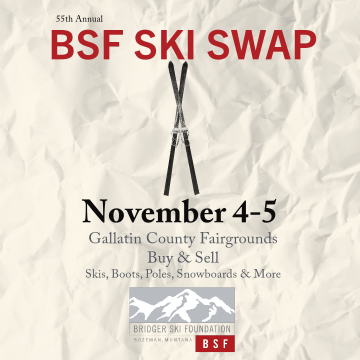
Bridger Ski Foundation to Host 55th Annual Ski Swap; Golden Ticket Giveaway for Local Youth

BOZEMAN, MT – Bridger Ski Foundation’s (BSF) 55th Annual Ski Swap will take place November 4-5, 2023 at the Gallatin County Fairgrounds in Bozeman. Steeped in tradition, the event attracts local legends and newcomers alike, with more than 10,000 items for sale. 

Skiers and riders will find equipment ranging from cross-country skis to fat powder skis, snowboards, poles, backpacks, helmets, boots, winter clothing, and more. In addition to consignment items from individuals, the Ski Swap also carries both new and used inventory from local retailers.

For those who want to make room for new gear, you can pre-register all of your consignment items online (preferably by October 31) and then drop everything off on Friday, November 3 between 10 am and 7 pm at the Fairgrounds. All sales take place in person, and BSF retains a 20% commission on sold items. You can pick up any unsold items at the end of the day on Sunday.  

Bridger Ski Foundation expects 5,000 people to come through the swap throughout the weekend. “It’s a ski swap, but it’s also a celebration,” says BSF Communications Director Jenny White. “People willingly (and cheerfully) stand in line—some of them hours before the doors open.” You will also find local organizations and sponsors with information tables and giveaways. This year, BSF will award $50 Golden Tickets to local youth, and they will offer ski waxing services as well.

BSF takes a 20% commission if a consignment item is sold. With thousands of items going out the door, it is the biggest fundraiser of the year for the nonprofit club, which provides ski programs for more than 1,000  youth and adults and also grooms a vast network of Community Nordic Ski Trails, including snowmaking at Sunset Hills. “For BSF, the Ski Swap is also a community service. It gives the people of Montana easy access to more affordable ski gear. Instead of things gathering dust in someone’s garage for 20 years, we’re getting those items circulating back into the community.” 

Intermountain Health has signed on to be the title sponsor of this year’s BSF Ski Swap, and a number of local businesses have also committed to supporting the Bridger Ski Foundation through this event. “It takes a village,” says White. “Bozeman has always been about keeping skiing a grassroots activity, and the BSF Ski Swap is a huge part of that.” 

BSF Annual Ski Swap Hours:

Friday, November 3, 10 am - 7 pm: Drop off your consignment items. (Register them on the website first.) 

Saturday, November 4, 10 am - 6 pm: Sale! $5 admission fee. Children under 12 free. (BSF members & Community Nordic Trail Pass holders get in free at 9 a.m.)

Sunday, November 5, 10 am - 2 pm: Sale! $2 admission and free after 12pm. Any sales tags marked “discount” will have a 50% markdown on Sunday. 

2 pm - 5 pm: Unsold Item Pick-up.

MORE INFO: www.bridgerskifoundation.org/skiswap

SKI SWAP PRO TIPS

BSF Membership & Trail Pass perks. Want to get into the Ski Swap early and for free? Purchase an annual membership to BSF or a Community Nordic Trails Membership to support the trails BSF grooms. 

Selling items? Clean them up so they sell better. Be sure to register each item online first so that BSF can pre-print your sales tag with a bar code on it. 

Cash: You’ll need cash when you drop off consignment items in order to pay the $1 per item fee. You’ll also need cash if you’re paying the admission fee ($5 Saturday, $2 Sunday). But don’t worry, you can pay for any items you purchase with a credit card.

Sunday deals. Many sellers opt to drop the price of their items by 50%  on Sunday. Great deals can be found on day two!

Don’t forget to pick up items. If you have items on consignment, you can check online to see whether or not they’ve sold. Sellers must pick up their unsold items between 2 and 5 p.m on Sunday. Any items left unclaimed by 5 p.m. on Sunday, November 5, 2023 are permanently retained by Bridger Ski Foundation and may be donated to local nonprofits in need. For example, Big Sky Youth Empowerment (BYEP) will begin choosing ski gear for their programs at 5 pm. 

Payout: BSF will mail checks to sellers for the amount of their sold item(s), minus the 20% consignment fee.

Add a Comment »

Gallatin Behavioral Health Coalition Shares Progress

Oct. 10 is World Mental Health Day and is the perfect opportunity to share the progress the Gallatin Behavioral Health Coalition and its members have made in enhancing the behavioral health system in our region.

The Gallatin Behavioral Health Coalition is a group committed to enhancing the behavioral health system of care in the region to be complete and responsive across the continuum, including health promotion, prevention, intervention, and recovery. The coalition is funded by the Montana Healthcare Foundation and the State Diversion Grant. 

The coalition includes representatives from Gallatin County, the City of Bozeman, Bozeman Health, Community Health Partners, the Help Center, Montana State University, Connections Health Solutions, HRDC, Greater Gallatin United Way, Gallatin City-County Health Department, Gallatin County Sheriff’s Office, Bozeman Police Department, Gallatin County Attorney’s Office, Gallatin County school districts, Intermountain, Youth Dynamics, Yellowstone Boys and Girls Ranch, AWARE, Montana Healthcare Foundation, and Yellowstone Club Community Foundation.

In the last year, the coalition has made great progress in its mission to implement an appropriate system of prevention, intervention, treatment, and rehabilitation for community members so every person receives the right services in the right place, every time.

“It takes a team to serve our community’s behavioral health needs; no one provider can do it all. We have made great progress in implementing crisis services, and are working on implementing a lot of other great ideas to better serve youth and adult needs across the behavioral health continuum. I am grateful and excited for the collaborative spirit of our coalition making this work possible,” said Kirsten Smith, Gallatin Behavioral Health Coalition Coordinator.

The coalition is working to implement the Crisis Now model of care, which has key elements of providing someone to call, someone to respond, and somewhere to go. Below are highlights in each of those areas from our coalition members. Read the Gallatin Behavioral Health Coalition’s full summary report here

Someone to Call:

The Help Center, our local 988/crisis line provider, gives real-time access to a live person every moment of every day for anyone who is in crisis, having suicidal thoughts, in emotional distress, or concerned about someone. 

They answer an average of 300 behavioral health calls a month. They are able to stabilize and de-escalate 75% of those who call them. Using the caller’s own strengths, support systems, the robust 211 and mental health database, and the Help Center’s crisis follow-up services –their work reduces demand on other community services. For the other 25%, callers are referred to community and medical services. 

For 24/7 help, you can reach the Help Center at 988 or 406-586-3333.

“We have been serving Gallatin County since 1971 and are proud to work alongside our coalition colleagues to address the needs of our growing community and help our community members access the services they need, 24/7,” said Mandy St. Aubyn, Development & Communications Coordinator, Help Center, Inc.

Someone to Respond: 

Gallatin Mobile Crisis, established in July 2022 and staffed by Connections Health Solutions, is an emergency behavioral health response program for individuals experiencing a mental health crisis. The team is composed of local behavioral health professionals who provide on-scene evaluations, treatment, and crisis intervention. The team currently operates 12 hours a day, seven days a week.

Since January, 84% of people have been successfully supported in the community and did not require a higher level of care. This service is keeping these folks safe at home and in our community, and out of our emergency department and jail.

“It has been our privilege to serve the community as the mobile crisis response provider and gain the trust of so many who have allowed us to be there during an extremely difficult time,” said Paige Bichler, MSN, RN, vice president of clinical operations for Connections Health Solutions. “We are proud of the work we’ve done to date alongside members of the coalition and are grateful for the continued support of the community. We look forward to continuing to provide those in need with the highest quality of care, right when they need it.”

Somewhere to Go:

Bozeman Health provides Psychiatric Emergency Services (PES) adjacent to the emergency department at Bozeman Health Deaconess Regional Medical Center and is open 24/7/365. The PES area is designed to deliver an enhanced level of care that provides a calming and therapeutic environment for patients experiencing acute behavioral health needs in our community. 

This year, the PES unit’s crisis interventionists conducted an average of 144 therapeutic encounters monthly between January and July. This service means more people are able to access behavioral healthcare for their crisis needs close to home. 

“Bozeman Health is proud to deliver this vital, therapeutic care environment for our community, said Dr. Kathryn Bertany, Bozeman Health CEO. “The health system continues its commitment to providing large portions of the behavioral health continuum, including integrated behavioral health in our clinics, outpatient psychiatry, crisis stabilization in our PES area, and inpatient psychiatry and hospitalization.”   

Add a Comment »

EPA to visit Bozeman to highlight $1.6 million in Bipartisan Infrastructure Law funding for SWIFR grants

Bozeman – On Tuesday, October 10, the U.S. Environmental Protection Agency will join the Deputy Mayor of Bozeman and the Montana Department of Environmental Quality to highlight $1,605,660 from President Biden’s Investing in America agenda to help the City of Bozeman enhance their Sustainable Organics Management Program to provide year-round recycling and composting services for organics and food waste. EPA is also providing $632,629 to the state of Montana to improve solid waste management planning and data collection in communities across the state.

“EPA’s Solid Waste Infrastructure for Recycling funds are helping communities across the nation reuse waste and reduce local and global environmental impacts,” said EPA Regional Administrator KC Becker.  “We are proud to support a growing program that will serve Bozeman residents for many years to come. Thanks to the Bipartisan Infrastructure Law, funding to expand and create new waste management facilities in Montana is part of EPA’s largest recycling investment in 30 years.”

EPA’s grant award will help the city create a Bozeman Sustainable Organics Management Program with new residential collection infrastructure to provide single- and multi-family households with year-round diversion services for organic waste, including food waste. These investments include the purchase of carts, collection trucks, technology improvements and program education and outreach to residents and businesses. The city estimates the program will serve up to 7,000 households by 2026 and reduce greenhouse gas emissions by 1,950 metric tons of carbon dioxide equivalent annually.

Add a Comment »

Montana State University center to collaborate with center in Utah on cancer research

BOZEMAN — Montana State University’s Center for American Indian and Rural Health Equity, or CAIRHE, in collaboration with a research center in Utah, has launched a new project that aims to address health in areas struggling with persistent poverty, including areas in Montana and other states. The work is supported by a $9.6 million grant from the National Cancer Institute, which is part of the National Institutes of Health. MSU’s portion of the award is $2.4 million. 

The new grant brings together the expertise of researchers at MSU’s CAIRHE; the Center for Health Outcomes and Population Equity, or HOPE, at Huntsman Cancer Institute; and the University of Utah to expand their impact through two initiatives that address poverty as a fundamental cause of cancer-related inequities. The joint project is known as HOPE & CAIRHE 2gether, or HC2. 

The grant is part of the National Cancer Institute’s Persistent Poverty Initiative. As part of this initiative, National Cancer Institute program officers and staff scientists provide expertise, data and other resources to assist the university research teams. The initiative’s goal is to empower institutions, clinics, communities and tribes to collaborate and develop a cancer prevention and control research program that focuses on and serves people living in persistent poverty.  

The grant’s co-principal investigators are Dr. Alexandra Adams, CAIRHE director and a faculty member in MSU’s Department of Sociology and Anthropology in the College of Letters and Science, and David Wetter, senior director of cancer health equity science and director of the Center for HOPE. Wetter is also a Jon M. and Karen Huntsman Presidential Professor in the Department of Population Health Sciences at the University of Utah. 

“The poverty level for a family of four is an income of $30,000 a year or less,” Wetter said. “Unfortunately, people living in poverty have a far greater likelihood of getting almost every type of cancer, and it’s critical to eliminate this inequity if we are to meaningfully reduce the pain and suffering due to cancer.”  

Social factors, such as living in poverty, being uninsured, having unstable housing or lacking access to healthy foods can put a person at a higher risk of getting cancer or lead to later stages of diagnosis with worse outcomes, Wetter explained. 

Adams noted that the inequities for Native American communities are especially severe.  

“Cancer rates in Native American communities are extremely high as a result of multiple inequities in health care, income and food availability, among other issues,” Adams said.  

One part of the grant is led by Emily Tomayko, assistant professor in MSU’s Department of Food Systems, Nutrition and Kinesiology and a CAIRHE researcher. Tomayko leads a project aimed at lowering the risk of cancer in Native American populations across four states by studying the social factors that affect health and by promoting family wellness.  

The project uses a culturally tailored, family-based wellness program called Turtle Island Tales. Tomayko and Adams developed the research-based program in partnership with eight tribes across the United States. Tribal nations in four states, including Montana, collaborate with CAIRHE on the project. 

Another part of the grant will be led by Chelsey Schlecter, a researcher at Huntsman Cancer Institute and assistant professor of population health sciences at the University of Utah. That project will address the social factors of health related to tobacco use. Using tobacco greatly increases the risk of getting cancer, and its use is concentrated in areas where people are experiencing poverty and are medically uninsured, according to Wetter. 

Wetter noted that both projects will benefit from the interstate collaborations. 

“We have Montana experts involved in our Center for HOPE tobacco use project and Utah experts involved in the CAIRHE project,” Wetter said. “Because of these collaborations, it gives us the opportunity to have a much greater impact with respect to reducing health inequities.” 

According to the National Cancer Institute, long-term goals of the Persistent Poverty Initiative are to conduct research that fosters cancer prevention efforts, as well as to promote programs that help reduce the risk of cancer among people living in poverty.  

Founded in 2014, CAIRHE is a multidisciplinary network of researchers, faculty members and students spanning multiple colleges and MSU academic departments. In addition to funding faculty research projects and smaller pilot projects that are working with Native and rural partners across the state, CAIRHE facilitates mentorship for junior faculty to help them become independently funded researchers who hold the highest level of grant funding from the NIH or other national grant-awarding agencies. 

Add a Comment »

Montana State professor, associate vice president, named fellow of National Academy of Public Administration


BOZEMAN
– Montana State University political science professor and Associate Vice President for Research Development Elizabeth Shanahan has been named a fellow of the National Academy of Public Administration.

Founded in 1967 by James E. Webb, then administrator of NASA, the National Academy of Public Administration was chartered by Congress to provide independent, nonpartisan and neutral advice to government leaders and agencies at all levels of government, similar to the National Academy of Sciences. Fellows are chosen by the membership based on their distinguished and continuing achievements in and contributions to public administration and public policy.

“This is awesome, fantastic news,” said MSU professor David Parker, head of MSU’s Department of Political Science in the College of Letters and Science. “Not only is this confirmation that Liz’s scholarship is deemed important but it’s important in a realm where she is going to be called on to help make policy and decisions on a national level. This is an honor befitting the work she has done.”

Shanahan is an expert in narrative risk communication and co-architect of the Narrative Policy Framework, which she spent her career developing and testing after arriving at MSU in 2005. The framework is a hypothesis-driven approach to the study of policy making, whose central question queries the power of narrative or stories to gain public attention, motivate behavior and shape policy outcomes. Her framework is now used internationally, having “made a pretty big splash in the policy world” when it was introduced, Shanahan said.

“The typical approach to risk and hazard mitigation is through the technical or engineering approach,” Shanahan said. “I’m bringing social sciences to bear in response to risk and natural hazards, as you must have community buy-in for technical approaches to be successful. People need to see policy as relevant to their lives, and scientific information communicated in narrative form can help.”

She believes her expertise in narrative risk communication is a primary reason she was selected as a NAPA fellow, as it positions her well to help governments—especially those with responsibilities in the American West—to prepare for and respond to natural hazards, including fires and floods, the spread of infectious disease similar to COVID-19 and cybersecurity threats.

“My nominators worked hard to make the case for geographic diversity,” she said, noting that a large percentage of current NAPA fellows are employed in policy positions in the White House and elsewhere in Washington, D.C.

Mere weeks before the beginning of the COVID-19 pandemic in the United States, an interdisciplinary MSU research team led by Shanahan published a paper on its research showing that delivering public information about potential hazards through narrative is significantly more effective at engaging people in risk reduction behaviors than science statements alone. During the pandemic, Shanahan led a group of social scientists on COVID-19 vaccine narrative communication, publishing on the use of visual narratives to increase vaccine uptake. Her team made risk communication recommendations to the U.S. House Committee on Science, Space and Technology.

Shanahan said she continues to research effective ways to communicate evidence-based information during natural disasters while ensuring that the persuasive power of narrative isn’t misused. As a NAPA fellow, she said she looks forward to working on challenges related to the environment, pandemics and climate change, particularly with an eye on preventing problems.

“How do we get policymakers to think ahead and, for example, stop pandemics before they happen?” she said.

Parker called Shanahan the “top scholar in our department,” and praised the caliber and volume of her published research.

Yves Idzerda, dean of the College of Letters and Science, noted that Shanahan is committed to helping faculty find practical applications for their research.

“Liz is an outstanding scientist whose commitment to moving research into practice truly embodies the land-grant mission,” Idzerda said. “Her research has led to the development of policies to help mitigate the effects of natural disasters, and she similarly works to help other MSU faculty develop programs for important research that may lead to important industrial, medical and societal innovations.”

Alison Harmon, MSU’s vice president for research and economic development, praised Shanahan’s research, as well as her work in the Office of Research and Economic Development.

“In this role, she represents the interests of faculty in seeking out the best ways for us to support researchers as they create their own agendas, seek funding and other resources, and translate their work into relevant outcomes,” Harmon said. “She will be an excellent adviser for policymakers.”

Shanahan will be the third current fellow with connections to Montana State University and the only one still serving as a member of the university faculty, according to a NAPA spokeswoman. The others are Sian Mooney, former assistant research professor in MSU’s Department of Agricultural Economics and Economics, and Mark Emmert, a former MSU provost and vice president for academic affairs.

The 2023 class joins nearly 1,000 academy fellows, including former cabinet officers, members of Congress, governors, mayors and state legislators, as well as prominent scholars, business executives, and public administrators. 

Shanahan is one of six MSU faculty members to be appointed to a national academy. The others are Dana Longcope, professor in the Department of Physics, National Academy of Sciences; professor Joan Broderick, head of the Department of Chemistry and Biochemistry, National Academy of Sciences and the American Academy of Arts and Sciences; retired Regents Professor Cathy Whitlock, Department of Earth Sciences, National Academy of Sciences; Alexandra Adams, faculty member in the Department of Sociology and Anthropology and director of the Center for American Indian and Rural Health EquityNational Academy of Medicine; and Peter Buerhaus, retired professor in the Mark and Robyn Jones College of Nursing, who sits on the Committee on the Future of Nursing 2020-2030 of the National Academies of Sciences, Engineering and Medicine.

Shanahan said that as a member of the academy, it will be a privilege to represent the American West, where she has found her permanent home in Montana and MSU.

“I wouldn’t be where I am without the support from the provosts, deans, department heads and, of course, the students. I owe a lot to this university,” she said.

Add a Comment »

Saturday, Oct. 7th, 2023

Make sure to have meat tested for CWD prior to donation, commercial processing

HELENA – Montana Fish, Wildlife & Parks along with the Montana Department of Health and Human Services are advising hunters to have their deer, elk and moose tested for chronic wasting disease (CWD).  

FWP strongly recommends that hunters receive a negative CWD test result before bringing their deer, elk or moose to a meat processor or donating it to a foodbank. While it is not a requirement, FWP is asking hunters to have a negative CWD test result in hand before bringing their animal to a processor for donation. 

If the animal tests positive for CWD, FWP will advise the hunter on proper carcass and meat disposal and give instructions on how to request a replacement license.  

There is no known transmission of CWD to humans. However, the Centers for Disease Control and Prevention recommends that hunters harvesting a deer, elk or moose from an area where CWD is known to be present have their animal tested for CWD prior to consuming the meat, and to not consume the meat if the animal tests positive.  

For more information on CWD, go to fwp.mt.gov/cwd

Add a Comment »

Friday, Oct. 6th, 2023

How to Get the Most From a Trip to Disneyland With Teens


Most people think that Disneyland, the world of dreams, thrills, and imaginative landscapes, is just a wonderland made just for little ones, but that’s not the case. There's plenty here that will keep teenagers equally captivated. In fact, with the right approach, you can turn a trip to Disneyland into a transformative adventure that you and your teen will cherish forever. In this guide, we aim to help you plan an unforgettable Disneyland journey tailored perfectly for teens. 

Do Extensive Research

One of the cardinal rules before planning a trip to Disneyland with teens is to carry out extensive research. Being informed about teenage-friendly attractions can help shape an itinerary that aligns with their interests and excitement level. For example, thrilling rides like Space Mountain or Indiana Jones Adventure often appeal to teens. Also, understanding park hours, crowd levels, and specific event schedules in advance can prevent last-minute rushes or disappointments. This pre-trip homework does not just maximize enjoyment but also efficiently utilizes everyone's time at the park.

Include Down-Time

While an action-packed day at Disneyland promises excitement, it's equally vital to account for some downtime. Ensure that the itinerary isn't too packed and incorporates enough time for teens to relax, shop, or explore quieter parts of the park. It provides necessary breaks between high-energy activities and helps prevent fatigue.

If they're fans of Disney merchandising, a shopping break might also meet their interest, giving them a chance to pick up unique souvenirs or collectibles.

Invest in Fast-pass+ System

Another effective way to enhance your teen's Disneyland experience is investing in the Fastpass+ system. It allows you to skip the long queues at popular attractions, maximizing time spent on enjoyment. Teens, known for their impatience and desire for instant gratification, will appreciate this feature as it reduces idle waiting times significantly. Additionally, booking Fastpass+ early for desired shows or rides ensures that your teen doesn't miss out on their most-anticipated activities due to limited availability. But keep in mind that this convenience and saved time often comes at an extra cost. 

Look for Higher-End Restaurants for a Memorable Dining Experience

Transforming meal times into memorable experiences is an excellent way to keep your teens engaged during a Disneyland trip. Opting for higher-end or themed restaurants rather than the usual fast food joints can add an extra layer of excitement to their dining journey.

For instance, check out the Lamplight Lounge on Pixar Pier. Besides serving delicious Californian gastro-pub cuisine, it also boasts a famed Lamplight Lounge secret menu, thus presenting not just a meal but an exciting culinary adventure. Splurging occasionally on such unique dining experiences can take your teen's Disneyland visit from good to unforgettable.

Encourage Interactive Activities

While rides and shows are fun, interactive activities can also add an exciting dimension to your teen's Disneyland experience. These hands-on experiences allow them to actively participate rather than passively watch.

Disneyland offers numerous workshops where teens can create their own Disney merchandise. Whether it's drawing favorite characters or making custom-themed jewelry, these activities foster creativity and engagement.

Additionally, they provide something tangible your teens can take home: a personal reminder of their exciting Disneyland journey. Offering such interactive opportunities not only diversifies the amusement but could also stir up hidden talents and interests in your teenage children. 

Include Shows and Parades 

No trip to Disneyland is complete without witnessing the dazzling shows and parades that the park offers. These performances are a wonderful way to break up the day and make your teen's experience more memorable.

Many of these shows, like Fantasmic! or World of Color, feature visually stunning spectacles guaranteed to captivate any viewer. They offer a change from the fast-paced thrill of rides and let you sit back, relax, and be entertained.

Besides, being able to catch their favorite Disney characters in action during parades is sure to delight teenagers. So, do check showtimes early in the day and plan accordingly to ensure you don’t miss these magical moments. 

Take Advantage of Photo Opportunities

Being a teenager is all about creating memories and cherishing moments, and there’s no better way to do that than clicking memorable photos!

Disneyland is nothing short of a picturesque setting with its whimsical castles, themed lands, delightfully colorful parades, and costumed characters, all making it a photographer's dream. Encourage your teens to capture these moments on their cameras or smartphones.

Additionally, consider using Disney’s own PhotoPass service that snaps professional photos throughout the park. From action shots on thrill rides to character meet-and-greet snapshot opportunities, these can be fun mementos for the teens.

Incorporating these picture-worthy instances into your trip can provide both an enjoyable pastime for your teenagers and lovely keepsakes of their time at Disneyland.

Allow Some Freedom 

A trip to Disneyland is a great opportunity for teenagers to exercise some independence while still within a safe and monitored environment. If you and your teens are comfortable with the idea, consider giving them some freedom to explore portions of the park on their own. They could select the rides they wish to go on or choose where they want to eat.

Giving teenagers this sense of autonomy can contribute positively to their enjoyment of the trip. It allows them space to make decisions, be responsible, and explore based on their interests. Plus, it addresses their natural desire for growing independence, but always remember: safety first. 

Conclusion

Disneyland offers a universe of delights for every age group - even your teenagers! To make their Disneyland adventure truly magical, aim to cater to their unique interests, tickle their taste buds with unique dining experiences, and encourage them to engage in interactive activities. Also, allow them the much-needed independence they crave but within clear communication boundaries. A carefully planned trip incorporating these suggestions will ensure your teens don't just tag along but play an active role in creating unforgettable memories. So, pack up those mouse ears and ready yourself for the enchanting journey that awaits at Disneyland! 

Add a Comment »

General antelope season opens Saturday

HELENA – General antelope season opens this Saturday, Oct. 7, and runs through Sunday, Nov. 12. For information about what to expect this season, check out Montana Fish, Wildlife & Parks hunting forecast.

FWP provides online information about hunting access, including our popular Block Management Program, which provides hunting access to more than 7 million acres of private land.

FWP’s interactive Hunt Planner is a mapping tool that allows users to look at information for various species, including hunting districts and regulations. The hunt planner interactive map is a great way to access our block management information. If you’re planning a hunt in a certain region of the state, you can see if there are Block Management Areas available to expand your opportunity.

Remember, regulations may change a bit from year to year depending on hunting district. Double check the regulations to be sure.

FWP’s Hunter FAQ is another great resource to help you prepare to go out into the field.

Upcoming hunting season dates

  • Youth Deer-Only – Oct. 19 – Oct. 20
  • Deer & Elk General Season – Oct. 21 – Nov. 26
  • Deer & Elk Muzzleloader – Dec. 9 – Dec. Dec. 17
  • Fall Mountain Lion – Oct. 21 – Nov. 26
  • Bison – Nov. 15 – Feb.15

Add a Comment »

News Comments