



How to Adapt Your Dog-Walking Routine When Your Mobility Changes
Wednesday Oct. 28th, 2026
How to Adapt Your Dog-Walking Routine as Mobility Changes
Practical ways to adapt your daily dog walk when your mobility changes, from safer routes and footwear to help with dog care and vet costs.
 Older man with a cane walking a calm Labrador on a flat paved autumn trail
How to Adapt Your Dog-Walking Routine When Your Mobility Changes
Your dog still waits by the door at the same time every morning, tail going, leash in their mouth. Lately, though, the walk takes more out of you than it used to. Maybe it's a knee that complains on hills, a recent surgery or balance that isn't what it was.
None of that means the walks have to stop. With a few practical changes to where you go, what you wear and who helps, most people can keep the routine that matters to both of them. Here's how to adjust it step by step.
Step 1 - Take Stock of What's Changed
The first step is an honest look at what's different now, because the right changes depend on the specific challenge. Tiring faster calls for different fixes than struggling with balance or grip.
It's worth taking seriously. The CDC reports that falls are the leading cause of injury for adults ages 65 years and older. A strong dog on a leash adds its own risks.
Write down what's changed over a week of normal walks. Ask yourself:
• How far can you walk before you need a rest?
• Do hills, curbs or uneven ground give you trouble?
• Can you hold the leash firmly when your dog pulls?
• Are some times of day harder than others?
Share the list with your doctor or physical therapist. They can tell you what's safe for you and may suggest exercises, a cane or other aids that make walking easier.
Step 2 - Choose Routes That Suit Your Body
Your route has as much effect on a walk as your fitness, so pick paths that work with your body, not against it. A shorter, flatter loop you can manage every day is better than a long one you dread.
Surface and Slope
Look for smooth, level paths with few curbs and gentle grades. Paved trails work well. Walk the route without your dog first, so you can spot hazards without being pulled.
Places to Rest
Plan stops along the way, such as a bench or a low wall where you can sit for a few minutes while your dog sniffs around. Knowing there's a place to sit halfway makes a longer walk feel manageable. Short loops near home also let you turn back early on a hard day.
Winter Conditions
Montana winters change every route. Ohio State University Extension advises that you avoid walking on surfaces that may be icy if you can, and if you can't, slow down and shorten your stride. On the worst days, a game of fetch in a cleared yard or an indoor training session can stand in for the walk.
Step 3 - Choose Footwear That Supports How You Walk
Shoes are one of the simplest things to change, and the right pair can make each step feel steadier. Look for a secure fit, a sole with good grip and an easy way to get them on, such as wide openings or hook-and-loop closures.
If your feet tend to catch or drag, it's worth looking at shoes built for that. Adaptive shoes from Cadense have soles with glide zones that help your foot move forward during each step and grip zones for stability when you put weight down. Try any new pair indoors and on short walks first, and ask your physical therapist whether they suit your gait before you rely on them for longer outings.
Swap to boots with deep treads when snow and ice arrive. Dry your shoes as soon as you get home, because wet soles slip on indoor floors.
Step 4 - Match the Leash and Gear to Your Grip
The right gear lets you stay in control of your dog without straining your hands or balance. A dog that lunges at a squirrel can pull a steady walker off their feet, so this step matters as much as your shoes.
Try a shorter leash with a padded handle, which gives you control without a long length to manage. A front-clip harness can reduce pulling for many dogs, and a hands-free waist leash can free your hands for a cane or railing. Never wrap the leash around your wrist, since a sudden pull can take you down with it.
Training helps too. A few short sessions on loose-leash walking, or help from a local trainer, can make your dog a much easier walking partner.
Top Tip: Before you change any gear, practice with it in your yard or a quiet hallway. Clip it on, walk a few slow laps and practice stopping and turning. Your dog needs time to get used to a new harness, and you need time to find the grip that feels steady before you're out on a busy sidewalk.
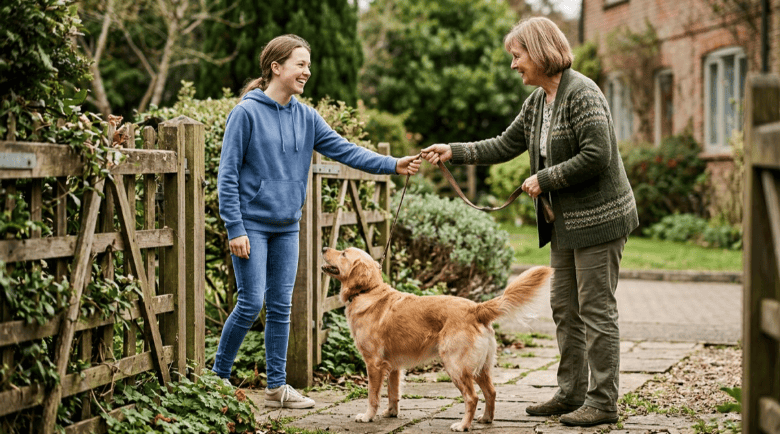 Teenage neighbor taking a golden retriever's leash from an older woman at her gate
Step 5 - Get Help With Dog Care
Asking for help keeps your dog active on the days you can't manage a full walk. It's a practical choice, and it protects both your health and your dog's routine.
Think about who could share the load:
• A neighbor who walks their own dog
• A grandchild or teenager looking for pocket money
• A local dog walker for regular weekday walks
• A doggy daycare for high-energy days
Line up a backup walker before you need one. If you have a flare-up or a bad weather week, you'll already know who to call. Many people find a set schedule, such as a walker on Tuesdays and Thursdays, is easier to keep than asking for help each time.
Step 6 - Plan for Veterinary Costs
As your routine changes, it's a good time to plan for your dog's vet costs too. An unexpected injury or illness can be stressful at any time, and harder to manage when your own mobility is limited.
Start by checking what you'd pay for a typical emergency visit at your local clinic, then decide how you'd cover it. Some people set aside a monthly amount in a savings account, while others choose pet insurance. Plans such as insurance for pets from Spot Pet Insurance offer accident and illness coverage that can help with costs like emergency care and surgery. Compare deductibles, reimbursement rates, waiting periods and exclusions across any plans you consider, since they vary by plan.
Keep your vet's number and the nearest emergency clinic saved in your phone. If getting there is hard for you, ask whether your clinic offers house calls or knows of a pet transport service in your area.
Keep the Walk, Change the Plan
Your dog doesn't need the same long walk every day. They need time with you and a routine they can count on. Adjusting the route, the gear and the help you have can keep that going for years.
This week, write down what's changed in your walks and pick one adjustment to try first, whether it's a flatter route, a new leash or a neighbor's number.
Frequently Asked Questions
How can I walk my dog safely with limited mobility?
Choose smooth, level routes with places to rest, wear shoes with a secure fit and good grip, and never wrap the leash around your wrist. Walk a new route without your dog first to spot hazards.
What should I do when it's icy?
Ohio State University Extension advises avoiding surfaces that may be icy if you can, and slowing down and shortening your stride if you can't. On the worst days, play in a cleared yard or train indoors instead.
How can I cover my dog's vet costs?
Some people set aside a monthly amount in savings, while others choose pet insurance with accident and illness coverage. Compare deductibles, reimbursement rates, waiting periods and exclusions before you choose a plan.
| Tweet |
