



How to Organize a Community Powerlifting Meet
Wednesday Oct. 28th, 2026
How to Organize a Community Powerlifting Meet
A practical guide for Bozeman lifting clubs planning a local powerlifting meet, covering venue, rules, registration, volunteers and lifter kit.
 Friends and family cheering from folding chairs behind a loaded barbell at a community gym
How to Organize a Community Powerlifting Meet
Your club has a dozen lifters who've been training hard all year, and someone finally said it out loud: "We should run our own meet." Everyone nodded, and now you're the one holding the clipboard.
A community meet is one of the best things a lifting club can do. It gives newer lifters a low-pressure first competition and gives everyone a target to train for. It also brings friends and family into a sport most of them have only seen on a phone screen. It takes planning, but none of it is complicated if you take it one decision at a time.
Step 1 - Choose Your Rules and Format
The first decision is which rules your meet will follow, because almost everything else depends on it. A meet sanctioned by a powerlifting federation follows that federation's rulebook for equipment, judging and records, and usually requires its referees and memberships. An unsanctioned club meet gives you more freedom but no official records.
Choose your rule set first, then write down the format decisions it leaves open:
• Full power or bench-only
• Raw only or equipped divisions too
• Weight classes and age divisions
• Maximum number of lifters
• Whether to give awards by class or by formula
For a first meet, simpler is better. A raw, full-power meet with a cap of around 30 to 40 lifters keeps the day to a manageable length. You can add divisions once you've run one smoothly.
Step 2 - Find a Venue That Can Handle the Weight
A powerlifting venue needs strong floors, enough space for a platform and warm-up area, and room for the people who come to cheer. Gyms and community centers around Bozeman can both work, but each needs a careful look before you commit.
The Competition Platform
The platform is where every lift happens, so it needs a solid, level floor and clear space around it for loaders and referees. Check the floor before you sign anything. Ask the venue whether loaded barbells can be dropped or set down there, and whether you need to bring extra flooring or mats.
The Warm-Up Area
Lifters need somewhere to warm up close to the platform, with racks and enough bars and plates. If the venue's own gym is next door, ask whether you can use it. Otherwise, plan to borrow equipment from your club.
Space for Spectators
Families and friends make the atmosphere. Check seating and parking, and whether there's a place to set up a scoring screen people can see.
Top Tip: Visit the venue at the same time of day your meet will run. You'll see how busy the parking lot gets and whether other events share the building. A twenty-minute visit can save you from discovering a basketball tournament next door on meet day.
Step 3 - Set Up Registration Early
Clear registration lets you plan the day around real numbers instead of guesses. Open it at least eight to ten weeks before the meet, and set a firm deadline a couple of weeks out so you've got time to build flights and order kit.
Collect everything you'll need in one form, such as:
• Name, age and contact details
• Weight class and division
• Estimated opening attempts
• Federation membership number, if sanctioned
• Kit sizes, if you're providing any
Ask lifters to sign a participation waiver as part of registration. Your venue or club insurer can usually tell you what wording they need. Send a confirmation email that repeats the date, weigh-in times and kit rules, so nobody shows up unprepared.
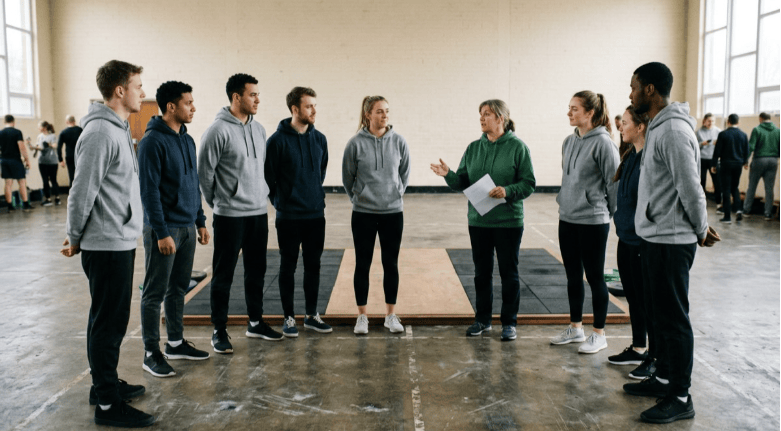 Volunteers in hoodies listening to an organizer's briefing beside a lifting platform
Step 4 - Recruit and Brief Your Volunteers
Volunteers keep a meet running on time, and you'll need more of them than you expect. A small meet still needs people in several roles at once, and most will be on their feet for the whole day.
Plan for these roles at a minimum:
• Three referees for each lift
• Loaders and spotters on the platform
• A scorekeeper and a table announcer
• A weigh-in teamSomeone trained in first aid
Safety deserves its own plan. Ask the venue whether it has an automated external defibrillator (AED), where it's kept and who knows how to use it. The National Heart, Lung, and Blood Institute notes that a sudden cardiac arrest is fatal unless treated right away with CPR and a defibrillator. Put the AED location in your volunteer briefing.
Hold a walkthrough the night before or the morning of the meet. Have loaders practice changing plates, and run one mock attempt start to finish. Ten minutes of practice makes the first flight far smoother.
Step 5 - Plan the Participant Kit
Kit rules depend on your chosen rule set, so tell lifters exactly what's required and what's allowed well before meet day. Many federations require a singlet for competition, along with rules on belts, wraps, sleeves and footwear.
A matching club singlet also makes a first meet feel official. If your club wants one for every lifter, a powerlifting singlet from Sports Gear Swag can be designed online, and there's no minimum order quantity, which suits a small club ordering for a handful of lifters. Check your rule set's requirements on cut and logos before you finalize the design, and collect sizes during registration.
Remind lifters about the smaller items too: long socks for deadlifts, chalk and enough food and water for a long day. A short kit checklist in the confirmation email answers most questions before they're asked.
Step 6 - Run Meet Day on a Clear Schedule
A clear schedule keeps lifters calm and spectators engaged. Most community meets follow the same basic order: weigh-ins, a rules briefing, then squat, bench press and deadlift in flights, with awards at the end.
Start weigh-ins early enough that lifters can eat and warm up afterward. Run a short rules briefing so newer lifters know the referee commands and how attempts are called. Post the flight order early, both on a wall and online, so lifters can plan their warm-ups.
Keep the energy up between flights with an announcer who knows the lifters' names. After awards, thank your volunteers by name. They're the people you'll need again next year.
Pick a Date and Book the Room
Running a community powerlifting meet comes down to a few decisions made in the right order: rules, venue, registration, volunteers, kit and schedule. Each one is manageable on its own, and your club already has most of the know-how.
This week, choose a rule set and call two possible venues to ask about dates and floors. Once you have a room booked, the rest of the plan has something solid to build on.
Frequently Asked Questions
How many volunteers do I need for a powerlifting meet?
Even a small meet needs three referees for each lift, plus loaders, spotters, a scorekeeper, a weigh-in team and someone trained in first aid. Hold a walkthrough before the first flight so everyone knows their role.
What should lifters wear to a powerlifting meet?
Kit rules depend on the meet's rule set, and many federations require a singlet for competition. Lifters should also bring long socks for deadlifts, chalk, water and food.
How far ahead should registration open?
Open registration at least eight to ten weeks before the meet. Set a deadline a couple of weeks out so you've got time to build flights and order kit.
| Tweet |
