



The Masonic Movement in Montana
Pat Hill | Sunday Nov. 1st, 2026
When white men moved into Montana in the early 1860s in pursuit of gold and new opportunities, Freemasons were among their ranks and would leave their mark on the history of the Treasure State.
Freemasons are members of one of the world’s oldest known fraternal organizations, with obscure origins as a secret society, said to range from the time of the building of King Solomon’s temple to the 17th century. Freemasonry takes various shapes across the globe, but all the fraternities share a belief in “a system of morality veiled in allegory and illustrated by symbols.”Masonic ritual uses the architectural symbolism of the tools of the medieval stonemason to teach moral and ethical lessons of the principles of “Brotherly Love, Relief, and Truth.”
Two of the principal symbols always found in a Masonic Lodge are the square and the compass.
The first Masonic Lodge in Montana was formed in 1862. Nathaniel P. Langford, who eight years later took part in the U.S. government’s first official expedition to what would become Yellowstone Park, was there.
“It was a clear September twilight [in 1862] when we camped on the western side of the range of the Rocky Mountains where they are crossed by the Mullan Road…” Langford wrote. “…Impressed with the grandeur of the mountain scenery and the mild beauty of the evening… we ascended the mountain to its summit, and there, in imitation of our ancient brethren, opened and closed an informal Lodge of Master Masons. I had listened to this solemn ritual of Masonry a hundred times, but never when it impressed me so seriously as upon this occasion; such also was the experience of my companions. Never was the fraternal clasp more cordial than when, in the glory of that beautiful autumnal evening, we opened and closed the first lodge ever assembled in Montana.”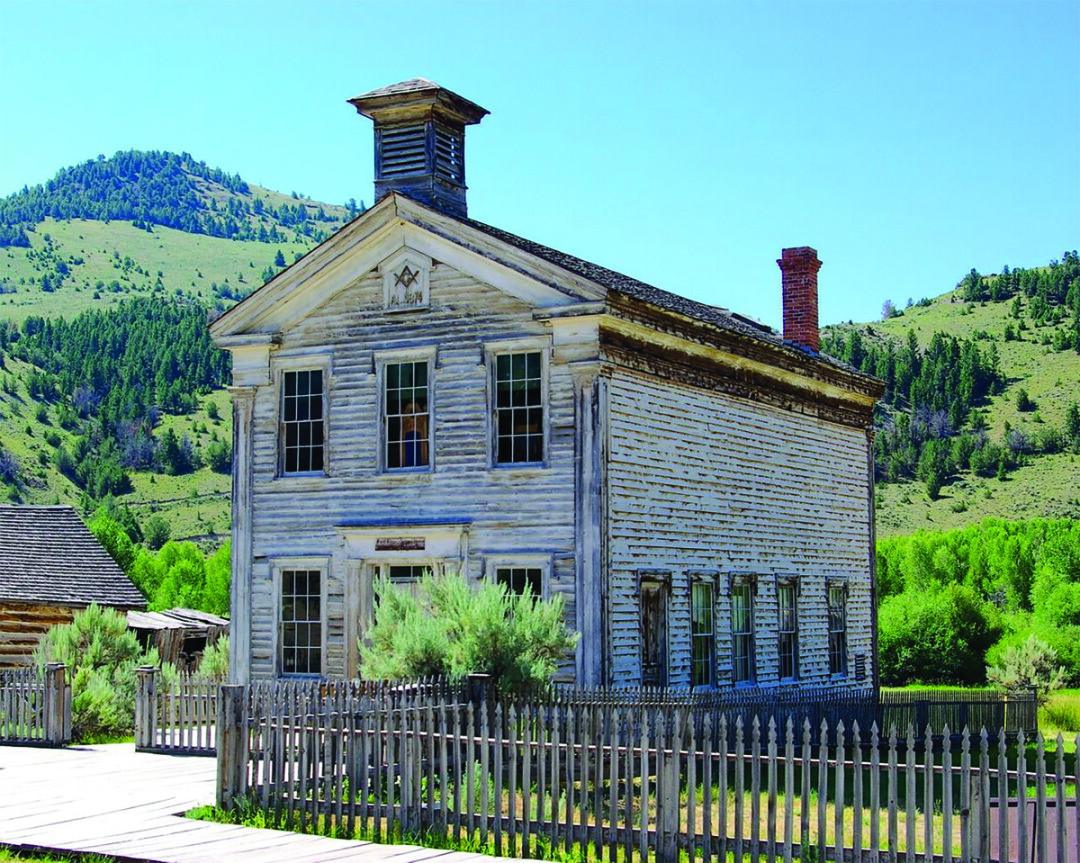
In the winter of 1863, Montana’s Masons came together to fight crime. Miners and merchants had grown tired of the robbery and murder spree being conducted by Bannack Sheriff Henry Plummer’s “road agent” gang. Many of the Masons who helped form the Vigilantes, an informal group designed to enforce “Western Justice” in the gold fields of southwest Montana, had met at the funeral of a fellow Mason, William H. Bell, at Bannack City. The Vigilantes made quick work of the road agents, hanging 21 of them within a month; the last road agent was hung from a large cottonwood tree by Camp Creek in the Gallatin Valley on February 3, 1864. One notable Montana Mason, former Grand Master Cornelius Hedges, later observed that “While it was by no means true that every Vigilante was a Mason, it might be said without serious deviation from the exact fact that every Mason in those days was a Vigilante.” Many of those Vigilantes were Bozeman Masons, including Nelson Story, Samuel Hauser, and Tom Cover; John Bozeman reportedly also attended meetings of the Committee of Vigilance.
Bozeman’s first Masonic Lodge, Gallatin Lodge No. 6, was formed on October 4, 1866. Members met on the upper floor of Bozeman’s first hotel, a small one-and-a-half story building built in the fall of 1864 on the northwest corner of Main Street and Bozeman Avenue, which the Masons purchased for $500 in 1866; they rented the first floor to the Empire Corral and later to Osborn’s Drug Store. The trouble with Lodge No. 6 was that it restricted membership to men or their sons with Confederate ties. In the wake of the Civil War between the States, trust was still hard to come by between Unionists and Southerners.
Nathaniel P. Langford, who wrote about that first Montana meeting of Masons in 1862, had become Grand Master of the Grand Lodge of Montana Masons. In 1870, Langford was in Bozeman about to depart on the government’s Expedition to the Upper Yellowstone country when he learned of the restricted membership practice at Lodge No. 6. Langford arrested the Lodge’s charter, basically suspending the existence of the Lodge. The Grand Master wrote in his Expedition diary that it was “the only means of bringing to a close a grievous state of dissension. In justice to my own convictions of duty, I could not have adopted any milder remedy than the one I applied.”
At the next meeting of the Montana Grand Lodge, a committee was formed to investigate what Langford termed “the gravest question yet presented to the Grand Lodge.” The committee, finding that about six men were responsible for the rift between the Masons in Bozeman, approved the action that Langford had taken, but also recommended restoration of the Lodge’s charter.
There were Masons in Bozeman who, while relieved that a Lodge still existed in town, desired that a second Lodge be formed, if for no other reason than to restore the harmony among men that Masonry advocates.
“Bozeman is not a populous city, and if the Fraternity of Gallatin Co. needs another Lodge, justice and prudence would urge its location at some other point,” Cornelius Hedges, then serving as Grand Master, said on October 3, 1871. “I doubt if a parallel instance could be produced in all the jurisdictions of the United States whereby two regular Masonic Lodges exist in a place the size of Bozeman.” Still, another charter was granted to the Unionist-leaning Masons of the Gallatin Valley, and on October 8, 1872, the Grand Lodge unanimously agreed to the formation of Bozeman Lodge No. 18. The first official meeting of the newly-chartered Lodge took place on October 19. The Masonic movement is alive and well across the globe in the 21st century, and Masonic Lodges No. 6 and 18 are active in Bozeman to this day.
There is yet another interesting twist to the Masonic story in Montana involving John Bozeman and one of his suspected murderers, Tom Cover. Bozeman’s body was recovered at the mouth of Mission Creek (where it empties into the Yellowstone River east of Livingston) after Cover, wounded in the left shoulder, ran into some of Nelson Story’s cowhands as he was making his way back to Bozeman. Cover said that Indians had killed Bozeman, and that Bozeman had identified the Indians as Crow during the skirmish. Still, Cover was and remains one of the main suspects in Bozeman’s murder.
John Bozeman was seeking membership in Masonic Lodge No. 6 in the town that bears his name about that time, and Cover was a member. In the spring of 1869, Cover left Bozeman and moved to Riverside, California. Reportedly, Cover died under mysterious circumstances in 1884 while searching for the Peg Leg Mine near Borrego Springs; some reports say Cover was killed by the brother of Boone Helm, whom the Montana Vigilantes had hung in the 1860s. The sun-bleached bones of Cover were later recovered and reportedly identified by the Masonic ring on the bony remains of his right hand.
| Tweet |