



Thomas Edison in Bozeman, Montana
Rachel Phillips | Sunday Nov. 1st, 2026
At the Gallatin History Museum, one never knows exactly what to expect when opening a bag of donated items. The museum’s mission focuses geographically on Gallatin County and southwest Montana, but a random variety of objects from exotic places have their way of sneaking into the building. Recently, a museum volunteer investigated the contents of what was believed to be a small collection of WWI letters and documents. To everyone’s surprise, among the papers was an envelope with the following printed in the return address corner: “Laboratory of Thomas A. Edison, Orange,
N. J.”
Curiosity piqued, our museum volunteer opened the envelope to find five vintage photographic prints of Thomas Edison in his laboratory. One of the five photographs depicts Edison holding a cigar and sitting in a chair next to mysterious boxes and wires. Handwritten on the back of the photo are the words: “Flashlight photo of Thomas A. Edison taken at about midnight March 10-11, 1911, in the Laboratory at Orange, N.J.” The remaining four images of Edison are less formal. He is seen stretched out on a crowded wooden workbench, papers covering his head. The handwritten note on one of these prints reads: “Mr. Thomas A. Edison caught napping on a table in his Laboratory at Orange one morning early in March 1911.”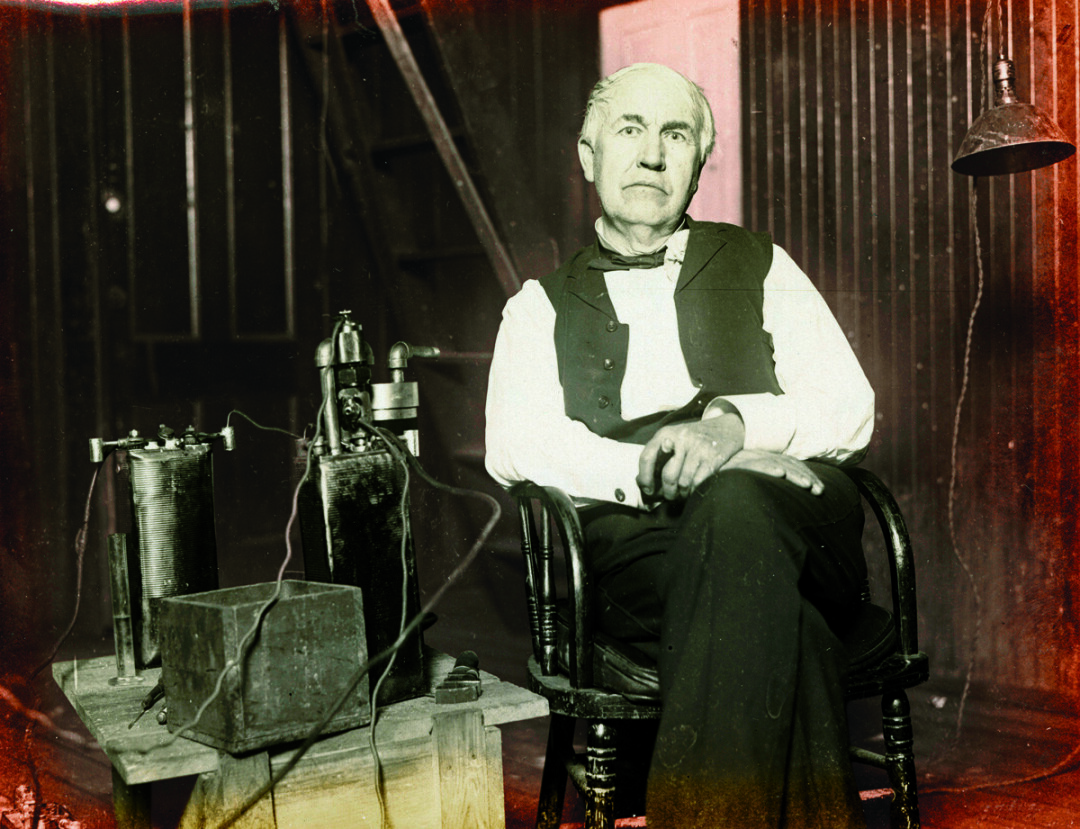
While entertaining and intriguing, the Edison envelope and photographs appear to have no obvious connection to Gallatin County or southwest Montana. The accompanying WWI papers belonged to a Pvt. Milward Crosby, who served with the 248th Aero Squadron. Further research has not yet yielded any connection between Mr. Crosby and Montana, but the Edison photos did get us thinking about the roundabout way Thomas Edison’s work affected Gallatin County.
Most people are familiar with inventors like Edison and Nikola Tesla, who pioneered work on lighting and electricity distribution in the late nineteenth and early twentieth centuries. Industry leaders quickly found that electric lights and their power delivery systems required significant amounts of copper—an excellent conductive material. The mines at Butte, Montana quickly became an essential cog in the wheel of electrical advancement. Nicknamed “The Richest Hill on Earth,” Butte produced over 22 billion pounds of copper between 1880 and 2000.
Not surprisingly, the lure of copper jumped the continental divide, and nineteenth century Bozeman businessmen looked for opportunities to mine the essential metal close to home. Copper, silver, and gold were found north of Three Forks as early as 1863, and in the 1880s and 1890s, Gallatin Valley businessmen filed gold, silver, and copper mining claims in the area. Many were located just north of the Missouri River headwaters in what is today Broadwater County. The region soon became known as Copper City.
One of the earliest and largest mines in Copper City was called the Green Eagle, and other mines were quickly established with creative names like Davenport, Stella, Electric, Antelope, The Silver Mine, and Crystal Canon. A diverse group of area businessmen dabbled in Copper City mining operations. Bozeman photographer James J. Bennett, Three Forks engineer George W. Thorne, and Gallatin Valley farmer Jacob O. Hopping were all active at Copper City. An 1883 Avant Courier article noted “the fortunate locators have an abiding faith in not only the increasing richness of ore bodies, but in their increase in size as depth is attained.” Despite ample enthusiasm, the mines at Copper City never blossomed. Finding investors with the capital to develop the mines proved difficult, deals fell through, and mines changed hands. Historian Lyle K. Williams described Copper City as “a perennial plant with its summer and then the winters when it lies dormant until a springtime of new investors starts it budding again.”
In addition to copper wires to conduct electricity, Edison’s inventions required power generation. In the mid-1880s, the dam at McAdow’s flour mill near what is today East Main Street moonlighted as the city’s first power plant. The Bozeman Electric Company, operated by George Wakefield, W.W. Livingstone, and T.K. Lysinger, contracted use of the water wheel at night when flour mill operations paused. Other early power plants east of Bozeman relied on water from Bozeman and Rocky Creeks to produce electricity for the first seven streetlights in town, which began illuminating in 1887.
The Gallatin Light, Power and Railway Company was established in 1892 and sold electricity to a growing number of homes and businesses as the century came to a close. The company also operated Bozeman’s new electric streetcar line which provided passenger transportation from Bozeman’s northeast side to the new Montana Agricultural College south of town. In 1906, the Madison River Power Company purchased Gallatin Light, Power and Railway and became Bozeman’s electricity provider for the next six years. Electrical power was generated at the Madison Power Station in Bear Trap Canyon north of Ennis Lake. This dam and power plant supplied electrical power to the growing Bozeman community until Madison River Power merged with other companies across the state to form the Montana Power Company in 1912.
An editorial printed in the December 19, 1905 issue of the Republican Courier highlighted Thomas Edison’s interest in the advancement of water power. “’The movement,’ he [Edison] says, ‘has already begun and is advancing rapidly.’” The editorial, titled “Electric Resources of Gallatin,” went on to highlight the abundance of Montana’s swift streams and its bright future in using its waterways to supply electrical power.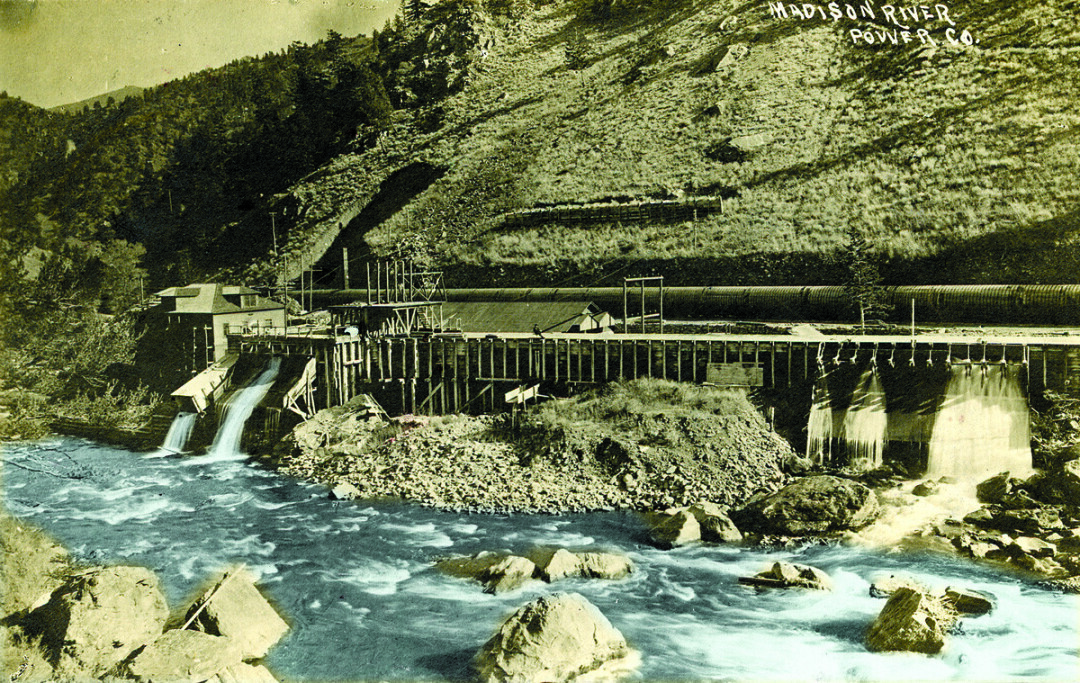
The editorial specifically mentioned the potential of the West Gallatin River in electricity production. “The possibilities of this splendid water power are almost beyond computation; and it is almost safe to say that, if its entire propelling power were made available, say from the mouth of Spanish creek to Taylor’s Fork, if it were properly harnessed to approved modern machinery, it would generate sufficient electricity to run all the mills and factories, besides furnishing light and heat, for a city of one hundred thousand inhabitants—and that without in the least interfering with either present or prospective diversion of water for irrigation purposes.” The article estimated the 34 miles of river between Spanish Creek and Taylor’s Fork would provide “41,400 horse-power.”
Though these big ideas to harness the power of the Gallatin River never came to pass, the increase in electricity demands in the early 1900s did lead to the introduction of a new industry in Bozeman. In 1906, William Spieth opened the first electrical shop in town and was arguably Bozeman’s first electrician. Spieth received his training on the job in the 1890s when he worked for the Gallatin Light, Power, and Railway Company maintaining lights in Bozeman’s businesses and on its streets.
In a 1940s newspaper article featuring Spieth’s reminiscence of his career, he recalled his typical daily schedule with Gallatin Light, Power, and Railway. After finishing his morning maintenance of carbon arc light fixtures around town, Spieth switched to “maintenance of the electric lines and electric street cars until evening. At dark he had to turn on the street lights and patrol the circuit to make sure all lights were burning. Those that were out had to be repaired if possible, or replaced. This work often lasted until 10 or 11 p.m. The rest of the day was his own. For this work he received $35.00 per month [the equivalent of about $1,300 dollars today].”
In Spieth’s newspaper reminiscence, he related that he and his brother decided to install one electric light in an upstairs room at the Spieth family home near the corner of Rouse Avenue and Babcock Street. Impressed with the result, their mother Barbara asked them to install another light in the kitchen. “In two weeks, she insisted that they wire the rest of the house. The rate was $2.50 per month for any number up to 5 outlets. Any number over 5 were 50 cents each per month.”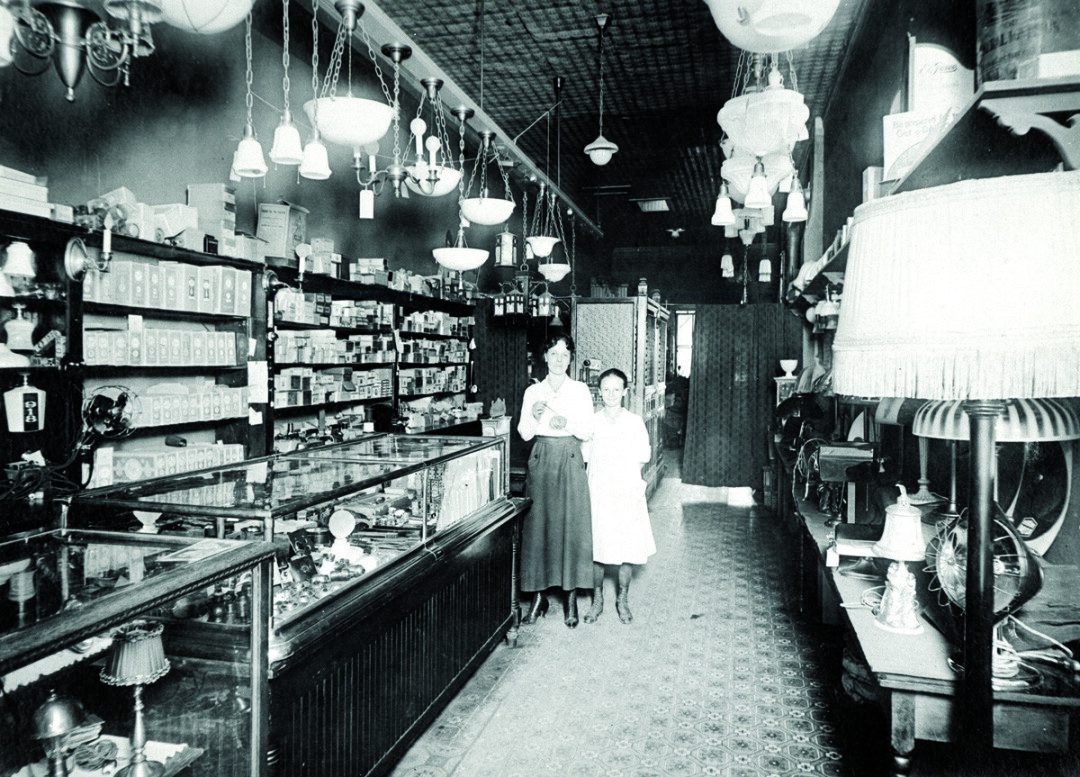
The Spieth family’s experience with electricity in the home was mirrored in many other Bozeman households, as the ease and convenience of electric lights won out over candles and gas lanterns. Bill Spieth’s business, called William Spieth Electric Wiring and Supplies, lasted for nearly forty years on Main Street. In addition to running his supply store, Spieth spent his career wiring and installing light fixtures in local homes and businesses, including the Golden Rule Building and the Bozeman Opera House.
Thomas Edison never made it to Bozeman in person, but his work certainly had an effect on local history. The candid snapshots of Edison napping at his New Jersey lab in 1911 may not immediately seem tied to southwest Montana, but they spark an interest in the exciting days of the birth of electricity in Bozeman. In a December 1905 editorial, Bozeman’s Republican Courier quoted Thomas Edison: “’We are groping on the verge of another great epoch in the world’s history,’ he said in an interview at his laboratory in West Orange, N.Y. the other day. ‘It would not surprise me any day to learn that someone... has seized upon electricity by the direct process, and begun another practical revolution in human affairs. It can be done. It will be done. I expect to see it before I die.’”
The author wishes to thank Cherryl Underhill and Ken Hamlin for their invaluable assistance with this article.
| Tweet |