



A Sure Cure For The Winter Blues
The Montana State College Ski Carnival
Rachel Phillips | Thursday Jan. 1st, 2026
In 1954, the Montana State College Ski Club introduced an event to celebrate the sport they loved, and to boost student morale. Held annually in January or February, the Ski Carnival was a welcome mid-season break for students. Activities and events ran the gamut from sport to sculpture.
Recreational and competitive skiing was huge at Montana State College in the mid-twentieth century. The sport boomed in popularity in the 1930s and 1940s, and several ski hills were developed in the Bozeman area that catered to families and college students. The first ski jumping competition in Gallatin County was held at Karst Ranch in Gallatin Canyon in 1937. The Bozeman Ski Club formed in the mid-1930s; club members hosted early ski jumping meets, and established ski hills near Bozeman at Pine Hill and in Bear Canyon.
Bear Canyon became the popular spot for winter recreation in the 1940s, and the newly formed Montana State College Ski Club spent every chance they could on the slopes, where they practiced technique and tried to avoid injury. A description of the Club in the 1947 Montanan annual creatively described the group. “Have you got a broken leg, neck or clavicle?... do you ache in embarrassing places?... do you jump with joy when a blizzard is forecast?... then you must be a member of the Ski Club... on the campus they are active in organizing ski meets and arranging various entertainments of interest to skiers.”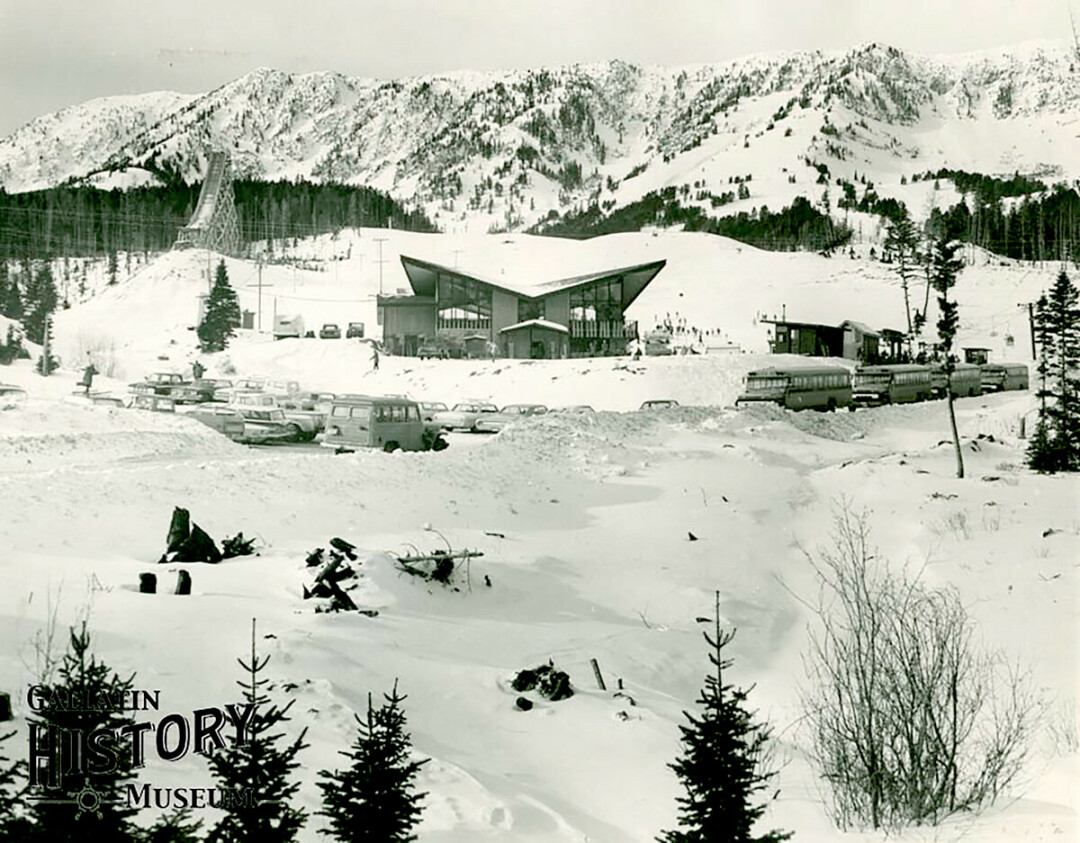
Bridger Bowl was born in 1954, and rope tows, lifts, and a ski jump were soon added. The Montana State College Ski Club and Ski Team continued to practice at Bear Canyon, but gradually Bridger Bowl became Bozeman’s skiing destination. Bear Canyon Ski Area was eventually acquired by Mount Ellis Academy, which operated the rope tow and chair lift. MSC students enjoyed Bear Canyon into the 1970s. A short article in the Montana State College school newspaper, the Exponent, on January 22, 1971, encouraged skiers to try night skiing there under the lights.
The signature event put on by MSC’s Ski Club was the Ski Carnival, which made its debut in February 1954. That year, carnival events were held in conjunction with a formal ski meet. Besides MSC, participating schools included Idaho State, University of Utah, Utah State Agriculture College, and the University of Montana (which at that time was known as Montana State University). Intramural and intercollegiate skiers competed in cross-country, giant slalom, and slalom races, as well as in the ever-popular ski jumping. On February 4, the Exponent noted that an in-state traveling trophy would be awarded to the winner of the team competition between Montana State College and MSU in Missoula.
The Carnival was a success that first year, and it was noted as a popular winter quarter activity in almost every Montanan yearbook from 1954 until 1971. In addition to serious ski races held at Bridger Bowl, many Carnival competitions included a variety of unique races that were no doubt hilarious for spectators. On February 1, 1957, the Exponent advertised the upcoming Ski Carnival’s “novelty races.” “Novelty races open to everyone will be held at the Bridger ski bowl. No skill is needed and awards in the form of buckles, belts, ski accessories, and pins will be given to the winners.” The novelty races featured some rather unusual and challenging competitions. “The program lists a rope race in which two skiers are tied together, a three-legged ski race, and a giant slalom for all those enrolled in beginning skiing.”
Night skiing events also added to the thrill of the Ski Carnival. The tradition of the “torchlight parade” provided opportunities for some interesting photography, as a multitude of skiers with flashlights and other sources of illumination made their way down the mountain at Bridger Bowl. On February 7, 1965, the Great Falls Tribune published a photo titled “Night Spectacle” by Steve Cox, captioned, “Skier’s leave patterns of light in the night as they weave down the slope at Bridger Bowl in the torchlight parade during the annual Winter Carnival... ”
Besides skiing, another integral piece of the Carnival in the 1950s and 1960s was the election of a “ski” or “snow” king and queen. Candidates were chosen from the Greek membership and voted on by the student body. Royalty were crowned during a ceremony at the Ski Carnival dance. Photos of the kings and queens were published in the Montanan yearbook alongside Homecoming royalty and other honorees. In 1957, Sue Keller of Pi Phi and Bob Bleakman of Sigma Alpha Epsilon won the crowns. Queen Sue Keller also took home first place in the novelty ski race.
Without a doubt, one of the most popular events associated with the Ski Club’s Carnival was the snow sculpture competition. This legendary battle was open to fraternities, sororities, and in some years, dormitories. Participating houses constructed magnificent snowy creations and scenes in their front yards. Judges examined the sculptures and awarded the winners. Each year’s snow sculptures surpassed the prior year’s creations in ingenuity and detail.
The snow sculpture competition was introduced with the first Ski Carnival in 1954, when an Exponent reporter compiled a short description of upcoming activities. “I’d like to put in a special plug for the snow sculptures. Prizes will be given for the sculpture which the committee feels is the most original and prettiest. Also the King and Queen event is of interest since this is something new on campus. The girls elect a king and the boys a queen. Go, go, go everybody. Do your bit to make this carnival a success—it’s bound to be fun.”
Top honors in the snow sculpture contest that first year went to Pi Kappa Alpha, a fraternity housed at 502 South Grand Avenue. A smiling figure sat in a life-sized, two-door convertible which featured detailed hubcaps and fenders and a rear-mounted spare tire. In 1957, Alpha Omicron Pi, a sorority located at South Fifth and West Garfield, won the competition with their presentation of a couple sitting in front of a wood stove. Sigma Nu, located on West College Street, won for the men that year, with a rearing horse pulling a sleigh carrying a Bobcat couple as passengers.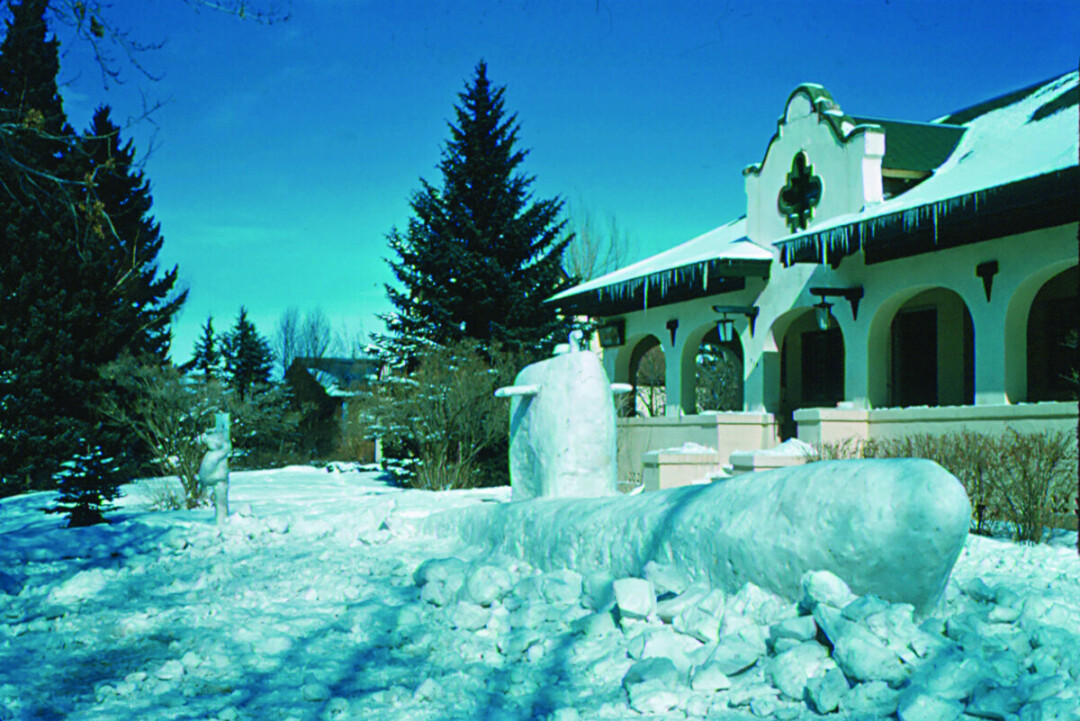
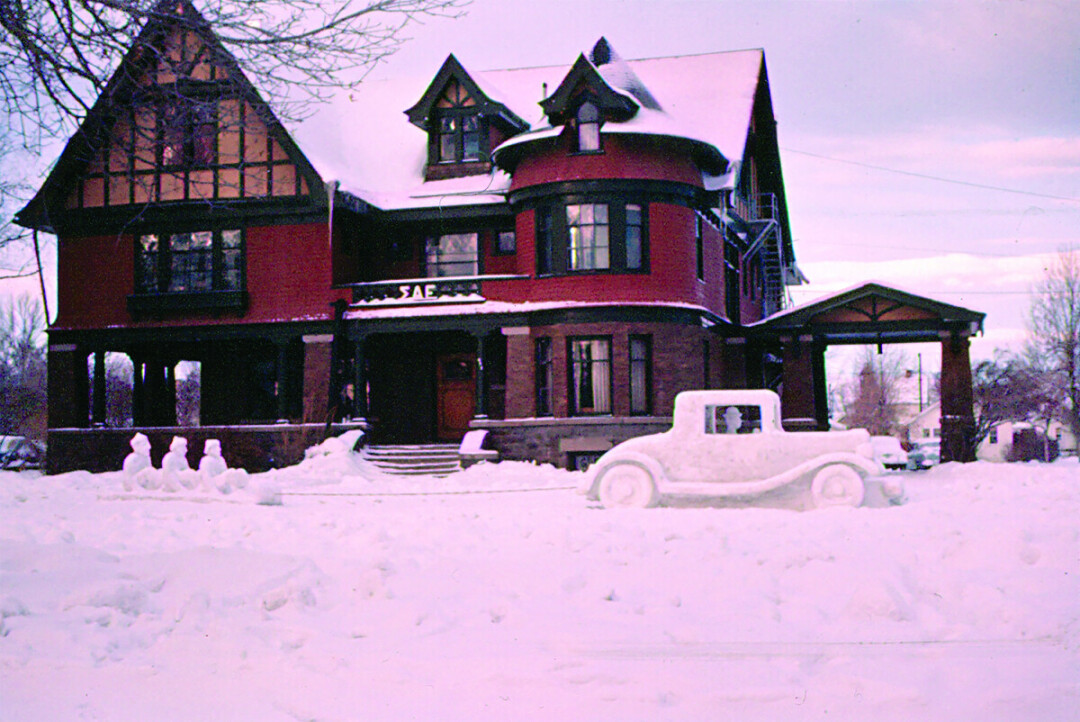
While many sculptures incorporated MSC’s bobcat mascot, some creations depicted famous characters and scenes. In 1959, first place was given to Sigma Alpha Epsilon for their recreation of Charles M. Russell’s famous painting “Waiting on a Chinook,” or “The Last of the Five Thousand,” in which a pack of wolves closes in on a starving cow during Montana’s infamous harsh winter of 1886-1887. Kappa Delta sorority won the women’s competition that year for their scene depicting a dapper gentleman offering his hand to a woman in a sleigh. In 1960, the bow of a massive submarine emerged through icy waters directly in front of the Men’s Co-op house at 712 South Willson Avenue. One year, a Ford Model A Coupe pulled a toboggan with three riders in front of the SAE house (now known as the Story Mansion) at 811 South Willson Avenue.
In the mid-1960s, MSC’s Ski Club began partnering with the Bozeman Chamber of Commerce to organize and promote the Ski Carnival, which continued through 1971. That last year, the Exponent advertised that the Carnival was planned for the end of January. A snow sculpture contest was again included in the list of events, but this time the icy works of art were constructed at sites in downtown Bozeman, not at Greek residences. The city provided “raw material” snow piles for use by competitors. Other events that year included a parade float building competition and the traditional torchlight parade.
This year, if winter drags on too long and cabin fever strikes, get inspired by MSC’s Ski Carnival. Night skiing or a three-legged ski race could be fun, but if safety is a concern, build a life-sized snow sculpture for your neighbors to enjoy.
| Tweet |